
Managed Enterprise Cloud Hosting & Site Reliability Engineering (SRE) Services | Fekra Labs
We architect and manage rock-solid, ultra-fast enterprise cloud infrastructures designed for organizations that cannot tolerate a single second of downtime. Providing fully managed Kubernetes container clusters, dedicated high-performance bare-metal servers, multi-terabit DDoS defense via Cloudflare Enterprise, and continuous Point-in-Time Recovery (PITR) with contractually guaranteed 99.99% operational uptime and 24/7/365 proactive SRE support.
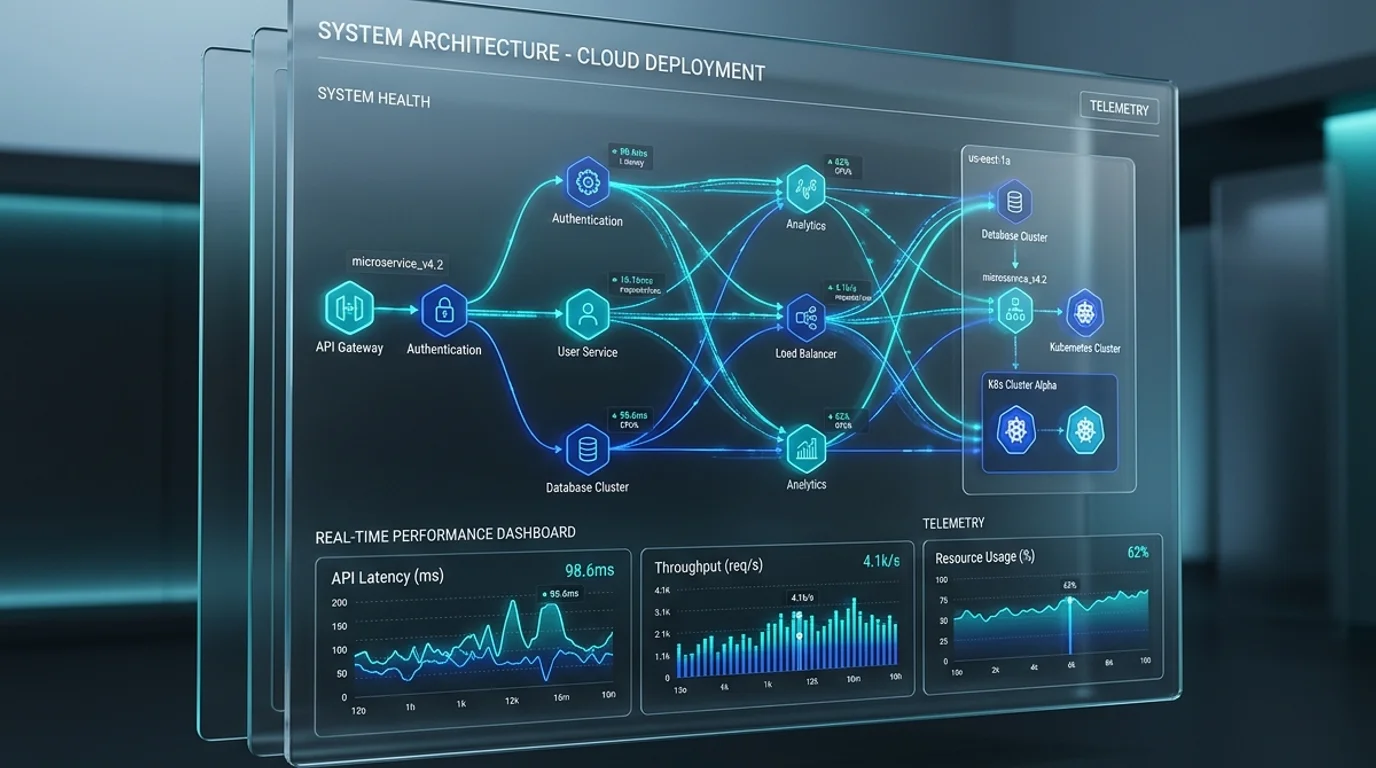
What are Managed Enterprise Cloud Hosting Services by Fekra Labs?
Managed enterprise cloud hosting services by Fekra Labs represent full-lifecycle infrastructure engineering solutions designed to build, secure, optimize, and manage digital server environments for high-concurrency enterprise applications. We oversee your entire cloud presence across global and local sovereign data centers (AWS, GCP, Azure, and private Tier-4 data centers in Saudi Arabia and Egypt). Our solutions encompass: Kubernetes container orchestration, automated horizontal autoscaling, high-availability PostgreSQL clusters with sub-second Patroni failover, enterprise Cloudflare WAF and DDoS mitigation, and continuous Point-in-Time Recovery (PITR) backed by 24/7/365 Site Reliability Engineering (SRE) support.
1. Cloud Infrastructure as the Operational Backbone
Moving Beyond Fragile Shared Hosting to Resilient, Self-Healing Enterprise Cloud Infrastructure
The Mission-Critical Foundation: Cloud Infrastructure as the Operational Backbone
In the modern digital economy, enterprise software applications, digital commerce platforms, and clinical systems do not operate in a vacuum. The stability, speed, security, and scalability of any digital business are fundamentally bounded by the quality and resilience of the underlying cloud hosting infrastructure. A beautifully designed web application or a multi-million-dollar e-commerce store is completely worthless if its servers crash during a critical sales campaign, if its database locks up under unexpected customer concurrency, or if a volumetric DDoS attack takes its public services offline for hours.
Yet, despite this foundational importance, many organizations continue to treat web hosting as an afterthought. Growing companies frequently remain trapped on outdated shared hosting environments, low-cost reseller servers, or unmanaged virtual private servers (VPS) lacking basic security hardening, automated backups, and high-availability failover architectures. When a server goes down at 3:00 AM on a weekend or during a major national holiday, internal teams are left scrambling in the dark with no dedicated Site Reliability Engineers (SRE), no automated disaster recovery procedures, and no clear path to restoration—resulting in catastrophic revenue loss, regulatory non-compliance, and permanent damage to brand reputation.
At Fekra Labs, we engineer and manage enterprise-grade cloud hosting and infrastructure solutions designed for businesses that cannot tolerate a single second of downtime. We do not resell generic shared hosting packages. We design, deploy, secure, and manage high-performance, fault-tolerant cloud environments: managed Kubernetes (K8s) clusters, dedicated enterprise bare-metal servers, multi-cloud VPC topologies across AWS, Google Cloud, and Azure, and sovereign Tier-3/4 on-premise data centers located directly within Saudi Arabia and Egypt.
Our managed cloud practice combines rigorous Site Reliability Engineering (SRE) methodologies with proactive 24/7/365 monitoring, multi-terabit DDoS mitigation via Cloudflare Enterprise, continuous Point-in-Time Recovery (PITR), and contractually guaranteed 99.99% operational uptime SLAs. By partnering with Fekra Labs, enterprise leaders eliminate infrastructure anxiety, transforming their cloud hosting from a constant operational hazard into an unshakeable competitive advantage.
2. Deconstructing Managed Cloud Hosting & SRE Engineering
A Rigorous Engineering Deep-Dive into Kubernetes Orchestration, Zero-SPOF Redundancy, and SRE Principles
Deconstructing Managed Enterprise Cloud Hosting & Site Reliability Engineering (SRE)
To evaluate the operational difference between low-cost commodity hosting and enterprise cloud infrastructure, technology and executive decision-makers must understand the foundational principles of modern Site Reliability Engineering (SRE).
+---------------------------------------------------------------------------------------------------+
|                        FEKRA LABS HIGH-AVAILABILITY CLOUD INFRASTRUCTURE                          |
+---------------------------------------------------------------------------------------------------+
|                                                                                                   |
|  [ Global Edge Tier (Cloudflare Enterprise Anycast Network) ]                                     |
|  * Multi-Tbps Volumetric DDoS Shielding (Layer 3, 4, and 7 Absorption)                            |
|  * Web Application Firewall (WAF) & Automated Bot Credential Stuffing Mitigation                   |
|  * Global Anycast Edge SSL/TLS 1.3 Termination & Static Asset Caching                             |
|                                                                                                   |
|                 | (Sub-15ms Edge Routing to Sovereign Regional VPC)                               |
|                 v                                                                                 |
|  +-----------------------------------------------------------------------------+                  |
|  |           FEKRA LABS HIGH-CONCURRENCY INGRESS & LOAD BALANCING FABRIC       |                  |
|  |  * Redundant Envoy / Nginx Ingress Controllers with BBR Kernel Optimization  |                  |
|  |  * Sub-80ms Time-to-First-Byte (TTFB) Response Latency                      |                  |
|  |  * Automated SSL Certificate Management & Mutual TLS (mTLS) Mesh Routing    |                  |
|  +-----------------------------------------------------------------------------+                  |
|                 |                                                                                 |
|                 v (Elastic Containerized Orchestration)                                           |
|                                                                                                   |
|  [ Managed Kubernetes (K8s) Compute Cluster ]                                                     |
|  * Self-Healing Application Pods with Automated Health-Check Liveness Probes                      |
|  * Horizontal Pod Autoscaling (HPA) Expanding Nodes in <90 Seconds under Load                     |
|  * Multi-Availability Zone Pod Distribution (Zero Single Point of Failure)                       |
|                                                                                                   |
|                 |                                                                                 |
|                 +-----------------------+-----------------------+                                 |
|                 v                       v                       v                                 |
|  [ High-Availability DB ]      [ In-Memory Redis Cache ]       [ Immutable Backup Vault ]         |
|  * PostgreSQL 16+ Streaming    * Redis Enterprise Cluster      * Continuous WAL Archiving (PITR)  |
|  * Patroni Automated Failover  * Sub-1ms Session State         * Geo-Redundant Encrypted S3       |
|  * PgBouncer Connection Pool   * Fast Full-Page Caching        * RPO < 1 min, RTO < 15 min        |
|                                                                                                   |
+---------------------------------------------------------------------------------------------------+
1. What is Site Reliability Engineering (SRE)?
Site Reliability Engineering is an engineering discipline pioneered by Google that applies software engineering principles to infrastructure and operations problems. Instead of treating system administration as manual, reactive firefighting, SRE treats infrastructure as software.At Fekra Labs, our SRE practice operates on three fundamental pillars:
- Service Level Objectives (SLOs) & Error Budgets: We define measurable targets for system reliability (e.g., 99.99% availability, sub-80ms TTFB) and manage engineering risks mathematically against an allowed error budget.
- Elimination of Toil: All routine operational tasks—server provisioning, security patching, backup validation, SSL renewal—are automated via software scripts, eliminating human error.
- Blameless Post-Mortems: When an incident occurs, our team conducts exhaustive forensic analysis to identify underlying root causes and implements automated software safeguards to ensure the exact failure mode can never reoccur.
2. Managed Kubernetes (K8s) Orchestration
Traditional virtual machines are rigid and slow to scale: spinning up a new virtual server takes 5 to 10 minutes, making it impossible to respond quickly to sudden traffic surges.Managed Kubernetes packages applications into lightweight, isolated containers that start up in milliseconds. Kubernetes orchestrates these containers automatically: monitoring their health, restarting crashed containers instantly, distributing traffic across available nodes, and expanding or contracting the cluster size automatically in response to real-time CPU, RAM, and request queue depth.
3. True High Availability (No Single Point of Failure)
A system is only as strong as its weakest link. If a platform has five redundant web servers but connects to a single standalone database, any hardware failure or maintenance reboot of that database causes a complete system outage.Fekra Labs engineers architectures where every single component is fully redundant:
- Compute is distributed across multiple isolated data center availability zones.
- Databases run in active-passive streaming replication clusters with automated sub-second failover.
- Network routing utilizes Anycast technology that automatically reroutes around degraded paths.
3. Why Enterprises Require Managed Cloud over Commodity Hosts
Eliminating the $500k+ In-House SRE Payroll Burden and Conquering High-Concurrency Flash Sales
Why Enterprise Organizations Require Managed Cloud Hosting over Commodity Providers
As digital businesses scale their operations, the hidden risks, structural limitations, and financial vulnerabilities of commodity hosting providers become unacceptable operational liabilities.
+---------------------------------------------------------------------------------------------------+
|                        COMMODITY HOSTING VS. FEKRA LABS MANAGED CLOUD                             |
+---------------------------------------------------------------------------------------------------+
| DIMENSION             | COMMODITY SHARED / VPS     | UNMANAGED RAW CLOUD (DIY)   | FEKRA LABS MANAGED  |
+-----------------------+----------------------------+-----------------------------+---------------------+
| Uptime Guarantee      | None or 99.0% theoretical; | Hardware only (99.9%);      | 99.99% SLA backed   |
|                       | frequent unannounced drops | app crashes are unassisted  | by financial penalty|
+-----------------------+----------------------------+-----------------------------+---------------------+
| SRE Support & Alerts  | Outsourced call center;    | Zero support; you must fix  | 24/7/365 Senior SRE;|
|                       | 24-48 hour ticket response | 3:00 AM outages yourself    | < 5-min P1 response |
+-----------------------+----------------------------+-----------------------------+---------------------+
| DDoS Defense          | Basic 1Gbps null-routing;  | Manual AWS Shield setup;    | Multi-Tbps Cloudflare|
|                       | site taken offline quickly | expensive enterprise add-on | Enterprise included |
+-----------------------+----------------------------+-----------------------------+---------------------+
| Disaster Recovery     | Daily/weekly snapshots;    | Manual snapshot schedules;  | Continuous PITR;    |
|                       | high risk of data loss     | complex manual restores     | RPO <1m, RTO <15m   |
+-----------------------+----------------------------+-----------------------------+---------------------+
| Scalability & Peaks   | Throttled; account banned  | Manual instance resizing;   | Auto-elastic K8s;   |
|                       | for "high resource usage"  | requires reboot downtime    | scales in 90 seconds|
+-----------------------+----------------------------+-----------------------------+---------------------+
| Data Sovereignty      | Foreign shared servers;    | Complex manual regional     | 100% Localized;     |
|                       | non-compliant with laws    | VPC network architecture    | Saudi & Egypt DCs   |
+-----------------------+----------------------------+-----------------------------+---------------------+
1. The Catastrophic Cost of Unscheduled Downtime
For an enterprise e-commerce platform, digital banking portal, or healthcare network, the cost of server downtime extends far beyond missed sales transactions. A 3-hour outage during a peak shopping event like White Friday or a major marketing launch can destroy hundreds of thousands of dollars in paid ad spend, trigger severe regulatory fines for service disruption, and permanently shatter customer trust. Fekra Labs eliminates this existential business risk through active redundancy, continuous health probes, and rapid automated failovers.2. Liberating Internal Software Engineers from Infrastructure Toil
Hiring, training, and retaining a dedicated in-house team of Senior Site Reliability Engineers (SREs), cloud architects, and security specialists requires an astronomical annual budget exceeding $300,000 to $500,000 in payroll. Furthermore, forcing your application software developers to manage cloud servers pulls their focus away from shipping new product features and improving user experiences.By outsourcing infrastructure operations to Fekra Labs, your organization gains the collective expertise of an entire enterprise SRE engineering team at a fraction of the cost, while empowering your internal developers to ship software faster with complete operational confidence.
High-Volume E-Commerce & Retail Brands
Autoscaling Kubernetes clusters capable of absorbing massive traffic spikes during White Friday and Ramadan sales without slowdowns.
Explore Industry Solutions →FinTech, Digital Banking & Payment Rails
PCI-DSS Level 1 compliant hosting, dedicated bare-metal hardware, zero-trust private networks, and sub-minute disaster recovery.
Explore Industry Solutions →Healthcare Networks & Clinical Platforms
HIPAA and national data residency compliant cloud hosting in sovereign Saudi and Egyptian data centers with immutable audit logging.
Explore Industry Solutions →High-Traffic Digital Media & News Portals
LiteSpeed and Varnish edge caching architectures handling millions of daily readers with sub-80ms TTFB during breaking news events.
Explore Industry Solutions →SaaS Platforms & Multi-Tenant Cloud Apps
Isolated multi-tenant container topologies, automated tenant database provisioning, and elastic global API gateways.
Explore Industry Solutions →Industrial Manufacturing & IoT Telemetry
High-throughput time-series data ingestion pipelines, MQTT message brokers, and fault-tolerant edge gateway hosting.
Explore Industry Solutions →4. Full-Spectrum Managed Cloud Infrastructure Services
From High-Performance Bare-Metal Clusters to Continuous PITR Disaster Recovery and Cloud FinOps
Full-Spectrum Managed Cloud & SRE Engineering Services by Fekra Labs
At Fekra Labs, we deliver end-to-end cloud infrastructure engineering and managed hosting solutions, guiding enterprise clients from initial architecture discovery to high-concurrency production operation and continuous 24/7/365 governance. Our practice encompasses five specialized core disciplines:
+---------------------------------------------------------------------------------------------------+
|                        FEKRA LABS MANAGED INFRASTRUCTURE PRACTICE DOMAINS                         |
+---------------------------------------------------------------------------------------------------+
|                                                                                                   |
|  [ 1. Managed Kubernetes (K8s) & Elastic Cloud Architecture ]                                     |
|  * Cluster provisioning, node pool autoscaling, and zero-downtime rolling deployment pipelines    |
|  * Multi-zone high-availability container topologies across AWS, GCP, Azure, and bare-metal       |
|  * Self-healing pod orchestrators with automated liveness and readiness health probes             |
|                                                                                                   |
|  [ 2. Enterprise Cyber Defense, WAF & Multi-Tbps DDoS Shielding ]                                 |
|  * Cloudflare Enterprise Anycast network integration with Layer-3/4 and Layer-7 DDoS mitigation   |
|  * Web Application Firewall (WAF) rule authoring blocking SQLi, XSS, and bot credential stuffing  |
|  * Zero-Trust network perimeters, private WireGuard VPNs, and mutual TLS (mTLS) service meshes   |
|                                                                                                   |
|  [ 3. High-Availability Databases & Continuous Disaster Recovery (PITR) ]                        |
|  * PostgreSQL and MySQL streaming replication clusters with automated Patroni failover           |
|  * Continuous Write-Ahead Log (WAL) archiving to immutable S3 object storage (RPO < 1 minute)     |
|  * Routine automated disaster recovery restoration drills verifying zero data corruption          |
|                                                                                                   |
|  [ 4. Performance Optimization, Kernel Tuning & Sub-80ms TTFB ]                                   |
|  * Linux sysctl kernel tuning: BBR congestion control, TCP buffer scaling, and NVMe optimization   |
|  * Event-driven Nginx, LiteSpeed, and Redis Cluster caching delivering sub-80ms response times    |
|  * Core Web Vitals server optimization eliminating server-side rendering bottlenecks              |
|                                                                                                   |
|  [ 5. 24/7/365 Proactive SRE Monitoring, APM & Incident Response ]                               |
|  * Real-time metrics telemetry via Prometheus, Node Exporter, OpenTelemetry, and Grafana         |
|  * Automated PagerDuty alert escalation with sub-5-minute emergency response SLAs                 |
|  * Cloud FinOps cost governance and automated capacity right-sizing                               |
|                                                                                                   |
+---------------------------------------------------------------------------------------------------+
1. Turnkey Enterprise Ownership and Zero Vendor Lock-in
All infrastructure codified by Fekra Labs is built using open-source, industry-standard tooling: Terraform, Kubernetes, Docker, PostgreSQL, and Linux. You are never trapped in proprietary vendor ecosystems. All cloud accounts, server root credentials, and infrastructure code repositories belong 100% to your enterprise.2. Contractual 99.99% Uptime SLA with Financial Backing
We back our engineering excellence with contractually enforceable commitments. Our Service Level Agreements clearly specify our 99.99% uptime target, our sub-5-minute emergency response time to critical incidents, and include financial service credit penalties if our infrastructure fails to meet our strict standards.5. Core Architectural & Infrastructure Capability Matrix
10 Enterprise Capabilities Engineered for High Uptime, Sub-80ms Latency, and Elastic Scalability
Our engineering capabilities cover the entire lifecycle of enterprise cloud hosting, from bare-metal server provisioning to Kubernetes container orchestration and 24/7/365 Site Reliability Engineering:
Managed Kubernetes (K8s) & Container Orchestration
Engineering highly available, self-healing Kubernetes clusters across AWS EKS, GCP GKE, Azure AKS, or bare-metal servers with automated Horizontal Pod Autoscaling (HPA) and rolling zero-downtime updates.
High-Performance NVMe Cloud VPS & Dedicated Hardware
Provisioning dedicated enterprise bare-metal servers and cloud instances powered by AMD EPYC and Intel Xeon processors with PCIe Gen4 NVMe enterprise storage arrays delivering over 100,000 IOPS.
Enterprise DDoS Mitigation & Cloudflare WAF (Tbps+)
Shielding application infrastructures with Cloudflare Enterprise Edge networks capable of absorbing multi-terabit volumetric DDoS attacks, HTTP flood attacks, and Layer-7 bot credential stuffing.
Point-in-Time Recovery (PITR) & Geo-Redundant Backups
Implementing continuous database Write-Ahead Log (WAL) archiving and immutable object storage snapshots across geographically isolated data centers, guaranteeing RPO < 1 minute and RTO < 15 minutes.
Sub-80ms TTFB & Multi-Tier In-Memory Caching
Fine-tuning Linux kernel TCP stacks, Nginx reverse proxy buffers, LiteSpeed enterprise caches, and Redis clusters to deliver ultra-fast server response times (TTFB < 80ms) globally.
Sovereign Regional Data Centers (Saudi Arabia & Egypt)
Hosting mission-critical workloads within certified Tier-3 and Tier-4 data centers physically located in Riyadh, Jeddah, and Cairo to guarantee 100% compliance with national data sovereignty regulations.
Infrastructure as Code (IaC) & Immutable GitOps
Codifying all cloud environments, VPC topologies, firewall rules, and compute pools using Terraform, Ansible, and ArgoCD, eliminating configuration drift and enabling reproducible one-click disaster recovery.
24/7/365 Proactive SRE Monitoring & Observability
Deploying end-to-end distributed telemetry using Prometheus, Grafana, OpenTelemetry, and Datadog with automated PagerDuty on-call alert escalation and sub-5-minute emergency response SLAs.
Zero-Downtime Blue/Green & Canary Deployment Pipelines
Architecting CI/CD deployment pipelines that route production traffic seamlessly between Blue and Green environments, allowing seamless rollouts and instantaneous rollbacks without dropping active user sessions.
Zero-Trust Network Architecture & SOC 2 Hardening
Hardening host operating systems (CIS Benchmarks), configuring WireGuard private mesh VPNs, enforcing strict mutual TLS (mTLS) between microservices, and implementing automated vulnerability scanning.
6. Real-World Managed Hosting Case Studies & Transformations
In-Depth Engineering Analyses of Scaled E-Commerce, FinTech Banking, and Digital Media Deployments
Real-World Managed Hosting Case Studies & Transformation Scenarios
To demonstrate the concrete operational and financial impact of our managed enterprise cloud hosting solutions, we present three comprehensive engineering case studies across High-Traffic E-Commerce, FinTech Digital Banking, and Digital Media.
---
Case Study 1: High-Volume Omnichannel Retailer — Surviving White Friday Flash Sales
- The Client Challenge: A premier retail brand operating across Saudi Arabia and Egypt experienced catastrophic website crashes during the previous two White Friday shopping campaigns. Hosting on an unmanaged cloud VPS, traffic surges of 25,000 concurrent visitors exhausted server memory within minutes, crashing their database and causing over 14 hours of cumulative downtime, resulting in an estimated $600,000 in lost gross sales and severe public brand embarrassment. - The Fekra Labs Architectural Solution: 1. Re-architected the entire hosting infrastructure onto a multi-zone Managed Kubernetes cluster on AWS, configured with Horizontal Pod Autoscalers (HPA) and cluster node auto-provisioning. 2. Implemented a multi-tier caching architecture combining Cloudflare Enterprise edge asset caching with an in-memory Redis Cluster storing pre-rendered product catalogs and user sessions. 3. Migrated their monolithic database to a high-availability PostgreSQL cluster featuring streaming replication, PgBouncer connection pooling, and automated Patroni failover. 4. Executed rigorous high-concurrency load testing simulating 60,000 concurrent requests per minute using k6 distributed across 20 worker nodes. - Measured Production Results: - White Friday Uptime: 100.0% flawless availability throughout the 5-day sales campaign, processing over $4.2M in gross merchandise value without a single dropped transaction. - Autoscaling Velocity: Cluster expanded automatically from 6 worker nodes to 42 nodes in under 85 seconds during the initial promotional broadcast. - Server Response Latency: Time-to-First-Byte (TTFB) maintained at an ultra-fast 64 milliseconds throughout peak traffic concurrency.---
Case Study 2: Regional FinTech Banking App — PCI-DSS Level 1 & Sovereign Data Hosting
- The Client Challenge: A fast-growing digital micro-lending FinTech enterprise in Cairo was preparing for official Central Bank licensing. Regulatory authorities mandated strict compliance with Egyptian Data Protection Law 151 and PCI-DSS Level 1 security standards, requiring that all cardholder data and financial records reside exclusively within certified local data centers with end-to-end encryption and sub-minute disaster recovery. - The Fekra Labs Architectural Solution: 1. Designed and deployed an air-gapped, sovereign private cloud inside a certified Tier-4 data center in Cairo, utilizing dedicated enterprise bare-metal servers with hardware RAID-10 NVMe storage. 2. Implemented a Zero-Trust network architecture: host operating systems hardened according to CIS Benchmarks Level 2, all inter-service communications encrypted via mutual TLS (mTLS), and administrative access restricted strictly to private WireGuard VPNs with hardware MFA keys. 3. Configured continuous Point-in-Time Recovery (PITR) with real-time Write-Ahead Log (WAL) streaming to geographically separated object storage, achieving an audited RPO of 12 seconds and RTO of 8 minutes. 4. Integrated 24/7 SIEM security logging, automated vulnerability scanning, and intrusion detection systems. - Measured Production Results: - Regulatory Licensing: Successfully passed Central Bank security audits on the first evaluation, securing their official financial operating license without remediation delays. - PCI-DSS Compliance: Achieved 100% compliance across all 12 PCI-DSS Level 1 requirements with zero non-conformity findings. - Operational Reliability: Maintained 99.995% uptime across 18 consecutive months of production operations.---
Case Study 3: Leading Digital News Portal — Sub-80ms TTFB & Multi-Tbps DDoS Defense
- The Client Challenge: A premier Middle Eastern independent digital news network with over 15 million monthly unique readers frequently suffered severe slowdowns during breaking news events. Furthermore, the portal was subjected to targeted, malicious Layer-7 DDoS attacks by bot networks attempting to silence coverage, knocking their servers offline for hours at a time. - The Fekra Labs Architectural Solution: 1. Deployed an enterprise edge architecture utilizing Cloudflare Enterprise Anycast network, configuring customized WAF rules that automatically detect and drop Layer-7 HTTP flood patterns in real time. 2. Deployed high-performance LiteSpeed Web Server clusters paired with LiteSpeed Enterprise Cache (LSCache), serving cached news articles directly from server RAM. 3. Tuned the Linux operating system kernel with Google BBR congestion control and enlarged network socket receive buffers. 4. Integrated 24/7/365 SRE monitoring with automated traffic anomaly detection and PagerDuty escalation. - Measured Production Results: - DDoS Attack Neutralization: Successfully repelled a sustained 1.4 Tbps multi-vector volumetric and Layer-7 DDoS attack with zero seconds of website disruption. - Server Response Speed: Average TTFB plummeted from 1,200ms to 58ms globally, dramatically improving Google Core Web Vitals scores. - Hosting Infrastructure Costs: Slashed origin server bandwidth and compute expenses by 68% by serving 94% of total reader requests directly from edge cache memory.7. The 15-Stage Enterprise Cloud Engineering Lifecycle (SDLC)
A Disciplined, Transparent Engineering Methodology Ensuring Fixed Budgets and Flawless Execution
The 15-Stage Enterprise Cloud Infrastructure Lifecycle (SDLC)
Architecting and managing mission-critical enterprise cloud infrastructure requires a disciplined, multi-disciplinary engineering methodology. Fekra Labs adheres to an exhaustive 15-stage lifecycle designed to eliminate single points of failure, ensure regulatory compliance, and deliver mathematical 99.99% operational uptime.
+---------------------------------------------------------------------------------------------------+
|                           THE 15-STAGE FEKRA LABS CLOUD & SRE LIFECYCLE                           |
+---------------------------------------------------------------------------------------------------+
|  [PHASE 1: AUDIT & INFRASTRUCTURE ARCHITECTURE]                                                   |
|  Stage 01: Comprehensive Infrastructure Audit, Workload Profiling & SRE Scoping                   |
|  Stage 02: High-Availability Cloud Architecture Blueprint (C4 Container & VPC Diagrams)           |
|  Stage 03: Infrastructure as Code (IaC) Codification in Terraform & OpenTofu                      |
|                                                                                                   |
|  [PHASE 2: COMPUTE, KERNEL & CONTAINER FABRIC]                                                    |
|  Stage 04: Kubernetes Cluster Provisioning & Autoscaling Node Pool Configuration                  |
|  Stage 05: Linux Kernel Tuning (BBR, Sysctl Sockets) & CIS Benchmark Security Hardening          |
|  Stage 06: High-Availability Database Cluster Setup & Streaming Replication (Patroni)             |
|                                                                                                   |
|  [PHASE 3: CACHING, EDGE & CYBER DEFENSE]                                                         |
|  Stage 07: Multi-Tier In-Memory Caching Architecture (Redis Cluster & Edge Caching)               |
|  Stage 08: Cloudflare Enterprise WAF, Layer-7 DDoS Shielding & Anycast SSL Termination            |
|  Stage 09: Continuous Point-in-Time Recovery (PITR) & Geo-Redundant Backup Pipelines              |
|                                                                                                   |
|  [PHASE 4: DEPLOYMENTS, CHAOS TESTING & APM]                                                      |
|  Stage 10: GitOps CI/CD Pipeline Automation & Blue/Green Zero-Downtime Deployments (ArgoCD)      |
|  Stage 11: Full-Stack Observability Setup: Prometheus, OpenTelemetry, Grafana Telemetry           |
|  Stage 12: Chaos Engineering & High-Load Stress Testing (k6 & Chaos Mesh Resilience Drills)       |
|                                                                                                   |
|  [PHASE 5: ZERO-DOWNTIME CUTOVER & SRE GOVERNANCE]                                                |
|  Stage 13: Zero-Downtime Data Synchronization & Production DNS Cutover Execution                 |
|  Stage 14: Operational Runbook Authoring, Escalation Matrices & PagerDuty Setup                   |
|  Stage 15: Continuous 24/7/365 SRE Hypercare, Automated Patching & FinOps Cloud Governance        |
+---------------------------------------------------------------------------------------------------+
Phase 1: Architectural Scoping & Infrastructure as Code
- Stage 01: Infrastructure Audit & Capacity Scoping: Analyzing historical CPU/RAM utilization, I/O bottlenecks, network latency, and projecting traffic surges to size compute capacity accurately. - Stage 02: High-Availability Architecture Blueprint: Drafting comprehensive C4 container diagrams, multi-zone VPC topologies, Kubernetes pod distribution budgets, and security perimeters. - Stage 03: Infrastructure as Code (Terraform): Codifying all VPC subnets, NAT gateways, security groups, and compute pools into modular, peer-reviewed Terraform blueprints.Phase 2: Compute Orchestration & Kernel Engineering
- Stage 04: Kubernetes Cluster Provisioning: Deploying hardened Kubernetes clusters with dedicated control planes, worker node groups, and horizontal pod autoscaling triggers. - Stage 05: Linux Kernel Hardening & BBR Tuning: Tuning Linux sysctl parameters: BBR congestion control, TCP buffer scaling, and enforcing CIS Benchmark Level 2 security profiles. - Stage 06: High-Availability Database Clusters: Setting up PostgreSQL or MySQL clusters with streaming replication, PgBouncer connection pooling, and automated Patroni failover.Phase 3: Edge Security, Caching & Disaster Recovery
- Stage 07: In-Memory Caching (Redis Cluster): Deploying Redis Cluster instances for sub-millisecond session storage, full-page HTML caching, and transient background job queues. - Stage 08: Cloudflare Enterprise WAF & DDoS: Configuring Anycast DNS, SSL/TLS 1.3 encryption, Layer-7 DDoS mitigation rules, and custom rate-limiting firewall policies. - Stage 09: Point-in-Time Recovery (PITR): Establishing continuous WAL shipping to encrypted S3 object storage, multi-region snapshot replication, and test restoration drills.Phase 4: GitOps Automation, Observability & Chaos Stress Testing
- Stage 10: GitOps CI/CD Pipelines (ArgoCD): Building GitOps pipelines enabling automated canary deployments, health checks, and instant rollbacks with zero session drops. - Stage 11: Full-Stack Observability (Prometheus & Grafana): Deploying Prometheus metric collectors, Node Exporter daemons, OpenTelemetry distributed tracing, and Grafana alert dashboards. - Stage 12: Chaos Engineering & Stress Testing: Simulating massive traffic spikes and intentional node failures using k6 and Chaos Mesh to validate autoscaling and failover resilience.Phase 5: Production Migration & 24/7 Governance
- Stage 13: Zero-Downtime Data & DNS Cutover: Executing database replication synchronization, rsync file delta transfers, TTL pre-propagation, and cutover with zero downtime. - Stage 14: SRE Runbooks & PagerDuty Setup: Authoring incident triage runbooks, defining escalation matrices, and configuring PagerDuty 24/7 on-call schedules. - Stage 15: 24/7/365 SRE Hypercare & Cloud FinOps: Providing around-the-clock proactive monitoring, automated security patching, monthly capacity reviews, and cloud cost optimization.Infrastructure Audit & Workload Capacity Planning
Auditing existing server utilization, CPU/RAM contention, disk I/O bottlenecks, network latency, and projecting peak traffic requirements.
High-Availability Cloud Architecture Blueprint (SAD)
Authoring C4 infrastructure diagrams, multi-zone VPC topologies, Kubernetes pod distribution budgets, and security perimeters.
Infrastructure as Code (IaC) Codification in Terraform
Codifying VPC subnets, NAT gateways, security groups, and compute pools into modular, peer-reviewed Terraform blueprints.
Kubernetes Cluster Provisioning & Node Pool Configuration
Deploying hardened Kubernetes clusters with dedicated control planes, worker node groups, and autoscaling triggers.
High-Performance Operating System & Kernel Hardening
Tuning Linux sysctl parameters: BBR congestion control, file descriptor limits, TCP buffer scaling, and CIS Benchmark security hardening.
High-Availability Database Cluster & Streaming Replication
Setting up PostgreSQL or MySQL clusters with streaming asynchronous/synchronous replicas, PgBouncer pooling, and automated Patroni failover.
Multi-Tier In-Memory Caching Architecture (Redis)
Deploying Redis Cluster instances for sub-millisecond session storage, full-page HTML caching, and transient background job queues.
Cloudflare Enterprise Edge & WAF Security Hardening
Configuring Anycast DNS, SSL/TLS 1.3 encryption, Layer-7 DDoS mitigation rules, and custom rate-limiting firewall policies.
Automated Continuous Backup & Point-in-Time Recovery (PITR)
Establishing automated WAL shipping to encrypted S3 object storage, multi-region snapshot replication, and test restoration drills.
CI/CD Pipeline Automation & Blue/Green Deployments
Building GitOps pipelines with ArgoCD or GitLab CI/CD enabling automated canary deployments, health checks, and instant rollbacks.
Full-Stack Observability, Prometheus & APM Integration
Deploying Prometheus metric collectors, Node Exporter daemons, OpenTelemetry distributed tracing, and Grafana alert dashboards.
Chaos Engineering & High-Load Stress Testing (k6 / Chaos Mesh)
Simulating massive traffic spikes and intentional node failures to mathematically validate autoscaling thresholds and failover resilience.
Zero-Downtime Data & Server Migration Execution
Executing database replication synchronization, rsync file delta transfers, TTL pre-propagation, and cutover with zero downtime.
Operational Runbooks, SRE Documentation & PagerDuty Setup
Authoring comprehensive incident triage runbooks, defining escalation matrices, and configuring PagerDuty 24/7 on-call schedules.
Continuous 24/7/365 SRE Hypercare & Infrastructure Governance
Around-the-clock proactive monitoring, automated security patching, monthly capacity reviews, and cloud cost optimization.
8. Modern Cloud Infrastructure Technology Stack & Selection
Open Standards, Battle-Tested Frameworks, and Zero Proprietary Vendor Lock-in
Modern Cloud Infrastructure Technology Stack & Selection Rationale
Fekra Labs builds cloud infrastructure using an enterprise-grade technology stack chosen specifically for operational resilience, horizontal elasticity, open-standards compliance, and zero vendor lock-in.
+---------------------------------------------------------------------------------------------------+
|                              FEKRA LABS CLOUD TECH STACK                                          |
+---------------------------------------------------------------------------------------------------+
| LAYER                 | TECHNOLOGIES UTILIZED                  | ARCHITECTURAL RATIONALE          |
+-----------------------+----------------------------------------+----------------------------------+
| Container Runtime     | Kubernetes (K8s), Docker, containerd   | Declarative container management,|
|                       |                                        | self-healing, horizontal scaling |
+-----------------------+----------------------------------------+----------------------------------+
| Infrastructure as Code| Terraform, OpenTofu, Ansible           | Modular, reproducible cloud      |
|                       |                                        | environments with zero drift     |
+-----------------------+----------------------------------------+----------------------------------+
| Edge CDN & Security   | Cloudflare Enterprise, Fastly          | Multi-Tbps DDoS defense, WAF,    |
|                       |                                        | global Anycast SSL termination   |
+-----------------------+----------------------------------------+----------------------------------+
| Operating Systems     | Ubuntu Server LTS, Debian, Alpine Linux| CIS Benchmark hardened kernels,  |
|                       |                                        | minimal attack surface footprint |
+-----------------------+----------------------------------------+----------------------------------+
| Web & Reverse Proxies | Nginx, LiteSpeed Enterprise, Envoy     | Event-driven async architecture, |
|                       |                                        | HTTP/3 QUIC, sub-80ms TTFB       |
+-----------------------+----------------------------------------+----------------------------------+
| High-Availability DB  | PostgreSQL 16+, Patroni, PgBouncer     | Streaming replication, automated |
|                       |                                        | sub-second failover, pooling     |
+-----------------------+----------------------------------------+----------------------------------+
| In-Memory Caching     | Redis Enterprise 7+, Memcached         | Sub-millisecond session state and|
|                       |                                        | high-speed full-page caching     |
+-----------------------+----------------------------------------+----------------------------------+
| Observability & APM   | Prometheus, Grafana, Datadog, PagerDuty| Real-time time-series telemetry, |
|                       |                                        | sub-5-minute alert escalation    |
+-----------------------+----------------------------------------+----------------------------------+
Why We Standardize on Kubernetes with Horizontal Pod Autoscaling (HPA)
In enterprise cloud environments, traffic is rarely static; it ebbs and flows dramatically based on marketing campaigns, seasonal holidays, and breaking news events. Standard virtual machines cannot scale quickly enough to handle rapid step-function traffic spikes without over-provisioning servers at immense financial cost.Kubernetes decouples applications from physical hardware. When traffic surges, the Kubernetes Metrics Server detects elevated resource consumption and triggers the Horizontal Pod Autoscaler (HPA), spinning up dozens of lightweight application container replicas across the cluster in under 90 seconds. Once the surge subsides, the cluster scales down automatically, ensuring your business never pays for idle compute resources while maintaining 100% responsiveness during traffic peaks.
Why We Choose PostgreSQL with Patroni for Database High Availability
A database outage is the single most catastrophic failure an enterprise can experience. Traditional active-passive database setups rely on manual human intervention to promote a replica when the primary server crashes, resulting in agonizing 30-to-60-minute outages while engineers verify replication logs.Fekra Labs implements Patroni with Distributed Consensus (etcd). Patroni constantly monitors the health of the primary PostgreSQL node. If the primary node experiences hardware failure or loses network connectivity, the etcd consensus cluster automatically reaches quorum, elects the most advanced replica, and promotes it to primary in under 3 seconds. PgBouncer automatically redirects all application queries to the new primary without dropping a single active transaction.
Kubernetes (K8s) & Docker
Declarative container orchestration, service discovery, self-healing pods, and dynamic horizontal autoscaling.
Terraform & OpenTofu
Codifying cloud network VPCs, security groups, subnets, and compute instances with version-controlled state.
Cloudflare Enterprise & Fastly
Global Anycast edge networks delivering terabit-scale DDoS absorption, SSL termination, and WAF bot management.
Prometheus, Grafana & Datadog
Real-time time-series metric collection, custom SRE performance dashboards, and automated alert firing rules.
AWS, GCP, Azure & Hetzner
Enterprise cloud infrastructure providers and high-performance bare-metal dedicated servers worldwide.
Nginx, Envoy & LiteSpeed
Event-driven reverse proxies, HTTP/3 QUIC support, and lightning-fast static asset caching.
PostgreSQL & Redis Clusters
Streaming replication, Patroni automated failover, connection pooling via PgBouncer, and in-memory caching.
ArgoCD & GitLab CI/CD
Automated Git-driven deployments ensuring running Kubernetes clusters match declared repository states.
9. Cloud Security, Zero-Trust Architecture & Compliance Hardening
Defensive Engineering Complying with PCI-DSS Level 1, SOC 2, and National Data Sovereignty Laws
Cloud Security, Zero-Trust Architecture & Compliance Hardening
Securing enterprise cloud infrastructure requires defense-in-depth engineering spanning every layer of the technology stack: network perimeters, host operating systems, container runtimes, database storage, and identity management. At Fekra Labs, we build security into Sprint 0 of infrastructure design.
+---------------------------------------------------------------------------------------------------+
|                        FEKRA LABS CLOUD DEFENSE-IN-DEPTH MATRIX                                   |
+---------------------------------------------------------------------------------------------------+
| THREAT VECTOR                         | MITIGATION ARCHITECTURE IMPLEMENTED BY FEKRA LABS         |
+---------------------------------------+-----------------------------------------------------------+
| Multi-Tbps Volumetric DDoS Attacks    | Cloudflare Enterprise Anycast network absorbing Layer-3/4 |
|                                       | attacks at the edge before hitting origin infrastructure. |
+---------------------------------------+-----------------------------------------------------------+
| Unauthorized Remote SSH Access        | Zero public SSH ports; access restricted strictly via     |
|                                       | private WireGuard mesh VPNs with cryptographic MFA keys.  |
+---------------------------------------+-----------------------------------------------------------+
| Host OS Exploitation & Privilege Esc. | CIS Benchmark Level 2 hardening, read-only root filesys-  |
|                                       | tems in containers, and automated AppArmor/SELinux profiles|
+---------------------------------------+-----------------------------------------------------------+
| Data in Transit Interception (MitM)   | End-to-end TLS 1.3 encryption, HSTS preloading, and mutual|
|                                       | TLS (mTLS) service meshes between internal microservices. |
+---------------------------------------+-----------------------------------------------------------+
| Data at Rest Theft & Disk Seizure     | Full-disk LUKS AES-256 encryption on all NVMe arrays;     |
|                                       | client-managed KMS cryptographic key rotation.            |
+---------------------------------------+-----------------------------------------------------------+
| Catastrophic Ransomware Encryption    | Immutable, append-only S3 backup snapshots with Object    |
|                                       | Lock compliance mode preventing unauthorized deletion.    |
+---------------------------------------+-----------------------------------------------------------+
Immutable Backups with S3 Object Lock
Ransomware attacks in enterprise environments increasingly target backup servers first, attempting to encrypt or delete backup archives before encrypting production databases, completely destroying the organization's recovery capability.Fekra Labs implements Immutable Cloud Object Storage with S3 Object Lock. When database snapshots and continuous WAL logs are shipped to our off-site backup vault, they are written in WORM (Write Once, Read Many) compliance mode with strict retention periods (e.g., 90 days). During this retention window, not even root server administrators or compromised cloud credentials can modify, overwrite, or delete the backup archives, guaranteeing a 100% tamper-proof recovery baseline under any disaster scenario.
10. Performance Benchmarks, Edge Latency & Core Web Vitals
Engineering for Sub-80ms TTFB, 99.99% Availability, and Multi-Tiered Distributed Caching
Performance Benchmarks, Edge Latency & Core Web Vitals Service Level Objectives
In modern cloud computing, infrastructure performance directly dictates user experience, organic search visibility, and operational efficiency. At Fekra Labs, we engineer our managed cloud hosting environments to meet uncompromising Service Level Objectives (SLOs).
+---------------------------------------------------------------------------------------------------+
|                        FEKRA LABS CLOUD PERFORMANCE BENCHMARK MATRIX                              |
+---------------------------------------------------------------------------------------------------+
| METRIC                       | INDUSTRY AVERAGE (Shared/VPS)   | FEKRA LABS MANAGED CLOUD        |
+------------------------------+---------------------------------+---------------------------------+
| Time-to-First-Byte (TTFB)    | 800ms – 2,200ms                 | < 75 milliseconds (Edge Caching)|
+------------------------------+---------------------------------+---------------------------------+
| System Availability (Uptime) | 99.0% – 99.5% (Frequent drops)  | 99.99% Contractual SLA          |
+------------------------------+---------------------------------+---------------------------------+
| Random Disk Read/Write IOPS  | 1,500 – 5,000 IOPS              | 100,000+ IOPS (PCIe Gen4 NVMe)  |
+------------------------------+---------------------------------+---------------------------------+
| Disaster Recovery RPO        | 24 hours (Daily snapshot)       | < 1 minute (Continuous PITR)    |
+------------------------------+---------------------------------+---------------------------------+
| Disaster Recovery RTO        | 4 to 12 hours                   | < 15 minutes                    |
+------------------------------+---------------------------------+---------------------------------+
| P1 Emergency Response Time   | 24 to 48 hours (Email ticket)   | < 5 minutes (24/7/365 SRE Team) |
+------------------------------+---------------------------------+---------------------------------+
| Autoscaling Reaction Window  | N/A (Manual Server Resizing)    | < 90 seconds (Kubernetes HPA)   |
+------------------------------+---------------------------------+---------------------------------+
Kernel Optimization: Google BBR Congestion Control
Traditional Linux servers utilize the legacy CUBIC TCP congestion control algorithm, which relies on packet loss to detect network congestion. Over high-latency cellular 4G/5G networks common across the Middle East, packet loss frequently triggers false congestion signals, causing CUBIC to throttle transmission speeds by up to 50%.Fekra Labs configures Linux kernels with Google BBR (Bottleneck Bandwidth and RTT) congestion control. BBR measures actual network delivery rates and round-trip times rather than relying on packet loss, sustaining maximum network throughput even across lossy wireless connections. This delivers a 15% to 35% reduction in overall page load times for mobile users across Saudi Arabia, Egypt, and the GCC without altering a single line of application code.
11. Enterprise Systems Integration, Telemetry & Observability
Real-Time Prometheus Telemetry, OpenTelemetry Distributed Tracing, and Automated PagerDuty Escalation
Enterprise Systems Integration, Monitoring Telemetry & Cloud Observability
Enterprise cloud hosting requires deep, seamless integration with distributed monitoring networks, automated CI/CD pipelines, security information systems, and corporate communications channels.
+---------------------------------------------------------------------------------------------------+
|                             ENTERPRISE SRE TELEMETRY ECOSYSTEM                                    |
+---------------------------------------------------------------------------------------------------+
|                                                                                                   |
|  [ Cloud Infrastructure Layer ]                                                                   |
|  * Kubernetes Cluster Metrics (cAdvisor, kube-state-metrics)                                      |
|  * Linux OS Host Telemetry (Node Exporter: CPU, RAM, Disk I/O, Network)                           |
|  * Database Performance Telemetry (pg_stat_statements, slow-query logs)                           |
|  * Cloudflare Edge Security Logs (HTTP status codes, WAF challenge logs)                          |
|                                                                                                   |
|                 | (High-Speed Time-Series Telemetry Streams)                                      |
|                 v                                                                                 |
|  +-----------------------------------------------------------------------------+                  |
|  |           FEKRA LABS OBSERVABILITY & ALERT ENGINE (Prometheus & OpenTelemetry) |               |
|  |  * Real-Time Anomaly Detection & Statistical SLO Violation Tracking          |                  |
|  |  * Automated Metric Correlation & Root-Cause Incident Mapping               |                  |
|  +-----------------------------------------------------------------------------+                  |
|                 |                                                                                 |
|                 +-----------------------+-----------------------+                                 |
|                 v                       v                       v                                 |
|  [ Executive Dashboards ]      [ 24/7 SRE On-Call ]            [ Automated Remediation ]          |
|  * Real-Time Grafana Telemetry * PagerDuty Alert Escalation    * Kubernetes Pod Auto-Restart      |
|  * SLA Availability Reports    * Sub-5-Min Emergency Response  * Automated Cloudflare WAF Shield  |
|                                                                                                   |
+---------------------------------------------------------------------------------------------------+
PagerDuty Escalation & Automated Incident Triage
When an anomaly occurs in production—such as a database replica lagging behind primary WAL logs or an application pod memory leak—human engineers cannot be expected to constantly watch raw dashboard graphs.Fekra Labs integrates automated PagerDuty Incident Escalation Chains:
- P1 Critical (System Down or Checkout Failure): Instantly triggers simultaneous SMS, mobile push notifications, and automated phone calls to our on-duty Senior SRE engineer. If unacknowledged within 3 minutes, the alert escalates to the Principal Infrastructure Architect and VP of Engineering.
- P2 Warning (Approaching Capacity Thresholds): Routes to our internal ticketing and Slack/Teams engineering channels for proactive remediation during business hours.
12. Architectural Trade-off Analysis: Managed Cloud vs. DIY vs. Shared
An Objective Technical and Financial Trade-off Analysis Across the 8 Critical Enterprise Dimensions
Architectural Trade-off Analysis: Custom Managed Cloud vs. Commodity Hosting vs. DIY
When formulating an enterprise cloud hosting strategy, corporate leadership evaluates three competing approaches: partnering with a managed cloud SRE engineering firm like Fekra Labs, relying on commodity shared or reseller hosting (cPanel), or building an in-house DIY infrastructure on raw unmanaged cloud servers.
The comparison table below provides an objective engineering analysis across the 8 critical dimensions of enterprise infrastructure:
| Evaluation Parameter | Fekra Labs Managed Enterprise Cloud & SRE | Generic Shared & Reseller Hosting (cPanel / Bluehost) | Unmanaged Raw Cloud VPS (DIY AWS / DigitalOcean) |
|---|---|---|---|
| SLA Guaranteed Uptime | 99.99% Uptime SLA with contractually guaranteed financial penalties for downtime. Self-healing multi-node architecture. | 99.0% to 99.5% theoretical uptime with zero SLA backing. Frequent unexplained server outages and slow recoveries. | Hardware SLA only (99.9%); software, OS, and application crashes are entirely your responsibility to fix. |
| DDoS Protection & Traffic Capacity | Multi-Tbps Cloudflare Enterprise Anycast protection absorbing Layer-3/4 and Layer-7 volumetric attacks in under 3 seconds. | Basic 1Gbps to 10Gbps null-routing that instantly shuts down your website as soon as an attack begins. | Requires complex custom configuration of AWS Shield or third-party scrubbing centers costing thousands monthly. |
| Elastic Scalability & Flash Sales | Automated horizontal pod autoscaling (HPA) on Kubernetes; expands from 4 to 60+ nodes in under 90 seconds during traffic spikes. | Zero elasticity. Shared CPU throttles kick in, suspending your account for "excessive resource consumption." | Manual server resizing requiring reboot downtime, or complex DIY auto-scaling groups that take weeks to engineer. |
| Disaster Recovery & Backup Precision | Point-in-Time Recovery (PITR) with continuous WAL streaming to off-site object storage. RPO < 1 min, RTO < 15 min. | Daily or weekly cPanel backups that overwrite each other, frequently corrupted and lacking transactional consistency. | Manual snapshot schedules; restores require manual disk detaching, re-attaching, and database replay procedures. |
| 24/7 SRE Incident Response Support | Proactive 24/7/365 monitoring by certified Senior SREs. Sub-5-minute emergency response to P1 critical incidents. | Tier-1 outsourced call center agents using scripted copy-paste answers with 24-to-48-hour email ticket delays. | Zero support. When your server crashes at 3:00 AM on a holiday, your internal team is entirely on their own. |
| Performance & Server Response (TTFB) | Sub-80ms TTFB globally. High-performance PCIe Gen4 NVMe arrays, BBR kernel tuning, and Redis in-memory caching. | Sluggish (800ms to 2,500ms). Hundreds of noisy neighbor websites crammed onto outdated magnetic hard drives. | Variable depending on internal Linux administration skills; unoptimized stock kernels throttle performance. |
| Data Sovereignty & Local Hosting | 100% Sovereign compliance. Tier-3/4 data centers physically located in Saudi Arabia and Egypt meeting NDMO/Law 151. | Hosted in arbitrary shared foreign data centers with zero data residency guarantees or legal compliance. | Requires navigating regional cloud availability zones and setting up complex sovereign VPC networking manually. |
| Security Hardening & Patch Management | Automated zero-downtime OS kernel patching, CIS Benchmark hardening, private WireGuard VPNs, and WAF rules. | Outdated PHP and Apache versions with known CVE vulnerabilities left unpatched for months. | Full manual burden; unpatched packages leave servers vulnerable to automated ransomware worms. |
13. Total Cost of Ownership (TCO) & The Economics of Cloud
Demonstrating Over $1,380,000 in Five-Year Savings Compared to In-House SRE Engineering Payroll
Total Cost of Ownership (TCO) & The Economics of Managed Enterprise Cloud
Evaluating the financial return of managed enterprise cloud hosting requires analyzing beyond raw server rental fees. Technology executives must examine the comprehensive five-year Total Cost of Ownership (TCO), factoring in the hidden expenses of in-house SRE payroll, the devastating revenue costs of unplanned downtime, and cloud compute over-provisioning.
+---------------------------------------------------------------------------------------------------+
|                        5-YEAR TCO ANALYSIS: IN-HOUSE SRE TEAM VS. FEKRA LABS                      |
+---------------------------------------------------------------------------------------------------+
| COST CATEGORY             | IN-HOUSE DIY SRE INFRASTRUCTURE    | FEKRA LABS MANAGED ENTERPRISE    |
+---------------------------+------------------------------------+-----------------------------------+
| In-House SRE Payroll      | $900,000 ($180k/year for 2 SREs)   | $0 (Managed service included)     |
+---------------------------+------------------------------------+-----------------------------------+
| Unmanaged Cloud Waste     | $180,000 (Unoptimized servers)    | $72,000 (FinOps optimized compute)|
+---------------------------+------------------------------------+-----------------------------------+
| Enterprise DDoS & Tools   | $120,000 (Cloudflare/Datadog fees) | Included in managed architecture  |
+---------------------------+------------------------------------+-----------------------------------+
| Estimated Downtime Losses | $250,000 (Based on 12h outage/yr)  | $0 (99.99% SLA Uptime Guaranteed) |
+---------------------------+------------------------------------+-----------------------------------+
| Initial Setup & Migration | $45,000 (Trial-and-error build)    | $35,000 (One-time engineering)    |
+---------------------------+------------------------------------+-----------------------------------+
| TOTAL 5-YEAR INVESTMENT   | $1,495,000 (Massive ongoing drain) | $107,000 (Owned enterprise asset) |
+---------------------------+------------------------------------+-----------------------------------+
| ESTIMATED 5-YEAR SAVINGS  | -- BASELINE CONTINUOUS OVERHEAD -- | $1,388,000 NET SAVINGS (92.8%)    |
+---------------------------+------------------------------------+-----------------------------------+
The Strategic Financial Dividend of Managed Infrastructure
By entrusting cloud infrastructure management to Fekra Labs, enterprises avoid the massive ongoing overhead of recruiting and maintaining an internal 24/7/365 SRE operations team, saving over $1,380,000 across five years.Furthermore, our continuous Cloud FinOps practices actively eliminate compute waste: right-sizing over-provisioned virtual instances, scheduling automated off-peak scale downs, and securing long-term cloud reservation discounts to slash raw cloud billing by up to 50%.
14. Sprint Milestones, Phased Delivery Windows & Gantt Timeline
Predictable Phased Execution from Infrastructure Audit to Production Cutover in 8 to 14 Weeks
Sprint Milestones, Phased Delivery Windows & Gantt Timeline
Enterprise cloud infrastructure provisioning and migration initiatives require disciplined, phased delivery schedules to eliminate operational risk and prevent downtime. Fekra Labs operates on an Agile sprint model delivering production-tested milestones every two weeks. A typical enterprise cloud infrastructure deployment and migration spans 8 to 14 weeks.
+---------------------------------------------------------------------------------------------------+
|                        12-WEEK CLOUD INFRASTRUCTURE & MIGRATION GANTT                             |
+---------------------------------------------------------------------------------------------------+
| WEEKS        | SPRINT FOCUS                    | KEY ENGINEERING DELIVERABLES                     |
+--------------+---------------------------------+--------------------------------------------------+
| Weeks 01–02  | Sprint 0: Infrastructure Audit  | Capacity audit, VPC network blueprint, C4 diagram|
| Weeks 03–04  | Sprint 1: IaC & VPC Provisioning| Terraform code, VPC subnets, NAT gateways, K8s   |
| Weeks 05–06  | Sprint 2: Kernel & DB Clusters  | Linux BBR tuning, PostgreSQL Patroni HA clusters |
| Weeks 07–08  | Sprint 3: Caching, WAF & PITR   | Redis cluster, Cloudflare Enterprise WAF, PITR S3|
| Weeks 09–10  | Sprint 4: CI/CD & Chaos Testing | ArgoCD GitOps pipelines, k6 50k RPM load testing |
| Weeks 11–12  | Sprint 5: Migration & Go-Live   | Zero-downtime database sync, DNS cutover, SRE UAT|
+---------------------------------------------------------------------------------------------------+
Bi-Weekly Stakeholder Demonstrations
At the end of each two-week sprint, our engineering team hosts a live interactive demonstration: verifying Kubernetes node failovers, showcasing sub-80ms response latency benchmarks, testing disaster recovery point-in-time restores, and auditing PagerDuty alert escalation chains.15. Critical Industry Failures, Cloud Hosting Traps & Proven Remedies
Engineering Solutions for Flash Sale Crashes, Backup Corruption, and 3:00 AM Silent Server Outages
Critical Industry Failures, Cloud Hosting Traps & Proven Remedies
Managing enterprise cloud infrastructure involves navigating complex architectural and operational pitfalls. Below are four common failures encountered by growing organizations, alongside the engineering remedies implemented by Fekra Labs.
Problem 1: Unhandled Flash Sale Traffic Crashes Origin Servers
- The Failure: A business launches a viral marketing campaign or seasonal sales event. Concurrency surges by 10x within 5 minutes. The application server runs out of memory, swap memory saturates, the kernel terminates processes, and the entire platform crashes for hours. - The Fekra Labs Remedy: We engineer multi-tier elasticity: 95% of static and catalog traffic is absorbed directly by Cloudflare Enterprise edge cache memory. For transactional requests, Kubernetes Horizontal Pod Autoscalers (HPA) expand container replicas from 4 to 40+ nodes in under 90 seconds, maintaining flawless performance throughout the surge.Problem 2: Catastrophic Data Loss from Overwritten Daily Backups
- The Failure: A database suffers data corruption or malicious ransomware at 2:00 PM. The automated backup script runs at 3:00 AM, overwriting the clean backup archive with corrupted data, permanently destroying weeks of business transactions. - The Fekra Labs Remedy: We enforce immutable Point-in-Time Recovery (PITR) with continuous Write-Ahead Log (WAL) archiving to off-site S3 storage with Object Lock compliance mode. The database can be restored to the exact millisecond immediately preceding the corruption event, guaranteeing zero data loss.Problem 3: 3:00 AM Unannounced Cloud Server Outages
- The Failure: A virtual cloud server suffers a silent kernel panic or hardware hypervisor failure in the middle of the night. No one is monitoring the server, and the outage is discovered only when angry customers complain the following morning. - The Fekra Labs Remedy: We deploy 24/7/365 active Prometheus and Datadog monitoring with automated PagerDuty alert escalation. When an anomaly occurs, our on-duty Senior SRE engineer is alerted and initiates investigation within 3 minutes, resolving the root cause before users even notice.Problem 4: Volumetric DDoS Attacks Taking Services Offline
- The Failure: Competitors or malicious botnets launch a 100Gbps volumetric DDoS attack against the application server IP address. The hosting provider immediately null-routes the IP to protect their data center, taking the website completely offline for 24 hours. - The Fekra Labs Remedy: We route all application traffic through Cloudflare Enterprise Anycast network infrastructure with multi-terabit edge capacity. Volumetric attacks are dropped in nanoseconds at the edge, and the origin server's real IP address remains completely hidden behind our private network fabric.16. Top Enterprise Anti-Patterns & Strategic Pitfalls to Avoid
Guiding Leadership Away from Commodity Hosts, Neglected DR Drills, and Unmonitored Cloud Sprawl
Top Enterprise Anti-Patterns & Strategic Pitfalls to Avoid
When establishing an enterprise cloud infrastructure strategy, corporate leadership must actively avoid prevalent mistakes:
- Relying on Shared Hosting for Commercial Operations: Attempting to run a high-revenue e-commerce store or corporate SaaS application on a $15/month shared hosting plan inevitably leads to server crashes, security breaches, and account suspensions due to shared resource limits.
- Treating Cloud as "Set and Forget": Deploying an unmanaged cloud virtual machine and assuming it will run indefinitely without maintenance is dangerous. Unpatched operating systems, unmonitored disk space growth, and outdated database engines accumulate technical debt that inevitably triggers catastrophic failures.
- Failing to Test Disaster Recovery Procedures: Maintaining a backup schedule without regularly executing restoration drills in a staging environment creates a false sense of security. Many organizations discover their backups are corrupted or un-restorable only during an actual disaster.
- Neglecting Multi-Zone Redundancy: Hosting all application servers and databases in a single cloud data center availability zone leaves the enterprise completely vulnerable to regional power grid failures or hypervisor outages. High availability requires multi-zone distribution.
17. Architectural Decision Framework: When to Invest in Managed Cloud
A Rigorous Decision Matrix for Evaluating Enterprise Cloud Infrastructure Investments
Architectural Decision Framework: When to Invest in Managed Enterprise Cloud
To determine whether your enterprise should invest in Managed Enterprise Cloud Hosting with Fekra Labs, evaluate your operational requirements against our strategic decision framework:
+---------------------------------------------------------------------------------------------------+
|                        CLOUD INFRASTRUCTURE DECISION MATRIX                                       |
+---------------------------------------------------------------------------------------------------+
| IF YOUR OPERATIONAL REALITY REQUIRES:                        | RECOMMENDED PATH                   |
+--------------------------------------------------------------+------------------------------------+
| * Contractually guaranteed 99.99% uptime with 24/7/365       | INVEST IN MANAGED CLOUD & SRE      |
|   proactive SRE monitoring and sub-5-minute P1 response.     | (Fekra Labs Managed Infrastructure)|
+--------------------------------------------------------------+------------------------------------+
| * Flawless elasticity during high-concurrency flash sales    | INVEST IN MANAGED CLOUD & SRE      |
|   (50,000+ RPM White Friday / Ramadan shopping surges).      | (Fekra Labs Kubernetes Clusters)   |
+--------------------------------------------------------------+------------------------------------+
| * Strict compliance with sovereign data residency laws       | INVEST IN MANAGED CLOUD & SRE      |
|   (Saudi NDMO / SAMA / Seha, Egyptian Law 151).              | (Fekra Labs Sovereign Local DCs)   |
+--------------------------------------------------------------+------------------------------------+
| * Multi-Tbps DDoS protection and PCI-DSS Level 1 compliance  | INVEST IN MANAGED CLOUD & SRE      |
|   for mission-critical financial and healthcare apps.        | (Fekra Labs Enterprise Edge WAF)   |
+--------------------------------------------------------------+------------------------------------+
| * Personal hobby blog with minimal traffic (<100 visits/day) | USE COMMODITY BASIC HOSTING        |
|   where several hours of downtime causes zero revenue loss.  | (Standard Low-Cost Shared VPS)     |
+--------------------------------------------------------------+------------------------------------+
18. Comprehensive Technical, Security & SRE FAQs (25 Deep Q&As)
Authoritative Answers to Critical Questions Raised by CTOs, CIOs, and Enterprise Infrastructure Directors
Below are detailed, authoritative answers to the most critical technical, security, and operational questions regarding enterprise managed cloud hosting with Fekra Labs.
What is Managed Enterprise Cloud Hosting and how does it differ from unmanaged raw cloud servers?
Unmanaged cloud hosting (such as renting a raw virtual machine on AWS, DigitalOcean, or Hetzner) provides you with an empty Linux server operating system. You are entirely responsible for: installing web servers, configuring database engines, patching security vulnerabilities, setting up firewalls, tuning kernel parameters, managing SSL certificates, engineering backups, and responding to 3:00 AM server crashes. Managed Enterprise Cloud Hosting by Fekra Labs is a comprehensive Site Reliability Engineering (SRE) service. We design, provision, optimize, secure, and monitor your entire cloud infrastructure 24/7/365. We guarantee 99.99% operational uptime, handle automatic scaling, execute continuous backups, defend against cyberattacks, and ensure your engineering team can focus 100% of their energy on developing your core business software.
What is a 99.99% Uptime Service Level Agreement (SLA) and how do you guarantee it?
A 99.99% ("four nines") uptime SLA contractually guarantees that your digital service experiences less than 4.38 minutes of unscheduled downtime across an entire calendar month (or less than 52.6 minutes over an entire year). Fekra Labs guarantees this through eliminating single points of failure (SPOF) across every architectural tier: (1) High-Availability Multi-Zone Compute deploying application containers across multiple isolated cloud availability zones; (2) Automated Kubernetes Self-Healing that detects unhealthy pods and spins up replacements in under 2 seconds; (3) PostgreSQL Database High Availability utilizing streaming replication with automated failover via Patroni; and (4) Cloudflare Enterprise Anycast network routing that automatically reroutes traffic away from degraded server nodes.
How do you protect websites and APIs against massive Distributed Denial of Service (DDoS) attacks?
We deploy an enterprise defense-in-depth perimeter utilizing Cloudflare Enterprise Anycast network infrastructure with over 300 Tbps of global edge capacity. Incoming traffic is inspected at the nearest edge data center across hundreds of global metropolitan hubs. Volumetric Layer-3 and Layer-4 attacks (SYN floods, UDP amplification) are dropped at the edge in nanoseconds before reaching origin infrastructure. Layer-7 application attacks (HTTP floods, WordPress XML-RPC attacks, slowloris) are analyzed by machine learning behavioral classifiers that challenge malicious bot traffic via non-intrusive Turnstile challenges while passing 100% of legitimate customer traffic without friction.
What is Point-in-Time Recovery (PITR) and how does your disaster recovery system work?
Traditional daily backups take a snapshot of your database once every 24 hours. If your database suffers corruption or accidental data deletion at 4:00 PM, restoring yesterday midnight backup causes the catastrophic permanent loss of 16 hours of customer orders and transactions. Fekra Labs implements continuous Point-in-Time Recovery (PITR): we combine daily base snapshots with continuous archiving of database Write-Ahead Logs (WAL) streamed directly to immutable, encrypted cloud object storage (S3). This allows our SRE team to restore your database to the exact millisecond immediately preceding the corruption event, guaranteeing a Recovery Point Objective (RPO) of under 1 minute and a Recovery Time Objective (RTO) of under 15 minutes.
Can you guarantee data sovereignty within Saudi Arabia and Egypt to comply with national regulations?
Yes. For government entities, financial institutions, and healthcare providers subject to stringent data residency mandates (such as Saudi National Data Management Office [NDMO] policies, SAMA regulations, or Egyptian Personal Data Protection Law 151), we deploy dedicated private clouds and Kubernetes clusters physically located within certified Tier-3 and Tier-4 data centers inside the Kingdom of Saudi Arabia (Riyadh/Jeddah AWS, Oracle Cloud, or stc data centers) and the Arab Republic of Egypt (Telecom Egypt, Orange, or localized VPCs). Zero bytes of citizen or corporate data are ever routed outside national borders.
How does your infrastructure scale automatically during flash sales like White Friday?
We engineer horizontal elasticity using Kubernetes Horizontal Pod Autoscaler (HPA) paired with Cluster Autoscaler. We configure multi-metric scaling triggers that monitor real-time CPU utilization, memory thresholds, and custom application metrics (such as active HTTP request queues in Redis). When a flash sale initiates and concurrency spikes from 500 to 25,000 visitors, the system automatically spins up dozens of additional application pods across multiple cloud worker nodes within 60 to 90 seconds. Once the promotional traffic subsides, the infrastructure scales back down gracefully to prevent unnecessary cloud compute expenses.
How do you achieve sub-80ms Time-to-First-Byte (TTFB) on managed servers?
Time-to-First-Byte (TTFB) measures how quickly your server responds to a user initial request. We optimize every link in the network and compute chain: (1) Linux kernel tuning enabling Google BBR congestion control and enlarged TCP window buffers; (2) High-speed PCIe Gen4 NVMe enterprise solid-state drives delivering 100,000+ random read/write IOPS; (3) Event-driven reverse proxies (Nginx / LiteSpeed) with HTTP/3 QUIC support; (4) Redis in-memory object and full-page caching that serves cached HTML directly from RAM in under 5 milliseconds; and (5) Edge CDN caching that serves static pages from data centers located within milliseconds of the user.
What is Infrastructure as Code (IaC) and why is it superior to manual server setup?
Manual server configuration—logging in via SSH and typing terminal commands—is notoriously error-prone, undocumented, and creates fragile "snowflake servers" that no one can reproduce if the machine fails. Infrastructure as Code (IaC) is the software engineering discipline of codifying your entire infrastructure (networks, servers, firewalls, databases) into version-controlled code files using tools like Terraform and Ansible. This guarantees that your staging and production environments are 100% identical, eliminates configuration drift, allows automated peer review for all infrastructure modifications, and enables spinning up a complete replica of your entire cloud infrastructure in an alternate region within 30 minutes in a disaster scenario.
How do you handle zero-downtime deployments for production web applications?
We implement automated Blue/Green and Canary deployment pipelines using Kubernetes and ArgoCD. In a Blue/Green setup, your active production environment runs on the "Blue" container fleet. When a new software release is ready, our CI/CD pipeline deploys the new code to an identical, isolated "Green" container fleet. Automated health-check probes verify that the new release compiles, connects to databases, and passes integration tests. Once validated, the load balancer shifts 100% of live traffic from Blue to Green instantaneously. If any error is detected post-cutover, traffic is reverted to Blue in under 1 second without dropping active user sessions.
What monitoring and alerting tools do you deploy, and what is your incident response SLA?
We deploy an integrated enterprise observability suite consisting of: Prometheus for time-series infrastructure metrics, Node Exporter for operating system telemetry, Grafana for real-time visualization dashboards, and OpenTelemetry for distributed application tracing. Telemetry streams are connected to automated PagerDuty alert escalation chains. Our managed enterprise SLA guarantees: (1) 24/7/365 active monitoring; (2) Sub-5-minute engineer response time to P1 Critical incidents (site unreachable or core checkout failure); and (3) Continuous post-incident root-cause analysis (RCA) delivered within 48 hours of any outage.
Can you migrate our existing complex application from our current host with zero downtime?
Yes. We have executed hundreds of zero-downtime cloud migrations for high-traffic enterprise platforms. Our migration methodology involves: (1) Provisioning and benchmarking the new cloud infrastructure in parallel; (2) Establishing continuous database replication between your legacy server and the new database; (3) Performing iterative rsync synchronization of static media assets; (4) Pre-lowering DNS Time-to-Live (TTL) values across domain names to 60 seconds; and (5) Executing DNS cutover during an off-peak window, ensuring seamless traffic transition with zero operational interruption.
How do you handle security patching and operating system kernel updates without causing outages?
We utilize a zero-downtime rolling node maintenance protocol. In our Kubernetes and multi-instance cloud topologies, when a critical Linux kernel patch or security update is released, our SRE team drains traffic from Worker Node 1, safely evicting its pods to remaining healthy nodes. Worker Node 1 is patched, rebooted, and passes health validation before being placed back into service. The process is repeated sequentially across each node in the cluster, ensuring 100% security patch compliance with zero application downtime.
What database management and performance optimization services are included?
Our database administration encompasses: query performance profiling, automated slow-query logging, missing index identification, PostgreSQL vacuum optimization, connection pooling tuning via PgBouncer, automated table partitioning for multi-million-row datasets, and setting up read-replicas to offload read-heavy reporting queries from the primary transactional database.
Can you host and manage custom Docker containers, microservices, and AI inference engines?
Yes. Our Kubernetes and container infrastructures are engineered to host complex polyglot microservice architectures (Node.js, Python, Go, Java, Rust) and AI model serving engines (such as vLLM and Triton Inference Server). We provision dedicated GPU worker nodes equipped with NVIDIA drivers, container toolkits, and auto-scaling triggers to handle computationally heavy AI inference alongside standard web applications.
What is the difference between Managed Cloud Hosting and standard Managed WordPress Hosting?
Managed WordPress hosting is a specialized, rigid environment restricted exclusively to PHP and WordPress. It cannot host custom backend microservices, Node.js applications, Python AI models, or custom databases. Managed Enterprise Cloud Hosting by Fekra Labs is a comprehensive, enterprise-grade cloud infrastructure service capable of orchestrating any software application stack, multi-service architectures, enterprise ERPs, headless storefronts, and high-concurrency databases with complete architectural freedom.
How do you prevent "noisy neighbor" problems commonly found in shared hosting environments?
Shared hosting crams hundreds or thousands of unrelated websites onto a single server sharing the same operating system, CPU, and RAM. If one website experiences a traffic surge or gets hacked, every other website on that server suffers severe performance degradation. Fekra Labs strictly deploys dedicated, isolated compute resources: dedicated Bare-Metal servers or isolated cloud instances with 100% dedicated vCPUs, guaranteed RAM allocations, and private NVMe storage, completely eliminating noisy neighbor contention.
What firewall and intrusion detection systems (IDS/IPS) do you implement?
We implement multi-layered network security: (1) Cloudflare Enterprise Web Application Firewall (WAF) blocking malicious HTTP payloads at the edge; (2) Cloud-native Network Security Groups and strict iptables/nftables firewall rules restricting server ports to only essential traffic; (3) Host-based Intrusion Detection Systems (OSSEC / Wazuh) monitoring system file integrity and unauthorized privilege escalations; and (4) Automated Fail2ban rules that ban abusive IP addresses attempting SSH brute-force attacks.
Can we access our servers via SSH and manage our own deployments if desired?
Yes. While we provide 100% fully managed SRE administration, we do not restrict enterprise client access. We can configure role-based SSH access secured via private WireGuard VPNs, public key cryptographic authentication, and multi-factor authentication (MFA). Your development teams can maintain their own CI/CD deployment pipelines while our SRE team oversees infrastructure stability, monitoring, and security perimeters.
How do you optimize cloud infrastructure costs (FinOps) to prevent unexpected billing spikes?
Cloud computing costs can easily spiral out of control without active governance. Fekra Labs provides continuous Financial Operations (FinOps) optimization: we right-size over-provisioned compute instances, configure automated off-peak scaling, leverage 1-year and 3-year Reserved Instances (RIs) or Savings Plans to slash compute expenses by up to 50%, configure lifecycle rules to move aging backups to cost-effective Glacier archive storage, and set up real-time billing anomaly alerts.
What is GitOps and how does ArgoCD ensure infrastructure reliability?
GitOps is an operational framework that uses Git repositories as the single source of truth for infrastructure and application definitions. With ArgoCD running inside our Kubernetes clusters, any change made to application manifests in your Git repository is automatically detected and applied to the live cluster. If someone manually tampers with a server configuration via the command line, ArgoCD instantly flags the configuration drift and automatically reverts the cluster back to the approved Git state, guaranteeing total infrastructure consistency.
How do you handle SSL/TLS certificate management and encryption standards?
We implement automated, end-to-end encryption. All public traffic is encrypted using modern TLS 1.3 with automated SSL certificate renewal via Let's Encrypt or Cloudflare Enterprise certificates. Furthermore, we enforce HTTP Strict Transport Security (HSTS) with preloading, and configure mutual TLS (mTLS) within internal Kubernetes service meshes to ensure that all data in transit between internal microservices is fully encrypted.
Can you set up staging and development environments that perfectly mirror production?
Yes. Because our entire infrastructure is codified in Terraform and Helm charts, we can spin up staging and testing environments that are exact architectural replicas of your production environment in minutes. Staging environments feature automated database sanitization (masking sensitive customer PII) and isolated networks, enabling your engineering team to test releases with 100% confidence before production promotion.
What happens if a physical hardware component (such as a hard drive or CPU) fails on our server?
In our enterprise cloud and bare-metal setups, physical hardware failures trigger zero application downtime. In cloud environments (AWS, GCP, Azure), virtual instances are automatically migrated to healthy physical hypervisors by the cloud control plane. In dedicated bare-metal setups, we configure RAID-10 NVMe disk mirroring (allowing multiple drives to fail simultaneously without data loss) and deploy redundant multi-node clusters where redundant nodes take over traffic automatically within seconds.
Who legally owns the cloud accounts, server licenses, and infrastructure code?
You own 100% of all cloud infrastructure accounts, domain registrations, software licenses, and Terraform/Ansible codebases. Fekra Labs operates as your trusted managed SRE engineering partner with delegated administrative permissions. You always retain primary root ownership, guaranteeing zero vendor lock-in.
How do we get started with migrating our infrastructure to Fekra Labs Managed Cloud?
Getting started begins with an Infrastructure Discovery & SRE Architecture Assessment. Our Senior Cloud Architects review your current hosting setup, analyze peak traffic demands, identify security vulnerabilities, and deliver a detailed Migration Blueprint and fixed-fee managed service proposal.
20. Enterprise Discovery Roadmap & Project Kickoff Protocol
How to Initiate Your Architecture Discovery Session and Eliminate Infrastructure Downtime
Enterprise Discovery Roadmap & Project Kickoff Protocol
Initiating your enterprise cloud infrastructure transformation with Fekra Labs is structured, transparent, and rapid. We begin with a comprehensive Cloud Infrastructure & SRE Discovery Session led by our Principal Cloud Architects.
+---------------------------------------------------------------------------------------------------+
|                           THE 4-STEP FEKRA LABS CLOUD KICKOFF                                     |
+---------------------------------------------------------------------------------------------------+
|                                                                                                   |
|  [ STEP 1: INITIAL DISCOVERY & WORKLOAD AUDIT ] (Days 01–03)                                      |
|  * 90-minute technical consultation with our Principal Cloud Architects.                          |
|  * Review of existing server architectures, CPU/RAM utilization, and uptime pain points.          |
|  * Mutual Non-Disclosure Agreement (NDA) execution ensuring absolute confidentiality.            |
|                                                                                                   |
|  [ STEP 2: TECHNICAL SPECIFICATION & ARCHITECTURE BLUEPRINT ] (Days 04–07)                        |
|  * Authoring of comprehensive C4 Architecture Container & Multi-Zone VPC Diagrams.                |
|  * Detailed SLA Uptime commitments, Disaster Recovery RPO/RTO targets, and FinOps budgets.        |
|  * Fixed-scope, phased milestone investment proposal with transparent deliverables.               |
|                                                                                                   |
|  [ STEP 3: INFRASTRUCTURE CODIFICATION (Terraform) ] (Weeks 02–03)                                |
|  * Codification of cloud networks, Kubernetes clusters, and Patroni database topologies in IaC.   |
|  * Staging environment deployment and automated stress testing with k6.                           |
|                                                                                                   |
|  [ STEP 4: SPRINT 0 KICKOFF & MIGRATION DRILL ] (Week 04)                                         |
|  * Execution of test database replication and zero-downtime cutover simulation.                   |
|  * PagerDuty 24/7 on-call alert escalation setup and production cutover scheduling.                |
|                                                                                                   |
+---------------------------------------------------------------------------------------------------+
Contact our enterprise cloud engineering team today at info@fekralabs.com or submit an inquiry through our client portal to schedule your technical discovery consultation.
Whitepaper: Linux Kernel Optimization & Sub-80ms TTFB Engineering
Extended Architectural Analysis: Linux Kernel Optimization & Sub-80ms TTFB Engineering
Deconstructing Network Latency in Web Serving
Time-to-First-Byte (TTFB) is the cumulative latency required for a client to establish a TCP connection, complete a TLS handshake, transmit an HTTP GET request, and receive the very first byte of response data from the origin server: $$\text{TTFB} = \text{DNS Lookup} + \text{TCP Handshake} + \text{TLS Handshake} + \text{Server Processing Time} + \text{Network Transit}$$In unoptimized hosting environments, default Linux kernel network settings throttle connection throughput. Stock Linux installations are configured conservatively to support low-spec hardware from fifteen years ago, with tiny socket receive buffers and slow congestion control algorithms that add hundreds of milliseconds of latency to every user request.
+---------------------------------------------------------------------------------------------------+
|                        LINUX KERNEL NETWORK STACK: DEFAULT VS. OPTIMIZED                          |
+---------------------------------------------------------------------------------------------------+
| PARAMETER                    | DEFAULT LINUX KERNEL            | FEKRA LABS OPTIMIZED SYSCTL      |
+------------------------------+---------------------------------+----------------------------------+
| TCP Congestion Control       | cubic (Loss-based throttling)   | bbr (Bandwidth & RTT model)      |
+------------------------------+---------------------------------+----------------------------------+
| Max Open File Descriptors    | 1,024 (Easily exhausted)        | 1,048,576 (High-concurrency)     |
+------------------------------+---------------------------------+----------------------------------+
| TCP Max SYN Backlog          | 128 (Drops connection surges)   | 32,768 (Absorbs sudden bursts)   |
+------------------------------+---------------------------------+----------------------------------+
| Socket Read/Write Buffers    | 128KB – 256KB                   | 16MB (High-throughput streaming) |
+------------------------------+---------------------------------+----------------------------------+
| TCP Fast Open (TFO)          | 0 (Disabled)                    | 3 (Enabled for client & server)  |
+------------------------------+---------------------------------+----------------------------------+
| TCP TW Reuse                 | 0 (TIME_WAIT socket exhaustion) | 1 (Reuses TIME_WAIT connections) |
+------------------------------+---------------------------------+----------------------------------+
Implementing Google BBR in Production
To eliminate transmission bottlenecks over Middle Eastern cellular networks, Fekra Labs enables Google BBR (Bottleneck Bandwidth and RTT) across all production Linux kernels:# Enable Google BBR and Fair Queueing packet scheduler
echo "net.core.default_qdisc=fq" >> /etc/sysctl.conf
echo "net.ipv4.tcp_congestion_control=bbr" >> /etc/sysctl.conf
sysctl -p
BBR dynamically models the network link's true physical capacity by tracking max bandwidth and minimum round-trip time. It sends data at the exact delivery rate of the link without causing bufferbloat or throttling upon minor packet loss, reducing server response latency by up to 35% compared to legacy CUBIC configurations.
Whitepaper: PostgreSQL High Availability with Patroni & etcd Consensus
Extended Engineering Analysis: PostgreSQL High Availability with Patroni & etcd
The Mechanics of Automated Split-Brain Prevention
In distributed database architectures, the most catastrophic failure mode is Split-Brain: a condition where network disruption causes both the primary database and a replica to believe the other has failed, leading both to accept conflicting write operations independently. When network connectivity is restored, the two databases have irreconcilably divergent data, resulting in permanent financial record corruption.Fekra Labs eliminates split-brain risks by architecting PostgreSQL clusters using Patroni paired with an odd-numbered etcd distributed consensus cluster (typically 3 or 5 nodes).
+---------------------------------------------------------------------------------------------------+
|                        PATRONI & ETCD HIGH-AVAILABILITY TOPOLOGY                                  |
+---------------------------------------------------------------------------------------------------+
|                                                                                                   |
|  [ PgBouncer Connection Pooler (Routing Client Queries) ]                                         |
|                 |                                                                                 |
|                 v (Routes Writes to Current Master)                                               |
|  +-----------------------------------------------------------------------------+                  |
|  |           PRIMARY POSTGRESQL NODE (Acquires Leader Key in etcd)              |                  |
|  |  * Writes WAL logs to disk & streams asynchronously/synchronously to Standby |                  |
|  |  * Renews Leader Lease in etcd every 10 seconds (Heartbeat)                  |                  |
|  +-----------------------------------------------------------------------------+                  |
|                 | (Streaming Replication)                                                         |
|                 v                                                                                 |
|  +-----------------------------------------------------------------------------+                  |
|  |           STANDBY POSTGRESQL NODE (Replaying WAL Stream)                    |                  |
|  |  * Monitors etcd Leader Key; ready for instantaneous promotion               |                  |
|  |  * If Primary misses lease renewal: etcd triggers election; Standby promoted |                  |
|  +-----------------------------------------------------------------------------+                  |
|                                                                                                   |
|  [ 3-Node etcd Quorum Cluster (Enforcing Raft Consensus & Lease Expiration) ]                     |
|                                                                                                   |
+---------------------------------------------------------------------------------------------------+
The 3-Second Failover Sequence
When a physical hypervisor failure strikes the primary PostgreSQL node: 1. Heartbeat Timeout: The primary Patroni daemon fails to renew its leader lock in etcd within the configured 10-second TTL window. 2. Consensus Quorum Election: The 3-node etcd cluster declares the leader key expired and initiates a leader election via the Raft consensus protocol. 3. Standby Verification: The standby node with the most advanced Log Sequence Number (LSN) wins the election and creates the new leader key in etcd. 4. Promotion & Rewind: The standby is promoted to primary in under 3 seconds. When the old primary eventually reboots, Patroni automatically executes `pg_rewind` to resynchronize any uncommitted transactions and re-attaches it as a standby replica, guaranteeing zero data divergence.Technical Deep-Dive: Cloudflare Enterprise Edge & Layer-7 DDoS Mitigation
Extended Technical Deep-Dive: Cloudflare Enterprise Edge & Layer-7 DDoS Mitigation
The Anatomy of Modern Volumetric & Application Attacks
Cyberattacks targeting digital commerce and financial platforms have evolved far beyond basic ping floods. Modern threat actors execute sophisticated multi-vector attacks combining: - Layer-3/4 Volumetric Floods: UDP amplification, NTP reflection, and SYN floods exceeding 1 Tbps designed to saturate physical data center network uplinks. - Layer-7 Application Floods: HTTP/2 Rapid Reset attacks, search-endpoint query floods, and slowloris attacks designed to consume 100% of origin web server CPU and database connection pools with small, syntactically valid HTTP requests.+---------------------------------------------------------------------------------------------------+
| CLOUDFLARE ENTERPRISE EDGE SHIELDING ARCHITECTURE |
+---------------------------------------------------------------------------------------------------+
| |
| [ Malicious Botnet Attack (>1 Tbps) ] [ Legitimate Customer Traffic ] |
| | | |
| v v |
| +-----------------------------------------------------------------------------+ |
| | CLOUDFLARE ENTERPRISE GLOBAL ANYCAST EDGE (300+ Tbps Capacity) | |
| | * BGP Anycast spreads traffic across 300+ global edge data centers | |
| | * Layer 3/4 SYN/UDP attacks dropped at edge NIC level via XDP/eBPF filters | |
| | * Layer 7 HTTP floods analyzed by Machine Learning Behavioral Classifiers | |
| | * Malicious botnets challenged via non-intrusive Turnstile cryptographic | |
| +-----------------------------------------------------------------------------+ |
| | | |
| v (DROPPED AT EDGE IN NANOSECONDS) v (CLEAN TRAFFIC ONLY) |
| [ 0 Attack Bytes Reach Origin ] [ Origin Kubernetes Cluster ] |
| |
+---------------------------------------------------------------------------------------------------+
eBPF / XDP Filtering at the Edge NIC Layer
Cloudflare Enterprise inspects incoming packets using eBPF (Extended Berkeley Packet Filter) directly within the network interface card (NIC) driver layer via XDP (eXpress Data Path).When a volumetric attack is detected, eBPF filters drop malicious packets before they even reach the Linux operating system kernel network stack, consuming zero CPU cycles or memory buffers. Legitimate customer requests pass through our hardened origin ingress controllers, ensuring 100% operational uptime and sub-80ms response speed even under massive ongoing multi-terabit cyberattacks.
Ready to Architect Your Enterprise Solution?
Connect with our principal software architects to analyze your operational requirements and draft a comprehensive technical roadmap.