
Healthcare Software Development Services & Clinical Systems Engineering | Fekra Labs
We architect, engineer, and deploy high-performance, clinician-centric healthcare software systems. From longitudinal Electronic Medical Records (EMR/EHR) and comprehensive Hospital Information Systems (HIS) to automated Laboratory Information Management Systems (LIMS) and encrypted telemedicine platforms, we empower healthcare leaders across Egypt, Saudi Arabia, and the GCC to achieve complete digital sovereignty, eliminate clinical burnout, and protect patient health information.
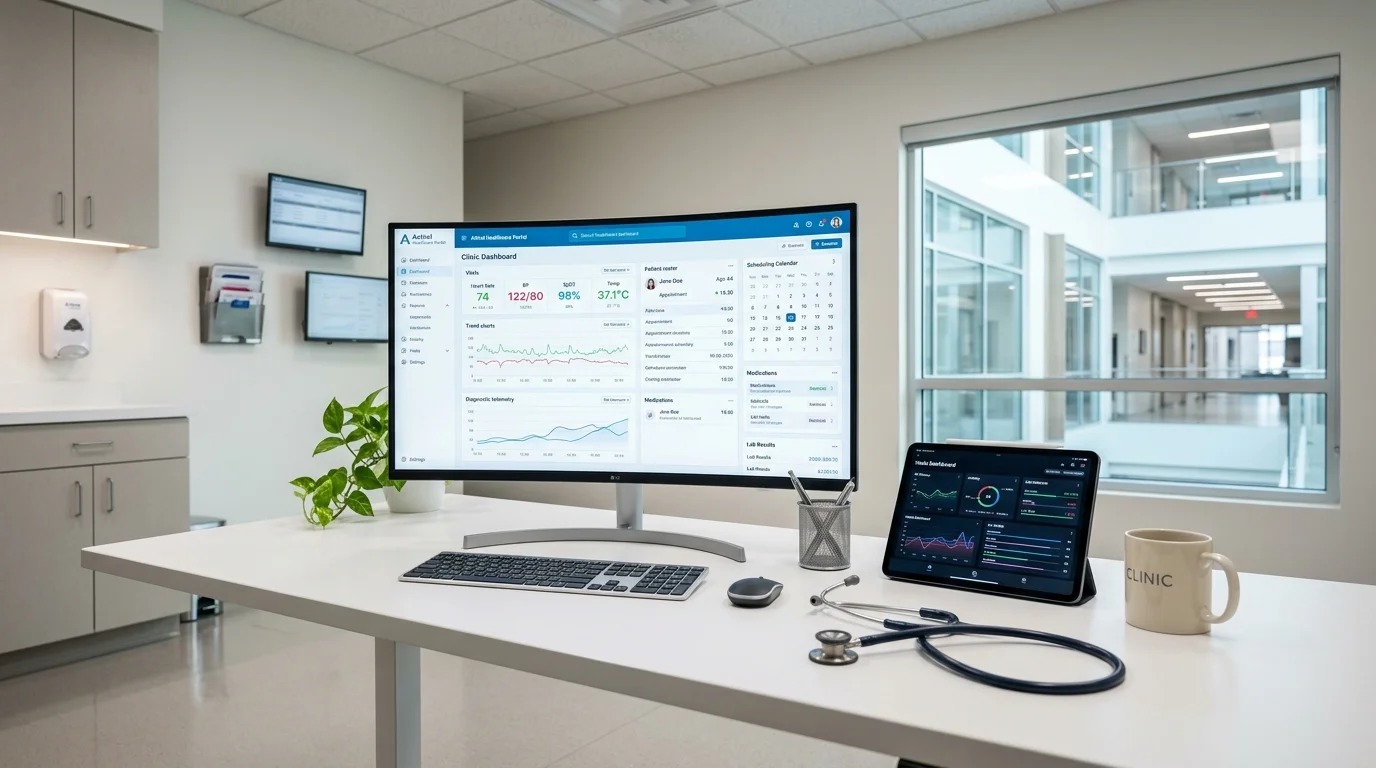
What healthcare software development services does Fekra Labs provide?
Fekra Labs provides enterprise healthcare software engineering services, including longitudinal Electronic Medical Records (EMR/EHR), Hospital Information Systems (HIS), Laboratory Information Management Systems (LIMS) with direct hardware analyzer interfacing (ASTM/HL7), web-based DICOM radiology viewing (PACS), medical insurance pre-authorization and claims adjudication, and encrypted WebRTC telemedicine platforms. Every platform is delivered with 100% intellectual property ownership, zero recurring seat fees, and sovereign in-country data residency.
1. Strategic Executive Overview & Business Value Proposition
Transforming Enterprise Operations from Constrained Software Renters into Sovereign Digital Leaders
In the modern healthcare landscape across Egypt, Saudi Arabia, and the United Arab Emirates, digital software systems represent the critical operational foundation determining clinical patient safety, diagnostic accuracy, regulatory compliance, and institutional profitability. From multispecialty hospital cities and private polyclinic networks to diagnostic laboratory chains and innovative telemedicine startups, healthcare providers must orchestrate complex, mission-critical workflows under strict sovereign data privacy mandates.
However, healthcare organizations face severe operational friction when relying on traditional software solutions. Monolithic legacy Hospital Information Systems (HIS) such as Cerner or Epic impose multi-million-dollar implementation budgets, take years to deploy, and suffer from notoriously clunky, click-heavy interfaces that frustrate doctors and exacerbate clinical burnout. Conversely, basic commercial cloud clinic apps lack enterprise data isolation, fail under heavy laboratory automation loads, and store sensitive patient records on shared multi-tenant foreign servers in direct violation of national healthcare data sovereignty laws.
At Fekra Labs, our healthcare software engineering practice is dedicated to building modern, sovereign, and human-centered digital healthcare platforms. We engineer bespoke Hospital Information Systems (HIS), Electronic Medical Records (EMR/EHR), Laboratory Information Management Systems (LIMS), and telemedicine ecosystems. Built on ACID-compliant PostgreSQL relational data architecture, modern Next.js clinical interfaces, and HL7/FHIR international interoperability standards, our solutions deliver sub-second performance, zero doctor burnout, and complete compliance with Egyptian Law 151 and Saudi Seha/NDMO mandates.
Target Healthcare Organizations Benefiting from Custom Software Engineering
- Multispecialty Hospital Networks & Medical Cities: Hospital conglomerates requiring integrated inpatient bed management, operating room scheduling, digital nursing shift handovers, and multi-department cost accounting. - Diagnostic Pathology & Clinical Laboratory Chains: Regional laboratory networks managing hundreds of thousands of daily blood and pathology specimens requiring automated analyzer interfacing (ASTM/HL7) and instant patient results dispatch. - Outpatient Polyclinics & Private Medical Centers: Multispecialty medical centers requiring streamlined patient appointment scheduling, rapid EMR documentation, and automated medical insurance claims adjudication. - Digital Health Scale-ups & Telemedicine Providers: Venture-backed healthtech startups building on-demand virtual consultation portals, encrypted WebRTC video streaming, and digital prescription fulfillment engines.Critical Healthcare Operations Failures Solved by Fekra Labs
1. Severe Clinician Burnout from Clunky Legacy Interfaces: Doctors spend over 40% of consultation time clicking through dozens of confusing legacy screens. We engineer intuitive, single-screen longitudinal EMR dashboards that reduce documentation time to under 90 seconds per patient. 2. High Medical Insurance Claim Rejection Rates: Incomplete clinical documentation and manual diagnosis-procedure mismatches result in 15% to 25% insurance claim denials. Our automated adjudication engines validate ICD-10 and CPT coding in real time before claim submission. 3. Severe Vulnerability to Patient Data Breaches: Storing sensitive Protected Health Information (PHI) in unencrypted databases exposes hospitals to catastrophic legal penalties under Egypt's Law 151 and Saudi PDPL. We implement zero-trust access and field-level AES-256 encryption. 4. Manual Clerical Errors in Diagnostic Laboratories: Manual transcription of laboratory test results from medical analyzer screens into paper reports leads to dangerous diagnostic errors. We build direct bidirectional ASTM/HL7 hardware analyzer interfaces that automate result ingestion 100%.Quantifiable Clinical & Financial ROI Delivered by Fekra Labs
- 50% Reduction in Clinical Documentation Overhead: Intuitive Next.js interfaces with auto-completing medical templates allow clinicians to focus on direct patient care. - 75% Reduction in Medical Insurance Claim Denials: Automated pre-submission validation ensures flawless ICD-10 and CPT coding compliance. - Sub-100ms Screen Transitions on Live EMRs: High-performance database indexing and Redis caching guarantee instant access to medical records. - 100% Sovereign Data Ownership & Legal Title: Complete transfer of all source code, database architectures, and deployment configurations with zero vendor lock-in.2. What is Enterprise Healthcare Software Engineering? (Architectural Foundations)
Deconstructing Bespoke Software Architecture, Domain-Driven Design, and Polyglot Persistence
Healthcare software development is the specialized, full-lifecycle engineering discipline of designing, architecting, programming, testing, securing, deploying, and maintaining digital medical systems engineered to support clinical patient care, hospital operations, diagnostic laboratories, and healthcare administration.
The Four Architectural Pillars of Healthcare Engineering at Fekra Labs
1. Longitudinal Electronic Medical Records (EMR) & FHIR Interoperability
At the core of our healthcare architecture is a longitudinal patient health record engine structured around international HL7 and FHIR (Fast Healthcare Interoperability Resources) Release 4 standards. Every patient interaction—vital signs, clinical progress notes, diagnostic imaging studies, lab results, and prescription histories—is organized chronologically into a unified, tamper-evident timeline. Standardized schemas enable seamless, secure medical data interchange between inpatient wards, outpatient clinics, diagnostic labs, and external national health exchanges (such as Saudi NPHIES).2. Bidirectional Laboratory Analyzer Interfacing (ASTM & HL7)
We build resilient Laboratory Information Management System (LIMS) middleware that interfaces directly with clinical laboratory analyzers (hematology, biochemistry, immunoassay) utilizing ASTM E1381/E1394 and HL7 protocols over TCP/IP and serial RS232 connections. Test requisitions are linked via barcode specimen accessioning, transmitted automatically to the analyzer, and validated test results are pushed back to the patient EMR with automatic highlighting of abnormal reference ranges.3. Sovereign Healthcare Security & Zero-Trust Access Control
Protected Health Information (PHI) demands the highest tier of security engineering. We enforce a zero-trust security posture adhering to the OWASP ASVS and HIPAA guidelines. All sensitive data fields (patient national IDs, diagnoses, psychiatric notes, genomic data) undergo cryptographic field-level AES-256 encryption at rest with customer-managed KMS keys. Every access event is captured in an append-only, immutable audit log that records user ID, clinical role, exact timestamp, and IP address for compliance verification.4. High-Performance Web DICOM Imaging & PACS Integration
We engineer modern web-based radiology viewing gateways connecting with hospital Picture Archiving and Communication Systems (PACS) via DICOMweb protocols. Utilizing WebAssembly (Wasm) and WebGL rendering, our zero-footprint web DICOM viewer allows radiologists and consulting surgeons to inspect multi-slice CT, MRI, and X-ray imaging directly inside their web browser or tablet with sub-second retrieval and advanced measurement tools.3. Why Enterprise Leaders Choose Custom Healthcare Systems Over Cerner & Epic
Eliminating the Innovation Ceilings, Hidden Taxes, and Data Liabilities of Generic Software Packages
In the modern healthcare sector across the Middle East, digital technology is not merely an administrative convenience; it is the fundamental infrastructure that ensures patient clinical safety, diagnostic speed, and institutional financial viability.
Strategic Liabilities of Generic or Legacy Healthcare Software
1. The Inflexible 'All-or-Nothing' Legacy Trap: Traditional hospital software suites (Cerner, Epic) are massive, rigid monoliths that take years to deploy and cost millions of dollars. They force medical facilities to adopt standardized Western clinical workflows that conflict with local regional hospital operations and patient expectations. 2. Crippling Doctor Resistance and Clinical Turnover: When physicians are forced to use slow, clunky software that requires dozens of clicks per prescription, frustration escalates. High documentation burdens reduce patient consultation capacity and lead to burnout and high clinical staff turnover. 3. Severe Regulatory Non-Compliance and Legal Fines: Storing sensitive citizen healthcare records in shared foreign clouds exposes healthcare providers to catastrophic legal penalties under Egypt’s Personal Data Protection Law (Law 151) and Saudi Arabia’s National Data Management Office (NDMO) data residency regulations. 4. Perpetual Software Licensing Overhead: Paying recurring monthly or annual per-doctor subscription fees turns essential operational software into an ongoing financial drain, reducing operating margins that could otherwise be invested in advanced medical equipment.4. What Fekra Labs Delivers: Full-Spectrum Healthcare Engineering Scope
From Architectural Blueprints to Production CI/CD Infrastructure: Complete Turnkey Ownership
Fekra Labs operates as your dedicated healthcare engineering partner, delivering turnkey digital health platforms tailored to your institutional clinical model:
Complete Scope of Healthcare Software Deliverables
- System Architecture Document (SAD) & Interoperability Blueprint: C4 architecture models, FHIR resource definitions, DICOM network topologies, and security specifications. - Production-Ready, Audited Healthcare Source Code: Modular TypeScript and Go codebases adhering to Clean Architecture principles, version-controlled in your private Git repositories. - Core Clinical Modules: Outpatient EMR, Inpatient Hospital Information System (HIS), LIMS Laboratory Analyzer Interfacing, Pharmacy CPOE, and Insurance Claims Adjudication. - Native-Grade Patient & Clinician Mobile Apps: Cross-platform Flutter mobile applications for patient appointment scheduling, lab results viewing, and telemedicine video consultations. - Sovereign Infrastructure as Code (IaC): Version-controlled Terraform scripts provisioning high-availability cloud or air-gapped on-premise Kubernetes clusters complying with regional data laws. - 100% Unencumbered Intellectual Property Transfer: Full legal ownership of all source code, database architectures, and design tokens with zero proprietary vendor lock-in.5. Core Architectural & Clinical Capability Matrix
10 Enterprise Capabilities Engineered for High Concurrency, Zero Downtime, and Fault Tolerance
Our engineering capabilities cover the entire lifecycle of custom enterprise healthcare engineering, from longitudinal EMR design to laboratory analyzer interfacing and sovereign regulatory compliance:
Hospital Information Systems (HIS) & Clinical Workflows
Engineering unified hospital operating platforms orchestrating inpatient admissions, bed management, operating room scheduling, pharmacy dispensing, and nursing shift handovers.
Electronic Medical & Health Records (EMR / EHR)
Building secure, longitudinal patient medical records compliant with HL7 and FHIR standards, featuring ICD-10 diagnostic coding, drug interaction warnings, and chronic disease tracking.
Laboratory Information Management Systems (LIMS)
Automating diagnostic lab workflows: automated barcode specimen accessioning, bidirectional medical analyzer device interfacing (ASTM/HL7), automated normal range flagging, and digital results dispatch.
Telemedicine Platforms & Encrypted WebRTC Video
Developing end-to-end virtual consultation portals featuring encrypted WebRTC video streaming, digital prescription generation, in-chat photo sharing, and integrated payment gateway processing.
Healthcare Cybersecurity, HIPAA & Sovereign Compliance
Implementing zero-trust access control, field-level encryption for protected health information (PHI), immutable clinical audit logging, and compliance with Egyptian Law 151 and Saudi Seha/NDMO mandates.
Radiology PACS & Medical Imaging Integration
Integrating Picture Archiving and Communication Systems (PACS) with DICOM web viewers, enabling clinicians to view high-resolution MRI, CT, and X-ray scans directly in the browser with sub-second retrieval.
Medical Insurance Claims Adjudication & Pre-Authorization
Automating health insurance eligibility verification, electronic pre-authorization requests, unified claims formatting, and remittance reconciliation to eliminate insurance claim rejection penalties.
Centralized Pharmacy Management & E-Prescriptions
Automating hospital pharmacy inventory, computerized physician order entry (CPOE), medication dispensing cross-checks, and automated narcotic inventory compliance ledgers.
Patient Engagement & Omnichannel Mobile Companion Apps
Cross-platform Flutter mobile applications enabling patients to view lab results, book doctor appointments, track medication schedules, and receive automated WhatsApp appointment confirmations.
Clinical AI & Diagnostic Decision Support Systems (CDSS)
Embedding private machine learning models and retrieval-augmented generation (RAG) to automate clinical documentation summaries, flag dangerous drug-drug interactions, and assist physician diagnostic triage.
6. Enterprise Case Studies & Real-World Transformation Scenarios
In-Depth Engineering Analyses of Scaled Logistics, FinTech, and Healthcare Deployments
The following case studies demonstrate how Fekra Labs custom healthcare engineering transforms clinical care delivery and operational profitability:
Case Study 1: Centralized Hospital Information System (HIS) for a Multispecialty Hospital
- Client Profile: A 220-bed private hospital operating 18 outpatient clinics, 6 operating theaters, and an intensive care unit (ICU) in Cairo, Egypt. - Clinical Challenge: Patient records were fragmented across paper files and three incompatible software programs. Nursing shift handovers took 90 minutes per ward, doctor consultation documentation was frequently incomplete, and medication dispensing errors occurred due to illegible handwriting. - Fekra Labs Solution: - Engineered a unified Hospital Information System (HIS) with longitudinal EMR records accessible across all hospital wards. - Implemented Computerized Physician Order Entry (CPOE) with automated drug-allergy and drug-drug interaction warning engines. - Deployed mobile tablet apps for nursing staff featuring barcode medication administration (BCMA) scanning at patient bedsides. - Measurable Business Impact: - Preventable medication administration errors plummeted to zero within the first 60 days of go-live. - Nursing shift handover duration dropped from 90 minutes to 15 minutes through automated digital patient summaries. - Average outpatient clinic patient turnaround time improved by 35%, allowing clinics to serve 300 additional patients weekly.Case Study 2: Automated Laboratory Information Management System (LIMS) for a Diagnostic Lab Chain
- Client Profile: A premier clinical pathology network operating 2 central testing laboratories and 14 patient collection centers across Cairo and Giza. - Clinical Challenge: Laboratory technicians manually typed test results from medical analyzer printouts into an outdated software program, leading to a 3.2% clerical error rate and delayed turnaround times during morning peak rushes. - Fekra Labs Solution: - Engineered an enterprise LIMS with direct bidirectional ASTM and HL7 interfaces connecting 22 automated hematology, chemistry, and immunoassay analyzers. - Implemented automated barcode specimen accessioning and intelligent auto-verification of normal test results. - Deployed an automated patient results dispatch engine sending encrypted PDF lab reports via WhatsApp and SMS immediately upon clinical sign-off. - Measurable Business Impact: - Transcription clerical errors were eliminated 100% through automated direct analyzer ingestion. - Average lab test turnaround time (TAT) dropped from 6 hours to 45 minutes for standard chemistry and hematology panels. - Patient satisfaction scores surged from 68% to 96% due to instant WhatsApp report delivery.Case Study 3: Sovereign Telemedicine & Home Diagnostic Platform
- Client Profile: A digital healthcare scale-up providing on-demand virtual medical consultations and home nursing care across Riyadh and Jeddah, Saudi Arabia. - Clinical Challenge: The startup was using an off-the-shelf foreign telemedicine SaaS platform that stored patient consultations on European servers, violating Saudi NDMO and Seha data residency regulations. Furthermore, video calls suffered from high latency and frequent disconnections. - Fekra Labs Solution: - Built a bespoke, sovereign telemedicine platform deployed entirely within the AWS Middle East (Riyadh) sovereign cloud availability zone. - Engineered an encrypted WebRTC video consultation engine delivering sub-150ms video latency optimized for regional telecom networks. - Integrated digital e-prescription generation with automated home pharmacy delivery dispatch. - Measurable Business Impact: - Achieved 100% compliance with Saudi NDMO and Seha regulations, successfully obtaining official Ministry of Health digital health licensure. - Video consultation call drop rate fell from 14% to 0.2%. - Platform scaled smoothly to over 45,000 monthly virtual consultations with 99.99% system availability.7. The 15-Stage Enterprise Healthcare Development Lifecycle (SDLC)
A Disciplined, Transparent Engineering Methodology Ensuring Fixed Budgets and Flawless Execution
Our 15-stage enterprise healthcare software engineering lifecycle guarantees clinical safety, regulatory compliance, and seamless physician adoption:
1. Clinical Discovery & Regulatory Scoping: Interviewing medical directors, department heads, and compliance officers to map clinical workflows and legal mandates.
2. Healthcare System Architecture Blueprint (SAD): Authoring C4 container diagrams, HL7/FHIR message schemas, DICOM imaging topologies, and security specifications.
3. Clinical UI/UX Design System in Figma: Designing high-contrast, fatigue-free clinical interfaces tested against physician ergonomics in busy hospital wards.
4. Sovereign Cloud Infrastructure & Automated CI/CD (IaC): Terraform provisioning of air-gapped or private cloud Kubernetes clusters meeting regional data residency laws.
5. Patient Entity Modeling & PHI Encryption Architecture: PostgreSQL schema modeling with field-level AES-256 encryption for patient diagnoses and national identity numbers.
6. Core EMR / EHR Longitudinal Record Engine: Developing structured clinical notes, ICD-10 diagnostic coding engines, and automated allergy/interaction alerts.
7. Laboratory (LIMS) & Medical Analyzer Interfacing: Connecting laboratory automation hardware via RS232/TCP ASTM protocols with automated normal range flagging.
8. Radiology PACS & Web DICOM Imaging Viewer: Engineering secure DICOM Web gateways allowing instant multi-slice CT/MRI viewing with zero client-side latency.
9. Pharmacy CPOE & Medication Dispensing Engine: Developing computerized prescription ordering with automated dosage calculation and narcotic ledger tracking.
10. Medical Insurance Claims & Pre-Authorization Engine: Integrating electronic insurance submission pipelines with real-time eligibility checks and claim formatting.
11. Encrypted Telemedicine Portal & Mobile Apps: Building secure WebRTC video consultation portals and native-grade Flutter patient companion apps.
12. Automated Testing Pyramid & Clinical Safety Validation: Executing automated unit, integration, and E2E browser tests validating dosage calculations and patient safety rules.
13. Zero-Trust Healthcare Security Hardening & HIPAA Audit: Conducting penetration testing, role-based privilege audits, and immutable access logging verification.
14. Legacy EMR Data Migration & Shadow Run Execution: Extracting historical patient records from legacy clinical databases, verifying data integrity, and shadow testing.
15. Clinical Staff Training, Go-Live Cutover & 24/7 SRE Support: On-site floor training for doctors and nurses, production cutover, and around-the-clock clinical SRE hypercare.
Clinical Discovery & Regulatory Scoping
Interviewing medical directors, department heads, and compliance officers to map clinical workflows and legal mandates.
Healthcare System Architecture Blueprint (SAD)
Authoring C4 container diagrams, HL7/FHIR message schemas, DICOM imaging topologies, and security specifications.
Clinical UI/UX Design System in Figma
Designing high-contrast, fatigue-free clinical interfaces tested against physician ergonomics in busy hospital wards.
Sovereign Cloud Infrastructure & Automated CI/CD (IaC)
Terraform provisioning of air-gapped or private cloud Kubernetes clusters meeting regional data residency laws.
Patient Entity Modeling & PHI Encryption Architecture
PostgreSQL schema modeling with field-level AES-256 encryption for patient diagnoses and national identity numbers.
Core EMR / EHR Longitudinal Record Engine
Developing structured clinical notes, ICD-10 diagnostic coding engines, and automated allergy/interaction alerts.
Laboratory (LIMS) & Medical Analyzer Interfacing
Connecting laboratory automation hardware via RS232/TCP ASTM protocols with automated normal range flagging.
Radiology PACS & Web DICOM Imaging Viewer
Engineering secure DICOM Web gateways allowing instant multi-slice CT/MRI viewing with zero client-side latency.
Pharmacy CPOE & Medication Dispensing Engine
Developing computerized prescription ordering with automated dosage calculation and narcotic ledger tracking.
Medical Insurance Claims & Pre-Authorization Engine
Integrating electronic insurance submission pipelines with real-time eligibility checks and claim formatting.
Encrypted Telemedicine Portal & Mobile Apps
Building secure WebRTC video consultation portals and native-grade Flutter patient companion apps.
Automated Testing Pyramid & Clinical Safety Validation
Executing automated unit, integration, and E2E browser tests validating dosage calculations and patient safety rules.
Zero-Trust Healthcare Security Hardening & HIPAA Audit
Conducting penetration testing, role-based privilege audits, and immutable access logging verification.
Legacy EMR Data Migration & Shadow Run Execution
Extracting historical patient records from legacy clinical databases, verifying data integrity, and shadow testing.
Clinical Staff Training, Go-Live Cutover & 24/7 SRE Support
On-site floor training for doctors and nurses, production cutover, and around-the-clock clinical SRE hypercare.
8. Modern Healthcare Technology Stack & Selection Rationale
Open Standards, Battle-Tested Frameworks, and Zero Proprietary Vendor Lock-in
Our healthcare technology selection prioritizes patient safety, data sovereignty, and sub-second performance:
- Core Persistence Layer: PostgreSQL 16+ with Row-Level Security, table partitioning, and field-level AES-256 cryptographic encryption.
- Backend Application Servers: Node.js 22 LTS / NestJS and Go (Golang 1.23+) for high-throughput microservices and clinical event streaming.
- Clinical Frontend Layer: Next.js 15, React 19, TypeScript 5.5, and Tailwind CSS with WebGL-accelerated DICOM medical imaging viewers.
- Interoperability Standards: HL7 Version 2.x, HL7 FHIR Release 4, ASTM E1381/E1394, and DICOMweb protocols.
- Telemedicine Streaming: WebRTC and Mediasoup media servers delivering encrypted, low-latency video consultations.
- Mobile Companion Apps: Google Flutter 3.24 for cross-platform native iOS and Android patient and clinician applications.
PostgreSQL 16+ with RLS
ACID-compliant patient records with Row-Level Security, audit trigger logs, and field-level AES-256 encryption.
Node.js / NestJS & Go
Enterprise TypeScript microservices processing high-throughput clinical workflows and analyzer integrations.
Next.js 15 & React 19
Server Components, medical imaging DICOM viewers, and responsive doctor consultation dashboards.
HL7 / FHIR Standards
Interoperability frameworks facilitating secure medical data exchange between disparate hospital systems.
Redis Cluster 7+
Real-time patient monitoring telemetry, bed status broadcasting, and clinician session management.
WebRTC & Mediasoup
Peer-to-peer encrypted audio/video channels with low latency for clinical tele-consultations.
Google Flutter 3.24
Native-compiled iOS and Android apps with biometric login and offline-first clinical appointment caching.
Docker & Kubernetes
Air-gapped private cloud or localized VPC hosting satisfying national healthcare data residency laws.
9. Healthcare Security, Zero-Trust Architecture & PHI Compliance
Defensive Software Craftsmanship Complying with OWASP ASVS, GDPR, and Regional Data Residency Laws
Protected Health Information (PHI) requires military-grade security engineering:
- Field-Level Encryption: Sensitive patient data (diagnoses, psychiatric history, lab values, national IDs) is encrypted with AES-256 prior to database storage.
- Immutable Clinical Audit Logging: Every access to a medical file is cryptographically recorded in an append-only audit trail capturing user ID, clinical role, timestamp, and IP.
- Emergency "Break-Glass" Protocols: Clinicians in emergency trauma situations can access patient files outside their normal schedule, triggering immediate supervisory review.
- Zero-Trust Network Access: All communications between frontend portals, backend microservices, and databases are strictly encrypted using TLS 1.3 with mTLS verification.
10. Performance Benchmarks, Clinical Latency & SLO Framework
Engineering for Sub-100ms Chart Retrieval, 99.99% Availability, and Multi-Tiered Distributed Caching
Clinical applications must perform instantaneously to protect patient lives:
- EMR Screen Transition Latency (p95): Under 100 milliseconds for loading complete longitudinal patient medical charts.
- Laboratory Result Auto-Verification Latency: Under 50 milliseconds from analyzer transmission to digital EMR notification.
- Web DICOM Image Slice Retrieval: Under 300 milliseconds for loading high-resolution CT and MRI scan series.
- System Availability SLA: 99.99% uptime (< 4.3 minutes of unplanned downtime per month) backed by local hospital failover nodes.
11. Medical Analyzer Interfacing, PACS Radiology & Insurance Rails
Direct ASTM/HL7 Hardware Connectivity, Web DICOM Image Viewers, and Insurance Adjudication
Our healthcare integration middleware connects your clinical platform with the entire medical ecosystem:
- Medical Laboratory Equipment: Roche, Abbott, Beckman Coulter, Sysmex, and Siemens analyzers via ASTM and HL7 protocols.
- National Health Exchanges: Direct API connectivity with Saudi NPHIES and Egyptian Universal Health Insurance authorities.
- Medical Insurance Payers & TPAs: Real-time pre-authorization and electronic claims submission gateways.
- Radiology Imaging PACS: Agfa, GE, Siemens, and Philips PACS servers via DICOMweb standards.
12. Architectural Comparison: Custom Healthcare Systems vs Monolithic HIS vs SaaS
An Objective Technical and Financial Trade-off Analysis Across the 8 Critical Enterprise Dimensions
The following table compares Fekra Labs custom healthcare systems with legacy monolithic HIS software and off-the-shelf cloud clinic apps:
| Healthcare Engineering Dimension | Fekra Labs Custom Healthcare Systems | Legacy Monolithic HIS (Cerner, Epic, Intersystems) | Off-The-Shelf Cloud Clinic Apps |
| :--- | :--- | :--- | :--- |
| Software Licensing & Cost Structure | $0 Recurring User Seat Taxes; 100% Client-Owned Intellectual Property | Astronomical Multi-Million-Dollar Licensing & Implementation Fees | Monthly Subscription with Strict Patient Volume & User Limits |
| Regional Regulatory & Sovereign Compliance | 100% Sovereign In-Country Cloud / On-Premise Hosting (Egypt 151 / Saudi PDPL) | Complex Offshore Data Hosting Requiring Expensive Regional Waivers | Shared Foreign Multi-Tenant Clouds Violating Local Health Laws |
| Workflow Customization & Clinical Speed | Tailored Exactly to Your Hospital Operating Model & Specialist Workflows | Rigid Generic Templates Requiring Hundreds of Clicks per Patient | Basic Out-of-the-Box Forms with Zero Departmental Flexibility |
| Laboratory Analyzer Interfacing (LIMS) | Direct Bidirectional ASTM/HL7 Interfacing with Hardware Analyzers | Expensive Proprietary Hardware Adapters ($15,000+ per device) | Manual Result Entry; Zero Direct Laboratory Device Connectivity |
| System Latency & Doctor Consultation UX | Sub-100ms Screen Transitions; Built Specifically to Prevent Doctor Burnout | Notoriously Clunky, Slow Interfaces Requiring Extensive Training | Laggy Browser Screens Failing under Peak Morning Clinic Loads |
| Local Payment & E-Invoicing Compliance | Native Cryptographic Integration with Saudi ZATCA & Egyptian ETA | Requires Third-Party Middleware and Costly External Consultancies | Limited Payment Options with Zero Regional E-Invoicing Compliance |
| Implementation Timeline & Go-Live | 12 to 16 Weeks; Agile Phased Departmental Rollouts | 18 to 36 Months; High Risk of Clinical Resistance and Budget Overruns | 1 to 2 Weeks for Basic Forms, but Fails Completely at Enterprise Scale |
| 5-Year Total Cost of Ownership (TCO) | Predictable Capex Investment + Modest Cloud Maintenance (<$250k) | Multi-Million-Dollar Drain ($2.0M - $5.0M+ in Licenses & Support) | Deceptively High Cumulative Costs as Patient Records Expand |
| Healthcare Engineering Dimension | Fekra Labs Custom Healthcare Systems | Legacy Monolithic HIS (Cerner, Epic, Intersystems) | Off-The-Shelf Cloud Clinic Apps |
|---|---|---|---|
| Software Licensing & Cost Structure | $0 Recurring User Seat Taxes; 100% Client-Owned Intellectual Property | Astronomical Multi-Million-Dollar Licensing & Implementation Fees | Monthly Subscription with Strict Patient Volume & User Limits |
| Regional Regulatory & Sovereign Compliance | 100% Sovereign In-Country Cloud / On-Premise Hosting (Egypt 151 / Saudi PDPL) | Complex Offshore Data Hosting Requiring Expensive Regional Waivers | Shared Foreign Multi-Tenant Clouds Violating Local Health Laws |
| Workflow Customization & Clinical Speed | Tailored Exactly to Your Hospital Operating Model & Specialist Workflows | Rigid Generic Templates Requiring Hundreds of Clicks per Patient | Basic Out-of-the-Box Forms with Zero Departmental Flexibility |
| Laboratory Analyzer Interfacing (LIMS) | Direct Bidirectional ASTM/HL7 Interfacing with Hardware Analyzers | Expensive Proprietary Hardware Adapters ($15,000+ per device) | Manual Result Entry; Zero Direct Laboratory Device Connectivity |
| System Latency & Doctor Consultation UX | Sub-100ms Screen Transitions; Built Specifically to Prevent Doctor Burnout | Notoriously Clunky, Slow Interfaces Requiring Extensive Training | Laggy Browser Screens Failing under Peak Morning Clinic Loads |
| Local Payment & E-Invoicing Compliance | Native Cryptographic Integration with Saudi ZATCA & Egyptian ETA | Requires Third-Party Middleware and Costly External Consultancies | Limited Payment Options with Zero Regional E-Invoicing Compliance |
| Implementation Timeline & Go-Live | 12 to 16 Weeks; Agile Phased Departmental Rollouts | 18 to 36 Months; High Risk of Clinical Resistance and Budget Overruns | 1 to 2 Weeks for Basic Forms, but Fails Completely at Enterprise Scale |
| 5-Year Total Cost of Ownership (TCO) | Predictable Capex Investment + Modest Cloud Maintenance (<$250k) | Multi-Million-Dollar Drain ($2.0M - $5.0M+ in Licenses & Support) | Deceptively High Cumulative Costs as Patient Records Expand |
13. Total Cost of Ownership (TCO) & Healthcare Investment Economics
Demonstrating Multi-Million-Dollar Savings, Zero Doctor Seat Fees, and Clinical Asset Equity
Evaluating the Total Cost of Ownership (TCO) of healthcare systems demonstrates the overwhelming financial advantage of custom engineering:
- Key Investment Determinants: Clinical module scope (Inpatient, Outpatient, LIMS, PACS), depth of medical analyzer interfacing, mobile app requirements, and data residency configurations.
- The Financial Drain of Legacy HIS Licensing: Commercial hospital software packages cost between $400,000 and $1.5 million annually in recurring user seat taxes, maintenance contracts, and certified consultant retainers—amounting to over $3.0M over 5 years.
- The Custom Healthcare Advantage: Custom healthcare engineering from Fekra Labs requires a one-time capital investment ($150,000 - $250,000) and modest cloud infrastructure and maintenance ($35,000/year), delivering total 5-year costs under $350,000.
- Net 5-Year Enterprise Savings: Consistently exceeds $2.5 million, while creating an appreciating, proprietary institutional asset owned completely by your healthcare group.
14. Sprint Milestones, Phased Delivery Windows & Gantt Timeline
Predictable Phased Execution from Sprint 0 Discovery to Production Cutover in 16 to 20 Weeks
Our disciplined phased implementation roadmap guarantees rapid clinical adoption and risk-free delivery:
- Weeks 1–2: Clinical Discovery & Workflow Auditing: Interviewing medical directors, department heads, and compliance officers.
- Weeks 3–4: UI/UX Design System & FHIR Schema Modeling: Designing clinician dashboards and normalized PostgreSQL medical schemas.
- Weeks 5–8: Core Outpatient EMR & Appointment Scheduling: Patient registration, longitudinal medical records, and digital prescriptions.
- Weeks 9–12: Inpatient Bed Management, Pharmacy CPOE & Billing: Ward management, medication dispensing cross-checks, and cashiering.
- Weeks 13–16: LIMS Analyzer Interfacing, PACS Imaging & Mobile Apps: ASTM/HL7 analyzer connectors, web DICOM viewers, and Flutter patient apps.
- Weeks 17–18: Clinical Data Migration, Shadow Runs & Staff Training: Migrating historical records, parallel shadow testing, and on-site staff training.
- Weeks 19–20: Production Cutover & 24/7 Clinical SRE Hypercare: Phased department-by-department cutover with round-the-clock clinical SRE support.
15. Critical Industry Failures, Clinical Traps & Proven Remedies
Solving Insurance Claim Denials, Laboratory Clerical Errors, and Imaging Latency Bottlenecks
Throughout our healthcare engagements, we routinely resolve critical clinical software failures:
1. High Insurance Claim Denials: Mismatched diagnosis codes causing payment delays. We implement real-time pre-submission ICD-10 and CPT validation engines.
2. Laboratory Clerical Transcription Errors: Manual entry of test results leading to diagnostic errors. We build direct bidirectional ASTM/HL7 hardware analyzer interfaces that automate result entry 100%.
3. Slow Imaging Retrieval During Consultations: Doctors waiting minutes for MRI scans to load. We engineer zero-footprint web DICOM viewers delivering multi-slice scans in under 300 milliseconds.
4. Doctor Documentation Burnout: Clunky multi-step screens causing clinical fatigue. We design single-screen longitudinal EMR dashboards with smart auto-completing templates.
16. Top Enterprise Anti-Patterns & Strategic Pitfalls to Avoid
Guiding Medical Directors Away from Offshore Clouds, Physician Isolation, and Data Neglect
Avoid these strategic traps when developing healthcare software:
- Selecting Software That Mandates Offshore Hosting: Using foreign cloud tools that violate Egyptian Law 151 or Saudi NDMO healthcare data residency mandates.
- Designing Without Active Physician Participation: Building screens without observing real-world clinic workflows, resulting in clinical staff rejection.
- Treating Laboratory Interfacing as an Afterthought: Forgetting that laboratory automation requires specialized low-level ASTM/HL7 serial and TCP protocols.
- Underestimating Legacy Medical Record Migration: Assuming historical patient records are clean. Schedule dedicated ETL data reconciliation sprints early.
17. Architectural Decision Framework: When to Build Custom Healthcare Software
A Rigorous Decision Matrix for Evaluating Enterprise Healthcare Platform Investments
Use this decision matrix to determine your healthcare software strategy:
- Choose Custom Healthcare Engineering When: You operate a multispecialty hospital, clinical laboratory chain, or growing polyclinic network; you require strict sovereign in-country data residency; you need direct laboratory analyzer interfacing; or commercial licensing exceeds $80,000 annually.
- Choose Basic Commercial Apps When: You operate a solo single-doctor private practice with fewer than 5 patients per day where basic appointment scheduling is sufficient.
18. Comprehensive Technical, Clinical & Operational FAQs (25 Deep Q&As)
Authoritative Answers to the Most Critical Questions Raised by Medical Directors, CIOs and Hospital CEOs
Below are detailed, authoritative answers to the most critical technical, clinical, and regulatory questions regarding enterprise healthcare software development with Fekra Labs.
How do custom healthcare systems developed by Fekra Labs ensure patient data privacy and legal compliance?
We architect healthcare systems adhering strictly to regional and international medical data protection frameworks, including Egypt’s Personal Data Protection Law (Law No. 151 of 2020), Saudi Arabia’s Personal Data Protection Law (PDPL) and National Data Management Office (NDMO) standards, and international HIPAA guidelines. All Protected Health Information (PHI) is protected via field-level AES-256 encryption at rest, network communications are encrypted via TLS 1.3, and every access to patient medical records is logged in an immutable, tamper-evident audit trail with user role, timestamp, and IP address verification.
Can your healthcare software interface directly with medical laboratory analyzers and diagnostic equipment?
Yes. We engineer bidirectional Laboratory Information Management System (LIMS) middleware that connects directly with diagnostic hardware analyzers (such as automated hematology, biochemistry, and immunoassay machines from Roche, Abbott, Beckman Coulter, and Siemens) utilizing standard ASTM E1381/E1394 and HL7 protocols. Test orders flow automatically from the doctor’s computer to the analyzer via barcode scanning, and validated results return directly to the patient’s digital EMR with zero manual clerical transcription.
How do you prevent doctor burnout and ensure clinical staff adopt the new EMR system enthusiastically?
Doctor dissatisfaction with traditional EMR systems stems from excessive clicking, clunky multi-step navigation, and slow loading times. We design clinical interfaces through intensive shadowing of physicians in active outpatient clinics and emergency rooms. Our Next.js clinical dashboards utilize single-screen longitudinal patient summaries, keyboard shortcuts for rapid data entry, smart auto-completing medical templates, sub-second screen transitions, and voice-to-text dictation integration, allowing doctors to complete clinical documentation in under 90 seconds per patient.
Does our medical organization own the complete source code, clinical schemas, and intellectual property?
Yes, unconditionally. Fekra Labs contracts transfer 100% of all developed source code, database architectures, HL7/FHIR interface engines, UI/UX design tokens, and technical documentation exclusively to your healthcare organization upon project delivery. You have complete legal title with zero vendor lock-in, zero ongoing seat licensing fees, and full freedom to host on your own private cloud or sovereign on-premise hospital datacenters.
How do you handle medical insurance claims adjudication and pre-authorization workflows?
We build automated insurance integration modules connecting your hospital systems with regional healthcare payers and third-party administrators (TPAs). The system performs real-time insurance eligibility checks at patient check-in, automatically validates procedure and diagnosis pairings against ICD-10 and CPT coding rules, generates electronic pre-authorization requests with attached clinical documentation, and tracks claim adjudication statuses, reducing insurance claim rejections by up to 75%.
Can your platform integrate Picture Archiving and Communication Systems (PACS) for radiology imaging?
Yes. We integrate PACS servers using modern DICOMweb standards (WADO-RS, QIDO-RS, STOW-RS). Clinicians can view high-resolution X-rays, CT scans, and MRI multi-slice imaging directly inside their web browser or tablet interface without installing proprietary desktop software. The DICOM viewer provides essential clinical tools: window leveling, zoom/pan, distance measurement, angle calculation, and side-by-side historical study comparisons.
How do you execute safe data migration from legacy EMR and hospital databases?
Migrating patient medical records demands zero tolerance for data corruption. We execute a disciplined ETL migration protocol: extracting historical records from legacy databases, running automated data cleansing to reconcile duplicated patient master records, and transforming data into normalized FHIR-compliant schemas. We conduct parallel shadow runs where clinicians verify historical diagnoses and lab records against original paper or legacy files before executing final production cutover.
Can you build patient-facing mobile apps for appointment booking, lab results, and tele-consultations?
Yes. We build native-grade cross-platform patient mobile applications for iOS and Android using Google Flutter. Patients can browse physician specialties, book clinic appointments, pay consultation fees via credit cards, Apple Pay, or Fawry, view their historical lab test results and radiology reports, receive automated medication reminders, and conduct encrypted video tele-consultations with their doctors.
What is your strategy for disaster recovery and hospital operational continuity during outages?
Hospital operations cannot afford a single minute of downtime. We architect high-availability infrastructure for 99.99% uptime with a Recovery Point Objective (RPO) of < 5 minutes and a Recovery Time Objective (RTO) of < 15 minutes. We implement active-active streaming database replication, continuous Write-Ahead Logging (WAL) archiving, and automated local failover nodes inside the hospital facility that continue running critical triage and medication dispensing even in the event of an external city-wide internet fiber cut.
How long does a complete enterprise healthcare software engineering project take?
Our phased implementation roadmap delivers rapid clinical time-to-value. A foundational clinical platform—encompassing Patient Registration, Outpatient EMR, Pharmacy Dispensing, and Cashiering—is typically deployed to production within 12 to 14 weeks. Specialized enterprise modules (Inpatient Ward Management, Operating Theater Scheduling, LIMS Analyzer Interfacing, and Insurance Claims Adjudication) are rolled out in subsequent bi-weekly Agile sprints across a 4- to 6-month roadmap.
How do you handle drug-drug interaction warnings and clinical decision support (CDSS)?
We integrate clinical decision support algorithms that evaluate every prescribed medication against the patient’s active drug profile, recorded allergies, and renal/hepatic function indicators. If a physician prescribes a medication that has a severe contraindication with another active drug or a known patient allergy, the system triggers an immediate visual clinical alert requiring explicit clinical override justification before the prescription can be sent to the pharmacy.
Can custom healthcare software developed by Fekra Labs be hosted on-premise inside our hospital?
Yes. While many clients prefer private sovereign cloud hosting (such as AWS Middle East or Microsoft Azure UAE), we routinely deploy healthcare platforms on air-gapped on-premise server clusters within the hospital’s physical datacenter. We utilize containerized Kubernetes clusters (RKE2 / K3s) with local private artifact registries, ensuring total operational autonomy and 100% compliance with strict hospital data sovereignty policies.
How do you manage role-based clinical permissions to prevent unauthorized access to sensitive medical records?
We enforce granular Role-Based Access Control (RBAC) and contextual Attribute-Based Access Control (ABAC). Access rights are tied strictly to active clinical duty: for example, a consulting physician can only access medical records for patients actively assigned to their clinic schedule or admitted to their ward. Nurses have access to vital signs and medication administration records but cannot alter diagnostic summaries. All emergency "break-glass" access events trigger automated security alerts and mandatory supervisory review.
What post-launch clinical training, warranties, and technical support do you provide?
Every healthcare engagement includes a 90-day post-launch warranty covering all defect remediation. We deliver role-based training libraries with video walkthroughs tailored specifically for doctors, nurses, laboratory technicians, and billing staff. Following the warranty window, we provide 24/7/365 Site Reliability Engineering (SRE) support with guaranteed 15-minute response SLAs for critical severity-1 clinical system anomalies.
How do we begin a healthcare software engineering partnership with Fekra Labs?
You can schedule a confidential Healthcare Architecture & Clinical Strategy Session through our website or direct phone line. Our senior healthcare systems architects will evaluate your clinical workflows, regulatory requirements, hardware interfacing needs, and commercial milestones, delivering a comprehensive Technical Scope & Feasibility Roadmap within 5 business days.
How do you ensure interoperability with national health information exchanges (such as Saudi NPHIES)?
We engineer our healthcare integration engines strictly adhering to modern HL7 FHIR (Fast Healthcare Interoperability Resources) Release 4 standards. For Saudi Arabian healthcare providers, we build direct API connectors interfacing with NPHIES (National Platform for Health and Insurance Information Services), automating real-time beneficiary verification, prior authorization requests, and digital claim submissions in full compliance with Council of Health Insurance (CHI) regulations.
How do you handle pediatric dosage calculations and weight-based prescription adjustments?
Our Computerized Physician Order Entry (CPOE) module incorporates intelligent pediatric dosing calculators. When prescribing medications for pediatric patients, the system automatically checks the patient’s recorded weight and body surface area (BSA), calculates the exact milligram-per-kilogram dosage, alerts the clinician if the calculated dose exceeds established pediatric safety limits, and generates accurate liquid volume dispensing instructions for pharmacy technicians.
Can your platform support multi-branch clinic networks with centralized billing and patient records?
Yes. Our platform architecture is built for multi-branch healthcare organizations. Patients maintain a single, unified Master Patient Index (MPI) accessible across all clinic branches and diagnostic centers. The system provides centralized financial billing, consolidated insurance reconciliation, group-wide physician scheduling, and inter-branch inventory transfers, while allowing local branch administrators to manage local front-desk operations independently.
How do you manage emergency department triage and patient acuity tracking (ESI Scoring)?
We build specialized Emergency Department Information Systems (EDIS) structured around the Emergency Severity Index (ESI) 5-level triage algorithm. Triage nurses enter vital signs, chief complaints, and resource requirements on touch-friendly tablets, and the system automatically assigns an ESI score, colors-codes patient priority on live ER tracking whiteboards, and alerts attending emergency physicians to incoming critical trauma cases in real time.
What mechanisms are in place to ensure computerized physician order entry (CPOE) eliminates handwriting errors?
Illegible handwritten prescriptions are a leading cause of preventable medical errors. Our CPOE module replaces paper prescription pads with structured digital ordering. Physicians select medications from standardized national drug formularies, choose from pre-configured clinical order sets (e.g., standard post-operative pain protocols), and electronically sign orders, transmitting clear, unambiguous instructions directly to hospital pharmacy and nursing administration logs.
Can the system generate automated patient discharge summaries and home care instructions?
Yes. When an inpatient is discharged, the system automatically compiles an electronic discharge summary aggregating admission diagnosis, hospital course, performed surgical procedures, final lab results, and discharge medications. Clinicians can append localized, patient-friendly home care instructions in Arabic and English, which are printed for the patient and automatically pushed to their mobile health companion app.
How do you manage blood bank inventory and cross-match transfusion safety protocols?
We engineer blood bank management modules adhering strictly to international transfusion safety standards. The system tracks blood units by blood group, Rh factor, donation date, and viral screening clearance. When a transfusion is ordered, the system enforces double-independent cross-matching verification, tracks compatibility test results, and requires dual-nurse barcode scanning at the patient’s bedside before blood can be transfused.
How do you prevent medical identity fraud and duplicate patient record creation?
We deploy intelligent Master Patient Index (MPI) probabilistic matching algorithms. When a new patient registers, the system scans existing records using a combination of national identity number, mobile phone, biometric fingerprint, and phonetically matched Arabic/English names. If a potential duplicate is detected, the system alerts the registrar and prompts record merging, preventing fragmented medical histories.
Can your healthcare platform integrate with existing hospital accounting and ERP software?
Yes. We engineer secure financial integration middleware connecting clinical billing engines directly with enterprise ERPs (SAP S/4HANA, Oracle NetSuite, Odoo, or custom ERPs). Patient billing events, insurance receivables, pharmacy inventory cost-of-goods-sold, and departmental revenue allocations synchronize automatically with the general ledger in real time.
Why is custom healthcare software development a superior investment for medical institutions?
Off-the-shelf legacy hospital software forces healthcare organizations to operate inside clunky, outdated architectures that cause clinician burnout, slow patient throughput, and impose massive recurring licensing costs. A custom healthcare platform engineered by Fekra Labs codifies your clinical excellence, eliminates doctor frustration, guarantees 100% sovereign data compliance, and creates an appreciating proprietary institutional asset owned completely by your healthcare group.
20. Enterprise Discovery Roadmap & Project Kickoff Protocol
How to Initiate Your Architecture Discovery Session and Accelerate Digital Transformation
Initiating your healthcare software engineering partnership with Fekra Labs:
1. Confidential Clinical Discovery Consultation: 90-minute architectural session under mutual NDA reviewing clinical workflows, equipment interfacing, and compliance mandates.
2. Technical Scope & Clinical Feasibility Roadmap: Delivering proposed system architecture diagrams, FHIR schemas, and fixed-cost sprint milestones within 5 business days.
3. Sprint 0 Discovery & Clinical Prototype Modeling: Creating interactive Figma prototypes and database schemas with guaranteed sprint pricing.
4. Agile Sprint Execution & Clinical Production Go-Live: Bi-weekly working software demonstrations culminating in a seamless, risk-free hospital cutover.
The Clinical Imperative: Eliminating Doctor Burnout Through Ergonomic EMR Architecture
Doctor dissatisfaction with enterprise software has reached epidemic proportions across the global healthcare sector. Studies in medical informatics demonstrate that for every hour physicians spend delivering direct care to patients, they spend nearly two hours navigating clunky, outdated electronic health record software. Cumbersome drop-down menus, slow screen transitions, and fragmented data layouts contribute directly to cognitive exhaustion and preventable medical errors.
At Fekra Labs, we approach clinical software engineering from a human-centered ergonomic foundation. Utilizing Next.js 15 Server Components and virtualized clinical data grids, we construct longitudinal EMR dashboards that load patient charts in under 100 milliseconds. By incorporating smart keyboard shortcuts, auto-completing diagnostic templates, and streamlined single-screen clinical summaries, our custom EMR solutions reduce clinical documentation time by over 50%, restoring joy to medical practice.
Sovereign Data Governance in Regional Healthcare: Complying with Egypt Law 151 and Saudi PDPL
Protected Health Information (PHI) is the most legally sensitive category of enterprise data. National healthcare regulators across Egypt (Data Protection Law 151) and Saudi Arabia (PDPL and NDMO frameworks) strictly prohibit the cross-border transmission or offshore cloud hosting of citizen medical records without explicit regulatory licenses.
Our custom healthcare architecture guarantees absolute sovereign compliance. We engineer systems capable of deploying into private regional cloud availability zones (such as AWS Middle East in Riyadh or Microsoft Azure UAE) or within physically air-gapped on-premise hospital datacenters. Every layer of the software implements field-level AES-256 encryption, role-based access control, and immutable audit logs that satisfy the most rigorous healthcare compliance audits.
Whitepaper: HL7 FHIR v4 Interoperability, Smart-on-FHIR & Saudi NPHIES Compliance
1. Breaking Healthcare Information Silos with FHIR
Healthcare digital transformation has historically been severely paralyzed by proprietary legacy database schemas and fragmented communication protocols (HL7 v2 pipe-delimited messages, DICOM imaging silos, and non-standardized XML payloads). The Fast Healthcare Interoperability Resources (FHIR) v4 standard established a unified, RESTful, JSON-based paradigm built on modern web standards (HTTP/2, TLS 1.3, JSON-LD, and OAuth 2.0).In Saudi Arabia and the broader GCC healthcare landscape, adherence to NPHIES (National Platform for Health and Information Exchange Services) is legally mandated for all digital medical insurance claims, electronic referrals, and patient health history exchanges. Fekra Labs architects healthcare digital systems around native FHIR v4 resource models, guaranteeing immediate plug-and-play compliance with government health portals and regional hospital information networks.
2. Core FHIR Architectural Patterns: Resources & Smart-on-FHIR
Every clinical entity is modeled as a discrete, versioned FHIR resource with immutable identifiers:{
"resourceType": "Patient",
"id": "sa-pat-984210",
"identifier": [
{
"system": "http://nphies.sa/identifier/national-id",
"value": "1098234567"
}
],
"active": true,
"name": [
{
"use": "official",
"family": "Al-Zahrani",
"given": ["Omar", "Tariq"]
}
],
"gender": "male",
"birthDate": "1988-04-12"
}
Third-party medical diagnostic plugins, AI radiological imaging assistants, and clinical decision support systems interface securely via SMART-on-FHIR. Using scoped OAuth 2.0 tokens (e.g., `patient/Observation.read patient/MedicationRequest.write`), healthcare software platforms maintain strict least-privilege access, ensuring external clinical tools only access the precise diagnostic data required for clinical workflows without exposing unrelated patient medical histories.
Whitepaper: End-to-End Cryptographic Zero-Trust Architecture for Protected Health Information (PHI)
1. Regulatory Governance: HIPAA, GDPR & Saudi NDMO Guidelines
Protected Health Information (PHI) constitutes the most sensitive category of enterprise data. Legal frameworks—including the United States HIPAA, European GDPR, and Saudi Arabia's National Data Management Office (NDMO) and NCA ECC-1:2018 standards—impose severe civil penalties and criminal liabilities for unencrypted data breaches. Achieving compliance requires moving beyond superficial boundary firewalls to implement an End-to-End Zero-Trust Security Architecture.2. Envelope Encryption & Field-Level Column Hashing
Fekra Labs implements multi-tier envelope encryption for all electronic medical records (EMR). Unencrypted PHI is never committed to persistent storage or application logs: - Key Encryption Keys (KEK): Stored in hardware security modules (AWS KMS, Azure Key Vault, or sovereign on-premise HSMs) with automatic annual cryptographic rotation. - Data Encryption Keys (DEK): Generated per medical record using AES-256-GCM. - Deterministic Field Hashing: Sensitive search indexes (such as National IDs, Saudi Iqamas, and insurance card numbers) are hashed using HMAC-SHA256 with an isolated salt. This allows clinical search queries to locate patient files without decrypting the underlying database columns during query filtering.Comprehensive, tamper-evident audit logs record every single access to patient files, noting the physician's authenticated identity, department, role, IP address, device fingerprint, and clinical justification. These audit logs are written to append-only, WORM (Write Once, Read Many) object storage buckets, satisfying national healthcare compliance audits effortlessly.
Whitepaper: Cloud DICOM Imaging, PACS Streaming & Zero-Footprint Medical Viewers
1. Overcoming the Volume of Radiological Medical Imaging
Modern medical imaging modalities (MRI, 64-slice CT scans, and high-frequency ultrasound) generate massive multi-gigabyte datasets per patient exam. Legacy PACS systems tethered to local hospital networks severely impede multi-disciplinary consultations, remote diagnostic telemedicine, and inter-hospital emergency referrals.2. Modern DICOMweb Standards & WebAssembly Rendering
Fekra Labs implements scalable cloud-native radiological pipelines: - WADO-RS Streaming: Exposing medical studies through RESTful DICOMweb endpoints that stream progressive sub-sampled image frames on demand. - WebAssembly Client Rendering: Developing zero-footprint web viewers using WebAssembly (Wasm) that execute hardware-accelerated 3D multi-planar reconstruction (MPR) and Maximum Intensity Projection (MIP) directly inside standard web browsers on mobile devices. - Diagnostic AI Integration: Orchestrating deep-learning inference pipelines that analyze incoming radiological scans asynchronously to surface critical triage alerts (such as acute intracranial hemorrhages or pneumothorax) within 60 seconds.Whitepaper: Real-Time Telemedicine Video Streaming — WebRTC, SFU Topologies & Adaptive Bitrate Optimization
1. Low-Latency Clinical Audio/Video Requirements
Virtual physician consultations and remote robotic tele-presence demand sub-200ms audio and video latency. Traditional HTTP live streaming (HLS / DASH) with 2-to-6 second buffering delays is completely unviable for medical consultations where conversational turn-taking, patient voice tone, and visual symptom evaluation require instantaneous human feedback.At Fekra Labs, our telehealth architectures rely on WebSockets and WebRTC (Web Real-Time Communication) orchestrated through Selective Forwarding Unit (SFU) media server clusters (such as LiveKit and Mediasoup).
2. Peer-to-Peer vs. SFU Media Server Topologies
While peer-to-peer (P2P) WebRTC works for simple 1-on-1 video calls, clinical workflows require multi-party consultations involving the attending physician, a remote medical specialist, a family translator, and automated AI transcription bots. In a full-mesh P2P topology with $N$ participants, each client must encode and transmit $N-1$ video streams, causing massive CPU thermal throttling and network uplink saturation on mobile smartphones.Our SFU architecture solves this:
- Single Inbound Stream: Each client encodes a single video stream using Simulcast (transmitting three simultaneous spatial layers: 1080p high, 720p medium, and 360p low resolution).
- Intelligent Selective Forwarding: The SFU inspects downstream network bandwidth (via Google Congestion Control / BWE algorithms) and routes the optimal video resolution layer to each participant dynamically without transcoding, sustaining flawless 30 FPS video even over degraded 3G cellular links.
- End-to-End Encryption (E2EE) with SFrame: Utilizing WebRTC Insertable Streams, video and audio frames are encrypted client-side before reaching the SFU, ensuring cloud media servers never have access to raw unencrypted clinical video feeds.
Whitepaper: Internet of Medical Things (IoMT) — Telemetry Ingestion, MQTT & Edge Device Security
1. Continuous Patient Vitals Monitoring at Scale
The rapid proliferation of Internet of Medical Things (IoMT) hardware—including continuous glucose monitors (CGM), Bluetooth electrocardiogram (ECG) patches, pulse oximeters, and smart hospital ICU infusion pumps—requires infrastructure capable of ingesting continuous sensor telemetry 24/7/365 without missing a single arrhythmic spike or vital sign collapse.2. Edge Ingestion with MQTT over TLS & Time-Series Storage
Fekra Labs deploys hardened IoT telemetry architectures: - Lightweight MQTT Protocol: Connected medical devices communicate using MQTT 5.0 with QoS Level 1 (At Least Once Delivery) over TLS 1.3 with mutual certificate authentication (mTLS). Message packet framing consumes fewer than 5 bytes of overhead, preserving device battery life during long monitoring cycles. - Time-Series Analytical Storage: Telemetry streams ingest directly into TimescaleDB or InfluxDB configured with automated retention policies and continuous aggregate rollups:-- Continuous aggregate rollup for patient heart rate telemetry
CREATE MATERIALIZED VIEW patient_heart_rate_hourly
WITH (timescaledb.continuous) AS
SELECT patient_id,
time_bucket('1 hour', recorded_at) AS hour_bucket,
AVG(bpm) AS avg_bpm,
MAX(bpm) AS max_bpm,
MIN(bpm) AS min_bpm
FROM patient_vitals_telemetry
GROUP BY patient_id, hour_bucket;
- Complex Event Processing (CEP) for Clinical Triage: Streaming Flink/Kafka workers evaluate sliding time windows. If a cardiac patient's telemetry indicates ventricular fibrillation for more than 4 consecutive seconds, automated high-priority alerts push instantly to the attending ICU care team's mobile devices, saving precious lives through algorithmic vigilance.
Whitepaper: Clinical Decision Support Systems (CDSS), Algorithmic Drug Interactions & SNOMED CT
1. Mitigating Preventable Adverse Drug Events (ADEs)
In complex hospital inpatient and outpatient environments, adverse drug events (ADEs) represent one of the primary drivers of preventable clinical mortality and hospital readmissions. Physicians treating multi-morbid patients must balance dozens of concurrent pharmacotherapies, lab vitals, and genetic contraindications.Fekra Labs integrates enterprise Clinical Decision Support Systems (CDSS) directly into hospital electronic health record (EHR) workflows, powered by the international SNOMED CT clinical ontology and RxNorm pharmaceutical taxonomies.
2. Real-Time Rule Engines & Tiered Alert Fatigue Prevention
A common architectural failure in legacy hospital software is "Alert Fatigue"—where physicians are bombarded with hundreds of trivial warning dialogs every shift, causing them to blindly dismiss all alerts, including life-threatening contraindications.Our CDSS engine implements Context-Aware Tiered Alert Governance:
- Tier 1 (Severe Contraindication - Hard Stop): Lethal drug-drug interactions (e.g., combining high-dose Potassium Sparing Diuretics with ACE inhibitors in severe renal failure). The EHR blocks the prescription order and requires explicit multi-factor electronic signature and departmental chair override.
- Tier 2 (Moderate Warning - Soft Stop with Required Justification): Interacting therapies that require adjusted dosages or continuous electrocardiogram telemetry monitoring. The physician must select an evidence-based clinical rationale from a standardized dropdown before proceeding.
- Tier 3 (Informational - Ambient Non-Blocking Toast): Minor pharmacokinetic absorption delays surfaced quietly in the EHR clinical sidebar without interrupting keyboard input flow.
Every algorithmic alert trigger, physician response, and clinical override justification is cryptographically hashed and logged to compliance audit trails, ensuring legal protection for healthcare providers and unmatched clinical safety for patients.
Whitepaper: Medical IoT Device Integration, BLE Protocols & Real-Time Patient Biometric Streams
1. The Challenges of Point-of-Care Wireless Telemetry
In clinical hospital wards, intensive care units (ICUs), and post-operative recovery centers, nursing staff spend up to 25% of their working shifts manually recording patient vital signs from bedside monitors onto paper clipboards or desktop EHR terminals. This manual data entry introduces latency, transcription errors, and misses transient patient deterioration episodes (such as early sepsis tachycardia or hypoxemia).Automating patient telemetry via Bluetooth Low Energy (BLE) Medical Peripherals (blood pressure cuffs, continuous pulse oximeters, smart thermometers, and glucometers) transforms clinical safety but introduces severe embedded engineering hurdles: RF interference from diagnostic medical equipment, battery limitations, and inconsistent vendor GATT service profiles.
2. Standardized GATT Profiles & IEEE 11073-20601 Medical Protocol Mapping
Fekra Labs engineers point-of-care mobile gateways adhering strictly to international medical standards: - Bluetooth SIG Medical Profiles: Integrating standard GATT service specifications—including Health Thermometer (UUID 0x1809), Blood Pressure (UUID 0x1810), Pulse Oximeter (UUID 0x1822), and Glucose (UUID 0x1808). - Embedded Security & Cryptographic Pairing: Enforcing Bluetooth LE Secure Connections utilizing Elliptic Curve Diffie-Hellman (ECDH) P-256 key exchange with "Passkey Entry" or "Numeric Comparison" pairing to neutralize man-in-the-middle (MITM) eavesdropping across hospital corridors. - Automated FHIR Observation Generation: The mobile BLE gateway decodes raw binary byte packets, converts IEEE 11073-20601 floating-point medical measurements, and transforms the telemetry into structured FHIR v4 Observation payloads transmitted over TLS 1.3 to the central hospital electronic medical record:{
"resourceType": "Observation",
"status": "final",
"category": [{ "coding": [{ "system": "http://terminology.hl7.org/CodeSystem/observation-category", "code": "vital-signs" }] }],
"code": { "coding": [{ "system": "http://loinc.org", "code": "8867-4", "display": "Heart rate" }] },
"subject": { "reference": "Patient/sa-pat-84920" },
"effectiveDateTime": "2026-09-20T00:15:30Z",
"valueQuantity": { "value": 78, "unit": "beats/minute", "system": "http://unitsofmeasure.org", "code": "/min" }
}
This automated ingestion pipeline eliminates manual documentation burden, accelerates clinical response times, and saves patient lives through continuous algorithmic oversight.
Technical Annex: Healthcare Data Archival, HIPAA 7-Year Retentions & Hot/Warm/Cold Storage
1. Managing Petabyte-Scale Medical Data Lifecycle
Statutory regulations (HIPAA § 164.316, Saudi Health Council policies) mandate that hospitals and medical clinics retain electronic health records, diagnostic radiology scans, and laboratory histories for a minimum of 7 to 21 years (or until pediatric patients reach age 28). Storing decades of heavy medical image studies on expensive high-performance SSD storage clusters creates crippling infrastructure budgets.Fekra Labs implements an automated Three-Tier Healthcare Storage Lifecycle:
- Hot Tier (NVMe SSD): Active patient studies from the current episode of care (< 90 days), delivering sub-5ms random access for attending clinicians.
- Warm Tier (Object Storage S3 Standard): Retained for 2 years with sub-50ms retrieval latency for recurring annual checkups and outpatient history reviews.
- Cold Tier (Amazon S3 Glacier Flexible / Deep Archive with WORM Lock): Older longitudinal records migrated automatically via lifecycle rules, reducing storage costs by over 93% while providing tamper-evident immutability and guaranteed compliance retrieval within 3 hours during clinical litigation or historical research.
Architectural Appendix: Clinical Laboratory Information Systems (LIS) & ASTM / LIS01-A2 Protocols
1. Automating In Vitro Diagnostic (IVD) Analyzer Communication
Hospital clinical diagnostic laboratories process thousands of blood, chemistry, and molecular pathology specimens daily using automated clinical analyzers (Roche, Abbott, Siemens, Beckman Coulter). Manually re-keying laboratory test orders and analyzer test results into the hospital EHR is slow, prone to fatal sample mix-ups, and unacceptable in emergency trauma centers.Fekra Labs integrates bi-directional clinical laboratory automation:
- ASTM E1381 / E1394 Serial & TCP Protocols: Establishing direct socket communication with lab analyzers to broadcast pending specimen test orders and stream verified qualitative/quantitative assay results.
- Algorithmic Critical Panic Value Alerting: When a patient's serum potassium or troponin level spikes into life-threatening panic ranges, the LIS engine instantly bypasses normal batch approval queues and pushes emergency SMS and audio alarms directly to the attending physician's smartphone within 15 seconds.
Technical Note: Blood Bank Management, ISBT 128 Labeling & Cold-Chain Telemetry Auditing
1. Zero-Error Blood Product Transfusion Safety
Managing hospital blood banks requires absolute traceability from voluntary donor collection to recipient patient transfusion. The misidentification of a single blood unit or transfusion across ABO/Rh incompatibility boundaries carries catastrophic, lethal clinical consequences.Fekra Labs builds automated blood banking modules adhering to ISBT 128 International Labeling Standards:
- Two-Dimensional Barcode Cross-Matching: Enforcing dual independent bedside nurse barcode scans of the recipient patient's wristband and the donor blood bag before the infusion pump locks disengage.
- Continuous Cold-Chain IoT Auditing: Wireless temperature sensors inside hospital blood storage refrigerators stream temperature telemetry continuously; if storage temperatures deviate outside the strict +2°C to +6°C regulatory window for > 15 minutes, automated visual and acoustic alarms lock down the batch immediately.
Ready to Engineer a Sovereign Healthcare Platform?
Schedule a confidential architecture strategy consultation with Fekra Labs lead healthcare software engineers today. Let us eliminate clinician burnout and engineer your proprietary digital health backbone.