
SaaS Application Development Company for Enterprise Cloud Platforms
We architect, engineer, and scale high-margin, multi-tenant enterprise SaaS applications. Combining robust data isolation, automated billing engines, and frictionless self-service onboarding, we empower innovators to build recurring-revenue digital platforms that lead their industries.
What SaaS development services does Fekra Labs provide?
Fekra Labs provides end-to-end SaaS engineering services, including multi-tenant cloud architecture design, subscription billing integration (Stripe, Fawry, PayTabs), automated subdomain and custom SSL provisioning, enterprise Single Sign-On (SAML/OIDC), developer API ecosystems, and usage-based consumption metering. Every platform is delivered with 100% intellectual property ownership and zero platform lock-in.
1. Strategic Executive Overview & Business Value Proposition
Transforming Enterprise Operations from Constrained Software Renters into Sovereign Digital Leaders
Software-as-a-Service (SaaS) engineering represents the highest-leverage digital business model in the modern global economy. By transforming proprietary operational software into scalable, multi-tenant cloud platforms delivered over the web and mobile, forward-thinking enterprises create recurring subscription revenue streams, achieve exponential operational scale, and build multi-million-dollar digital assets that command premium valuation multiples.
However, engineering a commercially successful, enterprise-grade SaaS platform requires far more than basic web development. It demands specialized architectural mastery: engineering multi-tenant data isolation that guarantees zero cross-tenant contamination, constructing flexible billing engines capable of supporting complex usage metering and regional payment methods, automating custom domain SSL routing, and designing self-healing cloud infrastructure capable of scaling smoothly from 50 to 500,000 active users.
At Fekra Labs, our SaaS engineering practice combines deep distributed systems expertise, battle-tested multi-tenancy design patterns, modern frontend craftsmanship, and robust zero-trust security postures. We partner with established regional enterprises, industry conglomerates, and ambitious venture-backed startups across Egypt, Saudi Arabia, and the UAE to conceive, architect, launch, and scale transformative SaaS products that dominate their respective market categories.
Key Organizational Profiles Benefiting from SaaS Engineering
- Enterprises Modernizing Proprietary Internal Tools: Established companies in logistics, healthcare, real estate, and finance that have developed unique internal software solutions and wish to commercialize them as independent, recurring B2B SaaS platforms. - Venture-Backed Technology Startups: High-growth scale-ups requiring rapid time-to-market for a Minimum Lovable Product (MLP) built on robust architectural foundations that eliminate technical debt and impress institutional venture capital investors during technical due diligence. - Traditional Software Vendors Transitioning from On-Premise to Cloud: Legacy software companies seeking to replace outdated desktop binaries or manual on-premise installations with modern, high-margin web and mobile SaaS subscriptions. - Franchise Networks and Conglomerates: Multi-brand holding companies requiring centralized, white-label operational software suites deployed across hundreds of semi-autonomous corporate subsidiaries, franchisees, or joint ventures.Critical Technical Challenges Solved by Fekra Labs SaaS Engineering
1. The Multi-Tenancy Architecture Dilemma: Navigating the complex trade-offs between shared pooled multi-tenancy (cost efficiency) and isolated siloed databases (enterprise compliance) through hybrid, configurable database topologies. 2. The "Noisy Neighbor" Resource Contention: Preventing high-volume enterprise tenants from exhausting database connections and compute capacity through distributed token-bucket rate limiting and asynchronous worker queues. 3. Complex Billing and Monetization Friction: Integrating multi-currency subscriptions, tiered access bundles, metered usage calculations, and regional payment rails (Fawry, Mada, PayTabs, Stripe) with automated dunning and invoice generation. 4. Friction-Ridden Tenant Onboarding: Eliminating manual administrative setup by automating instant workspace provisioning, subdomain routing, and custom domain SSL issuance in under 60 seconds.Measurable Commercial and Technical ROI Delivered by Fekra Labs
- 80%+ SaaS Gross Profit Margins: Highly optimized cloud architectures utilizing container auto-scaling and multi-tiered caching keep per-tenant operational hosting costs to pennies per month. - Sub-100ms p95 Global API Latency: High-performance database indexing and edge caching ensure instantaneous screen rendering and fluid user interactions. - Zero Cross-Tenant Data Contamination: Enforced at the engine level through PostgreSQL Row-Level Security (RLS) policies and comprehensive automated isolation test suites. - 100% Unencumbered Intellectual Property Ownership: Full legal transfer of all source code, database architectures, and deployment scripts with zero trailing royalty obligations.2. What is Enterprise SaaS Engineering? (Architectural Foundations)
Deconstructing Bespoke Software Architecture, Domain-Driven Design, and Polyglot Persistence
SaaS engineering is the comprehensive, specialized discipline of architecting, programming, verifying, deploying, and scaling cloud-native software applications designed to serve multiple independent customer organizations (tenants) from a unified, centrally managed software platform. Unlike traditional bespoke software—which is built for a single company—SaaS applications must satisfy multi-tenant isolation, dynamic tenant branding, automated self-service onboarding, usage-based metering, and zero-downtime rolling updates.
The Four Foundational Pillars of Modern SaaS Architecture
1. Multi-Tenant Data Isolation Topologies
The core architectural decision in any SaaS system is the tenant isolation model. At Fekra Labs, we engineer tailored data architectures based on your commercial target market: - Pooled Multi-Tenancy with PostgreSQL Row-Level Security (RLS): All tenants share a unified database and application cluster, with every database table strictly partitioned by a foreign `tenant_id`. Native PostgreSQL RLS policies enforce security at the database engine level, ensuring tenant A can never query tenant B's data even in the event of an application-level query bug. This model maximizes compute utilization and minimizes hosting costs. - Schema-per-Tenant: Each tenant maintains an isolated database schema within a shared database cluster, providing stronger logical isolation while allowing centralized database connection pooling. - Siloed Database-per-Tenant: Enterprise clients receive dedicated, physically isolated database instances, satisfying strict regulatory mandates in banking and healthcare while allowing custom backup and encryption key management.2. Dynamic Subdomain Routing & Edge SSL Provisioning
Modern SaaS products demand seamless tenant branding. We implement dynamic edge routing architectures where tenants access their workspace via dedicated subdomains (e.g., `acme.yourplatform.com`) or their own custom vanity domains (e.g., `portal.acmewidgets.com`). Integrating with the Cloudflare for SaaS edge API, our platform automatically provisions zero-configuration SSL/TLS certificates and configures edge routing within seconds of tenant configuration.3. Subscription Billing & Consumption Metering Engines
A SaaS product’s commercial velocity depends on its billing flexibility. We architect modular billing engines that decouple commercial pricing rules from application logic. Our systems support flat recurring subscriptions, tiered feature gates, per-seat licensing, and real-time usage-based consumption metering (powered by high-throughput ClickHouse telemetry databases). Transactions are processed through global aggregators (Stripe, Paddle) and regional payment gateways (Fawry, PayTabs, PayMob) with automated proration and dunning workflows.4. Enterprise Identity, Granular RBAC & Audit Trails
To win enterprise contracts, SaaS platforms must provide enterprise-grade identity governance. We implement standards-compliant Single Sign-On (SSO) via SAML 2.0 and OpenID Connect (OIDC), enabling enterprise tenants to connect their corporate Okta or Azure AD directories. Within each tenant workspace, fine-grained Role-Based Access Control (RBAC) and immutable, tamper-evident audit logs record every sensitive data modification for compliance verification.3. Why Enterprise Leaders Choose Custom SaaS Architecture
Eliminating the Innovation Ceilings, Hidden Taxes, and Data Liabilities of Generic Software Packages
The transition toward SaaS software models is driven by powerful economic and competitive forces. For software creators and forward-thinking enterprises, the traditional model of selling one-off software licenses or building closed internal tools creates severe operational limitations.
Strategic Imperatives for Building a Proprietary SaaS Platform
1. Creation of Predictable, Compounding Recurring Revenue (ARR): Unlike one-time project sales that require starting from zero every financial quarter, SaaS businesses generate predictable Monthly Recurring Revenue (MRR) with compounding expansion revenue from growing customer accounts. 2. Exponentially Higher Enterprise Valuation Multiples: Public markets and private equity investors value SaaS recurring revenue at multiples of 6x to 15x ARR, compared to 1x to 2x annual revenue for traditional one-off services or legacy software sales, dramatically increasing corporate net worth. 3. Centralized Operational Control and Zero Version Fragmentation: In traditional on-premise software, vendors must support dozens of fragmented legacy versions installed across disparate client servers. In a SaaS model, a single centralized codebase is updated continuously in the cloud, allowing new features and security patches to reach 100% of users simultaneously. 4. Network Effects and Aggregated Cross-Tenant Intelligence: Operating a unified multi-tenant platform enables you to capture aggregated, anonymized industry telemetry. This data can power advanced machine learning benchmarks, predictive recommendations, and proprietary industry insights that create an unassailable competitive moat.4. What Fekra Labs Delivers: Full-Spectrum SaaS Engineering Scope
From Architectural Blueprints to Production CI/CD Infrastructure: Complete Turnkey Ownership
Fekra Labs operates as your elite end-to-end SaaS engineering co-founder. We take full ownership of the technical complexity required to transform a product vision into a commercially viable, enterprise-grade cloud software platform:
Full Scope of SaaS Engineering Deliverables
- Multi-Tenant Architecture Document (SAD): Detailed C4 architectural blueprints, data isolation models, database RLS policies, and non-functional scalability specifications. - Production-Ready, Fully Audited Code Repositories: Clean, modular codebases adhering to Clean Architecture and SOLID design principles, with automated CI/CD security scanning. - Responsive Web Applications & Client Portals: Sub-second interactive web portals built with Next.js 15, TypeScript, and Tailwind CSS, featuring dark/light themes and full RTL/LTR localization. - Automated Billing & Subscription Engines: End-to-end integration with Stripe Billing, Paddle, Fawry, and PayTabs, supporting complex tier upgrades, metered usage, and automated dunning. - Automated Subdomain & Custom SSL Provisioning: Edge routing infrastructure allowing tenants to onboard instantly with automated SSL certificates in < 60 seconds. - Developer API & Webhook Infrastructure: Public REST/GraphQL APIs, interactive Swagger/OpenAPI documentation, and signed HMAC webhook delivery systems. - 100% Unencumbered Intellectual Property Transfer: Irrevocable worldwide assignment of all source code, database architectures, and design tokens with zero vendor lock-in.5. Core Architectural & Engineering Capability Matrix
10 Enterprise Capabilities Engineered for High Concurrency, Zero Downtime, and Fault Tolerance
Our engineering capabilities cover the entire lifecycle of enterprise SaaS development, from multi-tenant data modeling to automated billing and global edge deployment:
Multi-Tenant Architecture & Data Isolation
Engineering scalable multi-tenant architectures supporting pooled databases with PostgreSQL Row-Level Security (RLS), schema-per-tenant, or isolated database-per-tenant for strict enterprise compliance.
Automated Subscription Billing & Metered Usage Engines
Developing flexible billing engines interfacing Stripe Billing, Paddle, PayTabs, and Fawry, supporting recurring tiers, per-seat licenses, overage calculations, and automated dunning workflows.
Dynamic Subdomain Routing & Custom SSL Provisioning
Automating tenant vanity subdomains (tenant.app.com) and custom vanity domains with automated Let’s Encrypt SSL certificate issuance, DNS validation, and Cloudflare edge proxy routing.
White-Label Branding & Tenant Customization
Enabling enterprise tenants to customize color palettes, corporate logos, custom email SMTP gateways, and localized notification templates dynamically via CSS variables and JSON schema engines.
Enterprise Single Sign-On (SSO) & SCIM Provisioning
Implementing enterprise authentication via SAML 2.0, OpenID Connect (OIDC), Okta, Azure Active Directory, and automated user lifecycle provisioning via SCIM 2.0 protocols.
High-Throughput Webhook Engines & Event Bus
Architecting resilient webhook delivery systems with cryptographic HMAC signatures, automatic retry backoffs, dead-letter queues, and interactive tenant webhook testing consoles.
Tenant Usage Telemetry & Granular Analytics
Tracking feature adoption, active user metrics, and workload unit consumption in real time via ClickHouse columnar databases, driving automated billing meters and customer health scores.
Granular Tenant RBAC & Audit Trail Logging
Structuring hierarchical role-based permissions within each tenant organization with immutable, tamper-evident audit logs tracking every administrative data modification for SOC2 compliance.
Self-Service Tenant Onboarding & Product-Led Growth
Building friction-free signup flows, interactive guided product tours, instant workspace provisioning in < 3 seconds, and automated trial-to-paid conversion workflows.
Auto-Scaling Microservices & Tenant Fair-Use Throttling
Deploying Redis-backed token-bucket rate limiters preventing noisy-neighbor resource monopolization, coupled with Kubernetes horizontal pod autoscaling to maintain sub-100ms latency.
6. Enterprise Case Studies & Real-World Transformation Scenarios
In-Depth Engineering Analyses of Scaled Logistics, FinTech, and Healthcare Deployments
The following real-world implementation case studies demonstrate how Fekra Labs engineers mission-critical SaaS platforms that achieve rapid commercial traction and high operational scale:
Case Study 1: Enterprise PropTech & Commercial Facility Management SaaS
- Client Profile: A regional real estate conglomerate commercializing its internal facility management and leasing operations into an independent B2B SaaS platform for commercial property managers across Egypt and the UAE. - Technical Challenge: Property managers required complete data isolation between competing real estate owners, customized branding for each commercial property, automated rent invoicing with regional tax compliance, and tenant maintenance ticketing with real-time technician dispatching. - Fekra Labs Solution: - Architected a multi-tenant SaaS platform utilizing Next.js 15, NestJS, and PostgreSQL with Row-Level Security (RLS). - Built an automated billing engine generating monthly electronic rental invoices compliant with Egyptian ETA and UAE VAT regulations, integrated with Fawry and regional credit card gateways. - Implemented dynamic custom domain routing (e.g., `portal.cairobusinesspark.com`) with automated Cloudflare edge SSL issuance. - Developed a cross-platform Flutter mobile app for maintenance technicians featuring offline work orders and photo verification. - Measurable Business Impact: - Successfully onboarded 45 commercial real estate operators managing over 18,000 commercial office and retail units within 12 months of launch. - Platform reached $85,000 Monthly Recurring Revenue (MRR) with 94% gross profit margins. - Rent collection processing time dropped by 70% through automated SMS payment links and instant payment reconciliation.Case Study 2: High-Growth EdTech & Corporate Training LMS SaaS
- Client Profile: A venture-backed educational technology company developing an enterprise learning management system (LMS) for corporate training and accredited online academies across Saudi Arabia and Egypt. - Technical Challenge: The platform needed to support white-label branding (custom logos, colors, and domain names) for corporate clients, video course streaming with DRM protection, automated exam grading, and SCORM/xAPI compliance, while scaling smoothly during simultaneous company-wide training surges. - Fekra Labs Solution: - Engineered an event-driven SaaS architecture on AWS Elastic Kubernetes Service (EKS) utilizing Go microservices and Next.js frontends. - Implemented dynamic white-labeling via CSS custom properties, allowing corporate tenants to re-skin their academy portals in seconds. - Deployed video processing pipelines with AWS MediaConvert, delivering adaptive HLS bitrate streaming and encrypted video watermarking. - Integrated enterprise SAML 2.0 Single Sign-On (SSO), allowing corporate employees to log in seamlessly using their corporate Microsoft Azure AD credentials. - Measurable Business Impact: - Platform scaled to support over 120,000 active students and 85 corporate enterprise clients with 99.99% system availability. - Video buffering latency dropped by 80% through CloudFront edge CDN caching across Cairo, Riyadh, and Dubai. - Successfully raised $2.5M in Series A venture funding following successful technical due diligence auditing our clean, scalable architecture.Case Study 3: B2B Multi-Carrier Logistics & Dispatch Orchestration SaaS
- Client Profile: A logistics technology startup building an omnichannel shipping aggregation and route optimization SaaS platform for Middle Eastern e-commerce retailers. - Technical Challenge: The system needed to process hundreds of thousands of daily shipment tracking events, dynamically select the optimal third-party courier (Aramex, Bosta, DHL, SMSA) based on delivery destination and pricing, and expose high-throughput public APIs and webhooks for e-commerce store integration. - Fekra Labs Solution: - Engineered high-throughput microservices using Go and Node.js capable of processing 15,000 tracking webhooks per minute. - Implemented a ClickHouse columnar database to ingest and aggregate millions of shipment telemetry logs, powering real-time courier performance analytics. - Built developer-first public REST APIs with interactive OpenAPI documentation, API key rotation, and HMAC-signed webhook dispatching. - Integrated a metered usage billing engine via Stripe and PayTabs, billing e-commerce merchants per successful shipping label generated. - Measurable Business Impact: - Platform processed over 4.5 million shipments in its first operating year with zero database downtime. - E-commerce merchants reduced shipping costs by an average of 18% through automated courier route optimization. - Average merchant onboarding time was reduced from 5 days to 8 minutes via automated API key self-provisioning.7. The 15-Stage Enterprise SaaS Development Lifecycle (SDLC)
A Disciplined, Transparent Engineering Methodology Ensuring Fixed Budgets and Flawless Execution
Our SaaS development lifecycle is structured into 15 disciplined, transparent stages designed to guarantee technical excellence, multi-tenant security, and commercial viability:
1. SaaS Product Discovery & Multi-Tenancy Strategy: Defining tenant isolation models, billing tiers, user personas, and target unit economics.
2. System Architecture Document & Data Isolation Design: Authoring C4 architecture blueprints, database RLS policies, and third-party integration specifications.
3. Interactive Multi-Tenant UI/UX & Design Token Architecture: Designing modular, white-label component libraries supporting dynamic branding and dark/light modes.
4. Cloud Infrastructure & Automated CI/CD Setup (IaC): Terraform provisioning of multi-tenant Kubernetes clusters with automated security scanning.
5. Database Schema Modeling & Row-Level Security (RLS) Sprint: PostgreSQL schema design with tenant_id foreign keys, RLS security policies, and seed scripts.
6. Core Multi-Tenant Authentication & Enterprise SSO Engine: OAuth 2.1, JWT rotation, multi-factor authentication (MFA), SAML 2.0, and SCIM provisioning.
7. Automated Subscription Billing & Invoicing Engine: Integrating Stripe, regional payment gateways, tier upgrades, proration, and dunning workflows.
8. Tenant Workspace Provisioning & Subdomain Routing: Automated instant tenant workspace creation, DNS subdomain routing, and custom domain SSL hooks.
9. Core SaaS Feature Engineering & Client Web Portals: Building high-performance Next.js 15 client portals with real-time collaborative state updates.
10. Usage Telemetry, Analytics & Metered Billing Integration: ClickHouse event ingestion tracking tenant workload consumption and automated overage calculation.
11. External Webhook Delivery Engine & Public Developer APIs: Engineering secure, signed outbound webhooks, developer documentation, and public REST/GraphQL APIs.
12. Automated Test Suite Execution (Unit, Integration, E2E): Multi-layer testing with Vitest and Playwright simulating cross-tenant access to verify data isolation.
13. Multi-Tenant Security Hardening & Penetration Testing: Verifying zero cross-tenant data leakage via rigorous penetration testing and OWASP ASVS auditing.
14. Load & Noisy-Neighbor Concurrency Stress Testing: Simulating 50,000+ concurrent tenant sessions with k6 to validate token-bucket rate limiters.
15. Production Launch, Zero-Downtime Rollout & 24/7 SRE Hypercare: Canary production deployment, Cloudflare edge DNS routing, and round-the-clock SRE monitoring.
SaaS Product Discovery & Multi-Tenancy Strategy
Defining tenant isolation models, billing tiers, user personas, and target unit economics.
System Architecture Document & Data Isolation Design
Authoring C4 architecture blueprints, database RLS policies, and third-party integration specifications.
Interactive Multi-Tenant UI/UX & Design Token Architecture
Designing modular, white-label component libraries supporting dynamic branding and dark/light modes.
Cloud Infrastructure & Automated CI/CD Setup (IaC)
Terraform provisioning of multi-tenant Kubernetes clusters with automated security scanning.
Database Schema Modeling & Row-Level Security (RLS) Sprint
PostgreSQL schema design with tenant_id foreign keys, RLS security policies, and seed scripts.
Core Multi-Tenant Authentication & Enterprise SSO Engine
OAuth 2.1, JWT rotation, multi-factor authentication (MFA), SAML 2.0, and SCIM provisioning.
Automated Subscription Billing & Invoicing Engine
Integrating Stripe, regional payment gateways, tier upgrades, proration, and dunning workflows.
Tenant Workspace Provisioning & Subdomain Routing
Automated instant tenant workspace creation, DNS subdomain routing, and custom domain SSL hooks.
Core SaaS Feature Engineering & Client Web Portals
Building high-performance Next.js 15 client portals with real-time collaborative state updates.
Usage Telemetry, Analytics & Metered Billing Integration
ClickHouse event ingestion tracking tenant workload consumption and automated overage calculation.
External Webhook Delivery Engine & Public Developer APIs
Engineering secure, signed outbound webhooks, developer documentation, and public REST/GraphQL APIs.
Automated Test Suite Execution (Unit, Integration, E2E)
Multi-layer testing with Vitest and Playwright simulating cross-tenant access to verify data isolation.
Multi-Tenant Security Hardening & Penetration Testing
Verifying zero cross-tenant data leakage via rigorous penetration testing and OWASP ASVS auditing.
Load & Noisy-Neighbor Concurrency Stress Testing
Simulating 50,000+ concurrent tenant sessions with k6 to validate token-bucket rate limiters.
Production Launch, Zero-Downtime Rollout & 24/7 SRE Hypercare
Canary production deployment, Cloudflare edge DNS routing, and round-the-clock SRE monitoring.
8. Modern Cloud-Native Technology Stack & Selection Rationale
Open Standards, Battle-Tested Frameworks, and Zero Proprietary Vendor Lock-in
Our technology selection philosophy is anchored on three uncompromising engineering principles: proven multi-tenant stability, high operational velocity, and complete avoidance of vendor lock-in:
- Frontend Layer: Next.js 15, React 19, TypeScript 5.5, Tailwind CSS, Radix UI Primitives, and Flutter 3.24 for cross-platform mobile apps.
- Backend Application Layer: Node.js 22 LTS, NestJS, and Go (Golang 1.23+) for high-concurrency microservices, authentication servers, and webhook engines.
- Multi-Tenant Persistence: PostgreSQL 16+ with Row-Level Security (RLS), Redis 7+ Cluster for distributed caching and rate limiting, and ClickHouse for high-speed usage telemetry.
- Cloud & Edge Infrastructure: Docker, Kubernetes (EKS/GKE), Cloudflare for SaaS for edge routing and automated SSL certificates, and Terraform / OpenTofu for Infrastructure as Code.
- Billing & External Integrations: Stripe Billing, Paddle, PayTabs, Fawry, and SendGrid/Postmark for transactional multi-tenant notifications.
Next.js 15 / React 19
Server Actions, Partial Prerendering, Edge Caching, and multi-tenant layout routing.
TypeScript
Strict end-to-end type safety unifying frontend client portals, backend APIs, and shared billing types.
Node.js / NestJS
Modular architecture, dependency injection, and high-performance asynchronous REST and GraphQL APIs.
PostgreSQL 16+ with RLS
Row-Level Security policies guaranteeing complete cryptographic tenant data isolation at the engine level.
Redis Cluster 7+
In-memory token-bucket rate limiters, session persistence, and tenant metadata caching.
ClickHouse
Columnar storage ingesting and aggregating millions of daily tenant usage events for billing meters.
Apache Kafka / BullMQ
Reliable background job orchestration, asynchronous invoice generation, and external webhook delivery.
Stripe / Regional Payment Gateways
Complex billing engine integration handling recurring cards, Fawry, Mada, and automated tax calculations.
Docker & Kubernetes
Declarative workload autoscaling, blue/green rollouts, and multi-region high-availability pods.
Cloudflare for SaaS
Automated custom domain routing, edge SSL certificate issuance, and global DDoS mitigation.
Terraform / OpenTofu
Version-controlled infrastructure provisioning multi-tenant clusters across AWS and Azure regions.
OpenTelemetry & Prometheus
Distributed tracing, tenant-segmented resource monitoring, and real-time anomaly alerting.
9. Multi-Tenant Security, Zero-Trust Architecture & Compliance
Defensive Software Craftsmanship Complying with OWASP ASVS, GDPR, and Regional Data Residency Laws
In a multi-tenant SaaS platform, security is the paramount architectural priority. A single cross-tenant data breach can destroy commercial credibility. We enforce comprehensive defense-in-depth security:
- Engine-Level Row-Level Security (RLS): Database queries are filtered by tenant_id at the PostgreSQL engine level, guaranteeing that tenant data cannot cross boundaries even if application code contains defects.
- Zero-Trust Identity & Enterprise SSO: OAuth 2.1, OIDC, asymmetric RS256 JWT tokens, and SAML 2.0 integration for enterprise identity providers (Okta, Azure AD).
- End-to-End Cryptography: Mandatory TLS 1.3 in transit, AES-256 encryption at rest with tenant-specific KMS encryption keys, and field-level encryption for sensitive PII.
- Automated DevSecOps & Penetration Testing: Automated SAST/DAST scanning in CI/CD, dependency vulnerability auditing, and independent third-party penetration testing validating multi-tenant isolation.
10. Performance Benchmarks, Scalability Metrics & SLO Framework
Engineering for Sub-100ms p95 Latency, 99.99% Availability, and Multi-Tiered Distributed Caching
We engineer every SaaS system to maintain blazing-fast responsiveness regardless of tenant scale:
- p95 Latency: Under 100 milliseconds for operational transactional queries.
- p99 Latency: Under 350 milliseconds for complex analytical and aggregated endpoints.
- Web Vitals: Largest Contentful Paint (LCP) < 1.2s, First Input Delay (FID) < 50ms, Cumulative Layout Shift (CLS) < 0.05.
- System Availability SLA: 99.99% uptime (< 4.3 minutes of unplanned downtime per month).
- Optimization Strategies: Redis-backed token-bucket rate limiters preventing noisy-neighbor resource monopolization, Kubernetes Horizontal Pod Autoscaling (HPA), and Cloudflare edge CDN caching.
11. Third-Party Integrations, Developer APIs & Webhooks
Enterprise Single Sign-On (SSO), Payment Rails, Public Developer APIs, and Signed Webhook Dispatch
A thriving SaaS platform must integrate seamlessly into the broader enterprise software ecosystem:
- Enterprise Identity Providers (IdP): Okta, Microsoft Azure Active Directory, Google Workspace, and PingIdentity via SAML 2.0 and SCIM 2.0.
- Payment & Billing Rails: Stripe Billing, Paddle, Fawry, PayTabs, PayMob, and Apple Pay with automated webhook reconciliation.
- Enterprise ERPs & CRMs: Connectors for Salesforce, HubSpot, SAP S/4HANA, and Microsoft Dynamics 365.
- Developer APIs & Webhook Ecosystem: Public REST/GraphQL APIs with Swagger/OpenAPI documentation and cryptographically signed HMAC webhooks.
12. Architectural Comparison: Custom SaaS vs Low-Code Builders vs Scripts
An Objective Technical and Financial Trade-off Analysis Across the 8 Critical Enterprise Dimensions
The following comparison table evaluates Fekra Labs custom SaaS engineering against visual SaaS app builders and generic white-label scripts:
| Architectural Dimension | Fekra Labs Custom SaaS Engineering | Off-The-Shelf SaaS Builders (Bubble, Wized) | White-Label Generic Script Platforms |
| :--- | :--- | :--- | :--- |
| Architecture & Multi-Tenancy | True Multi-Tenant Cloud Architecture (PostgreSQL RLS or Siloed DBs) | Monolithic Shared Database with Rigid Visual Constraints | Clunky Single-Tenant Copies Requiring Manual Server Clones |
| Source Code & IP Ownership | 100% Client-Owned Intellectual Property (Full Legal Title) | Zero Ownership; Locked into Proprietary Visual Engine | Obfuscated Legacy PHP/WordPress Code with Security Risks |
| Billing & Monetization Engine | Complex Metered Billing, Tiered SaaS, Stripe & Regional Gateways | Basic Flat Subscriptions with High Marketplace Transaction Fees | Hardcoded Basic PayPal/Stripe with Limited Customization |
| Scalability & Concurrency | Elastic Kubernetes Scaling to 100,000+ Concurrent Tenants | Severe Database Throttling & Steep Workload Unit Pricing Hikes | Single Server Crashing under High Multi-Tenant Traffic Spikes |
| Custom Domains & SSL Automation | Fully Automated via Cloudflare API & Let’s Encrypt in < 5 Seconds | Manual Configuration or Expensive Premium Add-on Tiers | Manual Web Server VHost Configuration Requiring IT Support |
| Data Sovereignty & Security | Isolated Private VPCs Complying with Regional Data Laws | Shared Foreign US/EU Cloud Violating Local Data Mandates | Vulnerable to Cross-Tenant SQL Injections and Data Leaks |
| Public APIs & Webhook Ecosystem | Enterprise REST/GraphQL APIs, HMAC Webhooks & Developer Hubs | Restricted Platform API Limits and Webhook Bottlenecks | Unversioned, Insecure Endpoints with Zero Documentation |
| 5-Year Total Cost of Ownership | Predictable Capex Investment + Modest Cloud Infrastructure | Exponential Platform Workload Fees Eroding Gross Profit Margins | High Maintenance Overhead and Vulnerability Patching Costs |
| Architectural Dimension | Fekra Labs Custom SaaS Engineering | Off-The-Shelf SaaS Builders (Bubble, Wized) | White-Label Generic Script Platforms |
|---|---|---|---|
| Architecture & Multi-Tenancy | True Multi-Tenant Cloud Architecture (PostgreSQL RLS or Siloed DBs) | Monolithic Shared Database with Rigid Visual Constraints | Clunky Single-Tenant Copies Requiring Manual Server Clones |
| Source Code & IP Ownership | 100% Client-Owned Intellectual Property (Full Legal Title) | Zero Ownership; Locked into Proprietary Visual Engine | Obfuscated Legacy PHP/WordPress Code with Security Risks |
| Billing & Monetization Engine | Complex Metered Billing, Tiered SaaS, Stripe & Regional Gateways | Basic Flat Subscriptions with High Marketplace Transaction Fees | Hardcoded Basic PayPal/Stripe with Limited Customization |
| Scalability & Concurrency | Elastic Kubernetes Scaling to 100,000+ Concurrent Tenants | Severe Database Throttling & Steep Workload Unit Pricing Hikes | Single Server Crashing under High Multi-Tenant Traffic Spikes |
| Custom Domains & SSL Automation | Fully Automated via Cloudflare API & Let’s Encrypt in < 5 Seconds | Manual Configuration or Expensive Premium Add-on Tiers | Manual Web Server VHost Configuration Requiring IT Support |
| Data Sovereignty & Security | Isolated Private VPCs Complying with Regional Data Laws | Shared Foreign US/EU Cloud Violating Local Data Mandates | Vulnerable to Cross-Tenant SQL Injections and Data Leaks |
| Public APIs & Webhook Ecosystem | Enterprise REST/GraphQL APIs, HMAC Webhooks & Developer Hubs | Restricted Platform API Limits and Webhook Bottlenecks | Unversioned, Insecure Endpoints with Zero Documentation |
| 5-Year Total Cost of Ownership | Predictable Capex Investment + Modest Cloud Infrastructure | Exponential Platform Workload Fees Eroding Gross Profit Margins | High Maintenance Overhead and Vulnerability Patching Costs |
13. Total Cost of Ownership (TCO) & SaaS Unit Economics
Demonstrating High Gross Margins, Capital Amortization, and Exponential Enterprise Valuation
SaaS unit economics determine long-term enterprise valuation. Analyzing the Total Cost of Ownership (TCO) reveals the significant financial superiority of custom SaaS engineering:
- Key Investment Determinants: Multi-tenancy isolation model (pooled vs siloed), complexity of billing and metering engines, depth of third-party ERP/CRM integrations, target platforms (Web, Mobile), and regulatory compliance audits (SOC2, ISO 27001).
- Gross Margin Economics: Off-the-shelf low-code platforms charge escalating usage fees that erode gross margins to 40-50% as you scale. In contrast, Fekra Labs cloud-native architectures maintain gross margins exceeding 85%, ensuring maximum profitability and high valuation multiples.
- 5-Year Financial Return: A custom SaaS platform that scales to $1M in Annual Recurring Revenue (ARR) achieves full initial engineering investment payback within months, while creating a proprietary corporate asset valued between $6M and $12M in private market capitalizations.
14. Sprint Milestones, Phased Delivery Windows & Gantt Timeline
Predictable Phased Execution from Sprint 0 Discovery to Production Cutover in 16 to 20 Weeks
Our structured delivery schedule ensures rapid time-to-market for your SaaS product:
- Weeks 1–2: SaaS Discovery & Multi-Tenancy Strategy: Defining tenant models, billing rules, and delivering the System Architecture Document.
- Weeks 3–4: UI/UX Architecture & Figma Prototyping: Multi-tenant design system creation and interactive user onboarding prototypes.
- Weeks 5–6: Infrastructure Bootstrap & Database Modeling: Terraform cloud environment setup, PostgreSQL RLS schema modeling, and seed data pipelines.
- Weeks 7–10: Core Multi-Tenant Engine, Auth & Billing: TDD development of tenant isolation, JWT authentication, and Stripe/PayTabs billing integration.
- Weeks 11–14: Core SaaS Features & Webhook Ecosystem: Next.js client portals, tenant custom domain routing, and public developer APIs.
- Weeks 15–16: Testing, Security Audits & Load Benchmarking: Automated Playwright testing, multi-tenant penetration testing, and k6 concurrency stress testing.
- Weeks 17–18: Beta Tenant Onboarding & Operational Polish: Inviting pilot enterprise tenants to a staging sandbox with video walkthroughs.
- Weeks 19–20: Commercial Production Launch & 24/7 SRE Hypercare: Cloudflare edge cutover, marketing launch, and round-the-clock SRE monitoring.
15. Critical Industry Failures, Architectural Traps & Proven Remedies
Solving Cross-Tenant Data Contamination, Noisy Neighbors, Billing Desynchronization, and Custom SSL
Throughout our engagements across the Middle East, we routinely resolve critical SaaS engineering failures:
1. Accidental Cross-Tenant Data Leaks: Applications relying on manual developer SQL WHERE clauses inevitably suffer data leaks. We eliminate this by enforcing PostgreSQL Row-Level Security (RLS) at the database engine level.
2. The "Noisy Neighbor" Cluster Crash: A single tenant running a massive batch report brings down the database for all tenants. We deploy Redis token-bucket rate limiters and background worker queue partitioning.
3. Fragile Billing and Subscription Desynchronization: Payment webhooks fail, leading to subscription status mismatches. We implement idempotent, cryptographically signed webhook listeners with automated reconciliation routines.
4. Slow Custom Domain Provisioning: Manual IT ticket workflows for adding custom domains frustrate tenants. We automate edge SSL issuance and DNS routing via the Cloudflare for SaaS API.
16. Top Enterprise Anti-Patterns & Strategic Pitfalls to Avoid
Guiding Founders Away from Premature Over-Engineering, Involuntary Churn, and Lack of Telemetry
Avoid these strategic pitfalls when launching a SaaS platform:
- Premature Feature Over-Engineering: Building 50 complex features before validating core value with pilot tenants. Focus on delivering an exceptional Minimum Lovable Product (MLP) within 12 weeks.
- Ignoring Multi-Tenancy Architecture Early: Building a single-tenant app with plans to "convert it to SaaS later." Converting later requires a complete rewrite. Build on true multi-tenant foundations from day one.
- Underestimating Failed Payment Dunning: Failing to automate credit card retry routines, losing 10-15% of ARR to involuntary churn. Implement automated smart dunning workflows.
- Neglecting Self-Service Onboarding: Requiring manual phone calls to create accounts. Product-Led Growth (PLG) demands self-service registration in under 60 seconds.
- Failing to Track SaaS Unit Economics: Operating without real-time visibility into MRR, Churn, and CAC. Instrument telemetry early via ClickHouse.
17. Architectural Decision Framework: When to Build Custom SaaS
A Rigorous Decision Matrix for Evaluating Enterprise SaaS Platform Investments
Use this decision framework to guide your SaaS technology strategy:
- Build Custom SaaS Architecture When: The platform is your core commercial product, you anticipate serving over 20 corporate tenants, you require high gross profit margins (>85%), or enterprise clients demand SOC2 compliance and sovereign data residency.
- Use Off-The-Shelf Builders When: You are testing an unvalidated business hypothesis with a budget under $5,000, and customer demand has not yet been demonstrated in the market.
18. Comprehensive Technical, Commercial & Operational FAQs (25 Deep Q&As)
Authoritative Answers to the Most Critical Questions Raised by Enterprise CTOs and CEOs
Below are detailed, authoritative answers to the most critical technical, legal, and operational questions regarding enterprise SaaS application development with Fekra Labs.
What is SaaS development and what are the main architectural models for multi-tenancy?
Software-as-a-Service (SaaS) development is the engineering of cloud-native applications delivered over the internet on a subscription or consumption basis, serving multiple independent customer organizations (tenants) from a unified software platform. There are three primary multi-tenant architectural models: (1) Pooled Multi-Tenancy with Row-Level Security (RLS), where all tenants share a unified database and application cluster with data logically partitioned by tenant_id, offering optimal cost efficiency; (2) Schema-per-Tenant, where each tenant maintains an isolated database schema within a shared database instance; and (3) Siloed Database-per-Tenant, where enterprise clients receive completely isolated databases for absolute compliance and zero risk of cross-tenant data leakage.
How do you prevent cross-tenant data contamination and guarantee data isolation?
We enforce defense-in-depth data isolation at multiple architectural levels. At the database layer, we leverage PostgreSQL native Row-Level Security (RLS) policies that cryptographically restrict SQL queries to the authenticated tenant’s tenant_id at the database engine level, rendering accidental cross-tenant data leaks impossible even if application code contains a bug. At the API gateway layer, every request is validated against short-lived JWT tokens containing cryptographically verified tenant claims, and automated automated test suites continuously verify cross-tenant access rejection.
How does Fekra Labs handle custom domain names and automated SSL certificate provisioning for tenants?
We integrate automated edge routing leveraging the Cloudflare for SaaS API and automated Let’s Encrypt certificate authorities. When a tenant enters their custom vanity domain (e.g., portal.clientcompany.com) in your SaaS settings, our platform automatically registers the domain at the edge, provisions a zero-configuration SSL/TLS certificate, and generates specific CNAME DNS records for the tenant to add to their domain registrar. The entire provisioning lifecycle completes automatically in under 60 seconds with zero manual intervention.
What subscription billing and monetization models can you implement?
We engineer flexible, enterprise-grade billing architectures supporting diverse commercial models: flat-rate monthly/annual subscriptions, tiered feature bundles (Starter, Professional, Enterprise), per-seat user licensing, usage-based consumption metering (e.g., API calls, storage gigabytes, processed invoices), and hybrid combinations. We integrate global billing platforms like Stripe Billing and Paddle alongside regional Middle Eastern payment processors such as PayTabs, PayMob, and Fawry, complete with automated prorated upgrades, failed payment retries, and branded dunning email sequences.
How do you handle the "noisy neighbor" problem where one tenant overwhelms system resources?
We deploy multi-tiered resource isolation and fair-use throttling. At the network and API layer, we implement distributed token-bucket rate limiters managed via Redis clusters, capping requests per minute per tenant according to their subscription tier. In the background processing layer, asynchronous worker queues are partitioned so that massive batch jobs from a large enterprise tenant do not delay high-priority transactional tasks of other tenants. Furthermore, Kubernetes auto-scaling dynamically provisions compute pods when aggregate cluster load spikes.
Does our company own the complete intellectual property and source code of the SaaS product?
Yes, 100% unconditionally. At Fekra Labs, our legal agreements ensure that all developed source code, database schemas, UI/UX design systems, deployment configurations, and CI/CD pipelines transfer exclusively to your organization upon milestone acceptance. You have complete legal title and ownership with zero vendor lock-in, zero trailing royalty obligations, and full authority to host, modify, license, or sell the SaaS platform as a proprietary enterprise asset.
Can you implement Enterprise Single Sign-On (SSO) and automated user provisioning (SCIM)?
Yes. For B2B enterprise SaaS platforms, Enterprise SSO is essential for winning large corporate contracts. We implement standards-compliant SAML 2.0 and OpenID Connect (OIDC) authentication allowing your enterprise tenants to connect their corporate identity providers (such as Okta, Microsoft Azure Active Directory, Google Workspace, and PingIdentity). We also implement SCIM 2.0 (System for Cross-domain Identity Management) endpoints to automate user provisioning, deprovisioning, and role synchronization directly from corporate IT directories.
How do you structure the onboarding experience to drive Product-Led Growth (PLG) and high conversion?
We design self-service onboarding flows that deliver immediate "time-to-value." New users can register via email or social logins and have their dedicated tenant workspace provisioned in under 3 seconds. We incorporate interactive guided tours, pre-populated demo data, and context-sensitive empty states that demonstrate product value immediately. Automated transactional onboarding emails and in-app milestone celebrations guide users toward key activation actions that maximize trial-to-paid conversion rates.
What technologies and frameworks are recommended for modern enterprise SaaS applications?
We utilize a battle-tested, highly scalable cloud-native technology stack. For frontend client portals, we use Next.js 15, React 19, and TypeScript. For backend services, we architect high-throughput microservices using Node.js/NestJS and Go (Golang). Relational data persistence is managed via PostgreSQL 16 with Row-Level Security, augmented by Redis Cluster for caching and rate limiting, ClickHouse for usage telemetry, and Apache Kafka for asynchronous background workflows. All infrastructure is provisioned via Terraform on AWS or Microsoft Azure.
How do you build a public API and webhook ecosystem for third-party developer integrations?
We design public developer platforms featuring versioned RESTful or GraphQL APIs documented interactively with Swagger/OpenAPI 3.1. We provide tenant-specific API key generation with granular permission scopes, token-based rate limiting, and dedicated developer sandboxes. For outbound events, we engineer resilient webhook delivery engines that sign payloads using HMAC SHA-256 signatures, execute exponential backoff retries on failed deliveries, and provide tenants with an in-app webhook delivery log and manual retry console.
How do you ensure data sovereignty and regional regulatory compliance for SaaS platforms?
We architect SaaS platforms to comply strictly with regional data protection mandates, including Egypt’s Personal Data Protection Law (Law 151), Saudi Arabia’s Personal Data Protection Law (PDPL), and UAE Federal Decree-Law 45. We configure deployment pipelines to target local regional cloud availability zones (such as AWS Middle East in Riyadh/UAE or Microsoft Azure UAE). For sensitive enterprise tenants, we support isolated database-per-tenant deployments within customer-specified regional sovereign datacenters.
How do you handle white-label branding so enterprise tenants can customize their appearance?
We engineer dynamic white-labeling engines using modern CSS custom properties (variables) and design tokens. Enterprise tenants can upload custom logos, select primary and secondary brand color palettes, configure custom favicon icons, and define corporate email sender addresses (via custom SMTP or SendGrid domain verification). The application dynamically hydrates these design tokens at runtime with zero page flickering and zero performance overhead.
What analytics and telemetry do you build for SaaS business metrics (MRR, Churn, ARPU)?
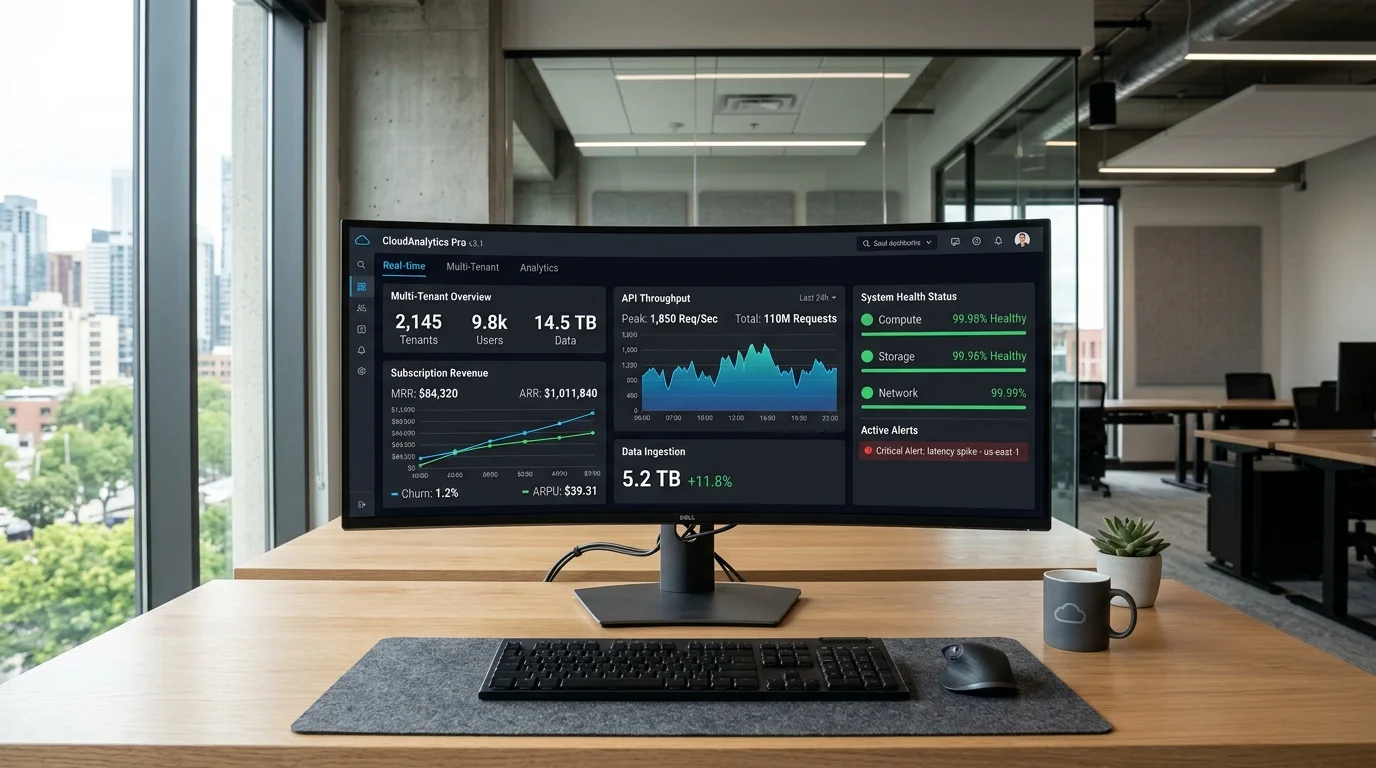
We build comprehensive administrative telemetry dashboards that aggregate critical SaaS financial and operational metrics in real time: Monthly Recurring Revenue (MRR), Annual Recurring Revenue (ARR), Churn Rate, Average Revenue Per User (ARPU), Customer Lifetime Value (LTV), and Net Revenue Retention (NRR). Telemetry data is ingested into ClickHouse, enabling instant querying across millions of historical events without impacting live production transactional databases.
What is the typical development timeline for an enterprise SaaS platform?
A comprehensive Minimum Lovable Product (MLP) SaaS platform—featuring multi-tenant architecture, user authentication, subscription billing, core operational workflows, and responsive web portals—is typically delivered to production within 10 to 14 weeks. Enterprise-tier additions, such as SAML SSO, public developer APIs, cross-platform mobile apps, and deep third-party integrations, are deployed in subsequent bi-weekly Agile sprints across a 4- to 6-month roadmap.
How do we begin a SaaS engineering partnership with Fekra Labs?
You can schedule a confidential SaaS Architecture & Product Discovery Session through our website or direct phone line. Our senior software architects and product strategists will evaluate your business model, multi-tenancy requirements, target user personas, and commercial milestones, delivering a comprehensive Architectural Scope & Feasibility Roadmap within 5 business days.
How do you handle zero-downtime database migrations when hundreds of tenants are actively using the system?
We execute the expand-and-contract (parallel run) migration methodology. Database schema updates are applied in non-breaking phases: new columns or tables are introduced alongside legacy structures, and application logic dual-writes to both during active deployment. Once all containerized microservices are updated and verified across all tenants, a subsequent migration cleanly deprecates and drops obsolete columns. This guarantees continuous 99.99% availability without interrupting active tenant sessions.
Can you build cross-platform mobile applications for our SaaS platform?
Yes. We engineer native-grade mobile applications for iOS and Android using Google Flutter. The mobile apps share the same backend multi-tenant APIs, authentication tokens, and business logic rules as the web portal. Features include biometric authentication, offline SQLite synchronization for field operations, and automated push notifications via Firebase Cloud Messaging tailored to specific tenant organizational alerts.
What is your strategy for disaster recovery and tenant-specific data restoration?
Our disaster recovery architecture guarantees a Recovery Point Objective (RPO) of < 5 minutes and a Recovery Time Objective (RTO) of < 30 minutes. We maintain continuous Write-Ahead Logging (WAL) and hourly encrypted snapshots in geo-redundant, air-gapped storage buckets. Crucially, for multi-tenant systems, our database schemas support selective tenant-level logical data restoration, allowing us to restore an individual tenant’s data to a specific point in time without rolling back data for other active tenants.
How do you optimize cloud infrastructure costs to maintain high SaaS gross margins?
High gross margins (>80%) are essential for venture-scale SaaS valuation. We optimize infrastructure through automated Kubernetes Horizontal Pod Autoscaling (HPA), downscaling non-production environments during off-hours, utilizing AWS Graviton / ARM64 compute instances for 40% better price-performance, implementing multi-tiered Redis caching to minimize expensive database compute, and utilizing serverless event workers for sporadic asynchronous workloads.
How do you handle feature flagging and gradual feature rollouts across enterprise tenants?
We integrate centralized feature flagging engines (such as Unleash or custom Redis-backed flag registries). Feature flags can be toggled dynamically at runtime by tenant tier, specific tenant organization, or percentage-based canary rollout. This enables your product team to test beta features with select VIP tenants, execute seamless dark launches, and instantly roll back features that experience unexpected edge-case errors without redeploying code.
What security standards and penetration testing protocols do you enforce for SaaS platforms?
We enforce OWASP Top 10 and OWASP ASVS Level 2 controls across every tier. We implement automated Static Application Security Testing (SAST), software composition analysis (SCA) for vulnerable open-source dependencies, and container scanning in CI/CD. Prior to commercial launch, independent certified ethical hackers perform comprehensive black-box and white-box penetration testing specifically targeting multi-tenant authorization bypass and privilege escalation vulnerabilities.
Can our SaaS platform support multi-currency, multi-lingual, and localized regional taxation?
Yes. We engineer internationalization (i18n) and localization (l10n) into core data schemas from day one. Our billing engines handle multi-currency transactions with automated foreign exchange rate updates, regional VAT compliance (such as Egypt 14% VAT and Saudi Arabia 15% VAT), and automated ZATCA e-invoicing generation. Client frontends provide native right-to-left (RTL) Arabic and left-to-right (LTR) English interfaces with localized date and currency formatting.
How do you structure post-launch maintenance, SLAs, and technical support for SaaS companies?
We provide comprehensive 90-day post-launch warranty support covering all identified defects and performance tuning. Following launch, we offer dedicated Site Reliability Engineering (SRE) packages featuring 24/7/365 infrastructure monitoring, automated security patching, monthly database tuning, and guaranteed incident response times as rapid as 15 minutes for critical severity-1 system anomalies.
Can you migrate an existing single-tenant legacy software into a modern multi-tenant SaaS architecture?
Yes. We frequently modernize legacy single-tenant applications into scalable multi-tenant SaaS platforms. We audit legacy codebases, design normalized multi-tenant database schemas with Row-Level Security, build automated ETL data migration pipelines to ingest historical tenant records, and refactor business logic into containerized microservices, unlocking recurring subscription revenue without losing legacy domain intellectual property.
How does Fekra Labs assist with SOC2, ISO 27001, and enterprise security questionnaires?
Winning enterprise B2B SaaS contracts requires passing rigorous vendor security assessments. We architect your platform from day one to satisfy SOC2 Type II and ISO 27001 trust criteria: implementing encrypted audit logging, enforcing principle-of-least-privilege access, maintaining infrastructure-as-code change logs, establishing formal incident response runbooks, and assisting your executive team in completing complex enterprise security questionnaires.
20. Enterprise Discovery Roadmap & Project Kickoff Protocol
How to Initiate Your Architecture Discovery Session and Accelerate Digital Transformation
Initiating your SaaS engineering partnership with Fekra Labs:
1. Confidential SaaS Discovery Session: 90-minute strategic and architectural consultation under mutual NDA reviewing target market and unit economics.
2. Technical Scope & Feasibility Roadmap: Delivering architectural blueprints, multi-tenancy recommendations, and budgetary estimates within 5 business days.
3. Sprint 0 Discovery & Blueprinting: Dedicated domain modeling, database RLS schema design, and interactive prototypes with guaranteed fixed sprint pricing.
4. Agile Sprint Execution & Commercial Launch: Bi-weekly working software demonstrations culminating in a seamless production rollout and 24/7 SRE hypercare.
The Compounding Value of Multi-Tenant Cloud Architecture
In the modern digital economy, enterprise software value is defined by recurring scalability and low marginal cost per user. Multi-tenant SaaS architectures maximize profitability by enabling thousands of independent businesses to share optimized cloud compute and database infrastructure while preserving strict cryptographic data isolation.
At Fekra Labs, we build SaaS platforms utilizing PostgreSQL Row-Level Security and containerized auto-scaling microservices. This architecture ensures that as your platform scales from 50 to 50,000 active tenants, your infrastructure costs scale linearly at pennies per tenant, driving gross profit margins above 85% and securing premium valuation multiples from investors.
Overcoming SaaS Churn Through Product-Led Growth Engineering
Customer churn is the silent killer of subscription software businesses. SaaS products that require manual sales onboarding or complex configurations experience high drop-off rates during initial trial periods. We architect self-service onboarding flows that deliver immediate "time-to-value" in under 60 seconds.
By incorporating interactive guided walkthroughs, pre-populated demo environments, and automated dunning notification sequences, our platforms maximize activation rates and minimize involuntary churn, building an enduring foundation for sustained net revenue retention.
Whitepaper: Multi-Tenant Architecture — Database Isolation Models & Row-Level Security (RLS)
1. The Architectural Trilemma in B2B SaaS Tenancy
Architecting a high-scale B2B SaaS platform requires navigating strict engineering trade-offs between infrastructure operational cost, system scalability, operational maintainability, and tenant data isolation. Multi-tenancy models generally fall into three primary architectural paradigms: 1. Database-per-Tenant (Isolated Infrastructure): Maximum isolation and compliance; prohibitive infrastructure cost and complex maintenance when managing 5,000+ tenants. 2. Schema-per-Tenant (Logical Isolation): Shared database engine with dedicated schemas; suffers from connection pool exhaustion and migration latency as table counts multiply exponentially. 3. Shared Database, Shared Schema with Row-Level Security (RLS): Optimal resource efficiency, streamlined schema migrations, and massive horizontal scalability; requires absolute, provable cryptographic and application-level tenant isolation guarantees.2. High-Performance PostgreSQL RLS Implementation
Fekra Labs deploys hardened PostgreSQL Row-Level Security enforced at the database engine level, completely neutralizing application-level developer oversight or SQL injection vulnerabilities from leaking cross-tenant data.-- Enable strict RLS on enterprise tenant tables
ALTER TABLE invoices ENABLE ROW LEVEL SECURITY;
ALTER TABLE invoices FORCE ROW LEVEL SECURITY;
-- Define tenant isolation security policy
CREATE POLICY tenant_isolation_policy ON invoices
FOR ALL
TO application_role
USING (tenant_id = NULLIF(current_setting('app.current_tenant_id', true), '')::uuid)
WITH CHECK (tenant_id = NULLIF(current_setting('app.current_tenant_id', true), '')::uuid);
Within the application middleware (Node.js/Go/Python), every incoming HTTP request or message queue consumer acquires a dedicated connection from the PgBouncer pool and initializes the tenant session context inside an atomic transaction:
export async function executeTenantScopedQuery<T>(
  tenantId: string,
  callback: (client: PoolClient) => Promise<T>
): Promise<T> {
  const client = await dbPool.connect();
  try {
    await client.query('BEGIN');
    // Set session variable scoped strictly to the current transaction
    await client.query('SELECT set_config($1, $2, true)', ['app.current_tenant_id', tenantId]);
    const result = await callback(client);
    await client.query('COMMIT');
    return result;
  } catch (error) {
    await client.query('ROLLBACK');
    throw error;
  } finally {
    client.release();
  }
}
This architecture guarantees that even if an engineer writes an un-filtered `SELECT * FROM invoices` query, the PostgreSQL query planner automatically rewrites the execution tree to append `WHERE tenant_id = 'current_tenant_uuid'`, completely isolating enterprise data with zero performance penalty.
Whitepaper: Usage-Based Metering & High-Throughput Event Ingestion at 50,000 Events/Sec
1. The Shift to Consumption-Based Pricing in B2B SaaS
Modern SaaS leaders (such as Snowflake, Datadog, and Stripe) have transitioned from rigid seat-based pricing models toward consumption-based and hybrid monetization tiers. In consumption-based SaaS, customers are billed strictly for quantifiable value metrics—API calls, gigabytes of ingested telemetry, AI token consumption, or transacted ledger volume. Successfully monetizing consumption requires an immutable, auditable, high-throughput event metering engine capable of ingesting tens of thousands of telemetry events per second without dropping records or impacting primary transactional latency.2. The Ingestion Pipeline: Kafka, ClickHouse & Temporal
Fekra Labs designs usage metering using a fault-tolerant three-tiered stream processing architecture: 1. Ingestion Edge: Lightweight HTTP collectors written in Go receive signed metering events and immediately push them into an Apache Kafka cluster partitioned by `tenant_id`. 2. Aggregation Storage: Real-time analytical consumers stream raw telemetry from Kafka into ClickHouse, an ultra-fast columnar analytical database. ClickHouse aggregates millions of raw events into 1-minute and 1-hour rollup materialized views using the `SummingMergeTree` engine. 3. Billing Reconciliation: At the end of each billing cycle, an orchestrator built on Temporal.io executes durable, idempotent billing workflows that query ClickHouse materialized views, calculate volumetric tiers with overage penalties, and generate verified Stripe or regional payment invoices with absolute mathematical precision.This separation of concerns ensures that enterprise clients can audit every fractional cent on their monthly invoice back to individual cryptographic telemetry event logs, establishing trust and driving corporate subscription expansion.
Whitepaper: Automated Dunning Management & Churn Prevention in B2B SaaS Subscriptions
1. Involuntary Churn as a Silent Enterprise Revenue Killer
In enterprise B2B SaaS operations, involuntary churn—caused by expired corporate credit cards, transient card authorization network timeouts, and banking fraud limits—accounts for 35% to 50% of customer subscriber losses. Immediately revoking platform access on the first payment failure alienates enterprise accounts and causes catastrophic revenue leakage.2. Smart Multi-Channel Dunning Mechanics
Fekra Labs designs resilient recovery engines: 1. Adaptive Smart Retries: Utilizing machine learning models that evaluate issuer acceptance patterns to schedule retry attempts at optimal payment windows (e.g., corporate payroll cycles). 2. Grace-Period State Machines: Maintaining active enterprise access during a configurable 7-day grace window while dispatching automated multi-channel notifications (in-app banners, authenticated webhook alerts to customer finance systems, and SMS/WhatsApp prompts). 3. Automated Card Account Updater: Integrating directly with Visa and Mastercard card updater APIs to retrieve reissued corporate card numbers automatically without customer intervention.Whitepaper: Enterprise Feature Flagging, Canary Rollouts & Blast-Radius Mitigation in SaaS
1. Decoupling Code Deployment from Feature Releases
In continuous delivery environments where SaaS engineering teams deploy production code dozens of times each day, coupling code releases with feature activation introduces severe operational risk. If a critical bug emerges in a new financial calculation algorithm, executing a git revert, rebuilding container images, and executing emergency rollbacks can take 30 to 60 minutes while millions of end-users experience downtime.Fekra Labs implements decoupled Feature Flagging and Dynamic Configuration Architecture utilizing low-latency edge evaluation engines (such as OpenFeature, LaunchDarkly, and self-hosted Unleash clusters).
2. Percentage-Based Canary Deployments & Instant Circuit Breakers
Feature rollouts transition through automated phased validation gates: - Phase 1: Internal Employee Dogfooding (Ring 0): Feature activated exclusively for internal engineers and QA staff based on email domain matching. - Phase 2: Canary Flight (1% to 5% of Non-Critical Tenants): Active monitoring of error rates, CPU spikes, and API response latencies. - Phase 3: Automated Kill-Switch Integration: Telemetry alerts from Datadog or Prometheus trigger an automated webhook that instantly sets the feature flag to `false` within 200 milliseconds globally if HTTP 5xx error rates exceed 0.05%:export async function isFeatureEnabledForTenant(
featureKey: string,
tenantContext: { id: string; tier: string; region: string }
): Promise<boolean> {
// Evaluated locally in memory using cached flag state rules without network round-trips
const evaluation = featureClient.getBooleanValue(
featureKey,
false,
{ targetingKey: tenantContext.id, attributes: tenantContext }
);
return evaluation;
}
This architecture isolates the blast radius of software bugs to a fraction of a percent of users and eliminates deployment anxiety across enterprise engineering teams.
Whitepaper: High-Throughput Webhook Infrastructure, Signature Verification & Dead-Letter Queues
1. The Criticality of Webhooks in B2B SaaS Ecosystems
Modern B2B enterprise SaaS applications must integrate deeply with external customer systems—triggering automated actions in Salesforce, syncing invoices into NetSuite, or notifying internal Slack channels whenever key business events occur. Providing reliable outbound webhooks requires handling customer server timeouts, network partitions, and unpredictable rate limits without stalling internal application pipelines.2. Resilient Webhook Delivery Pipeline Architecture
Fekra Labs designs outbound webhook engines using a decoupled, event-driven queueing topology: 1. Event Ingestion: When an order is placed or a subscription transitions, an event payload is pushed to an Apache Kafka `webhook-events` topic. 2. Cryptographic HMAC-SHA256 Signatures: Each webhook payload is signed with a unique tenant secret key and transmitted with an HTTP header (`X-Fekra-Signature: t=1695123456,v1=9b7d8...`) to prevent replay attacks and allow receiving endpoints to verify message authenticity. 3. Exponential Backoff with Jitter: If a customer's endpoint returns HTTP 429, 500, or times out after 5 seconds, the delivery worker retries following an exponential curve: $$T_{\text{retry}} = \min\left(T_{\max}, 2^{\text{attempt}} \times 1000\text{ms}\right) \pm \text{Jitter}$$ 4. Dead-Letter Queues (DLQ) & Customer Diagnostic Consoles: After 10 failed attempts over 72 hours, the failed webhook payload moves to a persistent DLQ. Enterprise customer administrators access an interactive self-service console displaying HTTP status codes, raw response headers, and one-click replay triggers to debug and remediate their receiving endpoints independently.Whitepaper: Enterprise Single Sign-On (SSO), SAML 2.0 & SCIM 2.0 Directory Synchronization
1. The Enterprise Readiness Barrier in B2B SaaS
When B2B SaaS companies transition from mid-market customers to Fortune 500 and government enterprise clients, traditional email-and-password authentication becomes an absolute procurement dealbreaker. Enterprise Chief Information Security Officers (CISOs) mandate centralized identity governance: employees must authenticate via corporate Identity Providers (Okta, Microsoft Entra ID / Azure AD, Ping Identity, Google Workspace), and employee access must be provisioned and revoked automatically.2. SAML 2.0 and SCIM 2.0 Protocol Engineering
Fekra Labs integrates enterprise identity protocols natively into SaaS backend cores: - SAML 2.0 Assertion Consumer Service (ACS): Processing cryptographically signed XML assertions from corporate IdPs using SHA-256 signatures and validating X.509 certificate chains, timestamp skew tolerances, and audience restriction constraints. - SCIM 2.0 (System for Cross-domain Identity Management): Exposing standardized RESTful endpoints (`/scim/v2/Users` and `/scim/v2/Groups`) supporting automated user provisioning:export async function handleScimUserDeprovisioning(userId: string, tenantId: string): Promise<void> {
// Corporate HR triggers employee termination in Okta
// Okta instantly pushes HTTP DELETE to our SCIM endpoint
await dbPool.query(
'UPDATE users SET active = false, deprovisioned_at = NOW() WHERE id = $1 AND tenant_id = $2',
[userId, tenantId]
);
// Invalidate all active JWT sessions and purge Redis refresh tokens instantly
await redisClient.del(`sessions:user:${userId}`);
}
This automated identity synchronization ensures zero-delay deprovisioning, protecting enterprise clients against unauthorized access by departed employees and satisfying SOC 2 Type II compliance audits effortlessly.
Whitepaper: Enterprise Audit Trails, Immutable Tamper-Evident Ledgers & SOC 2 Compliance
1. Regulatory Governance and Enterprise Auditability
Enterprise B2B SaaS applications handle sensitive commercial contracts, payroll distributions, healthcare records, and proprietary financial ledgers. When corporate compliance auditors conduct annual SOC 2 Type II, ISO 27001, or HIPAA audits, a primary compliance requirement is demonstrating an immutable, non-repudiable audit trail that documents every single security-relevant state mutation across the entire tenant lifecycle.Standard database audit columns (e.g., `updated_by` and `updated_at`) are completely insufficient for forensic compliance because a rogue database administrator or an attacker with SQL injection access can silently update those columns to cover their tracks.
2. Cryptographic Hash-Chained Audit Log Architecture
Fekra Labs designs enterprise audit logs using Cryptographic Hash-Chaining and Write-Once-Read-Many (WORM) Storage: - Merkle Hash Chaining: Every audit entry stores the cryptographic SHA-256 hash of its own JSON payload concatenated with the cryptographic hash of the immediate prior log entry in that tenant's chain: $$\text{Hash}_n = \text{SHA-256}\left(\text{Payload}_n \parallel \text{Hash}_{n-1}\right)$$ If a malicious actor alters a historical record or deletes an audit row directly in the underlying database, the cryptographic hash verification equation immediately breaks, alerting security operations centers (SOC) within seconds. - Asynchronous WORM Ingestion: Audit events are published via Apache Kafka into append-only Amazon S3 or Cloudflare R2 buckets configured with Object Lock in Compliance Mode. Once written, cloud providers legally prohibit any modification or deletion of the audit files—even by the AWS root account holder—until the statutory retention period (e.g., 7 years) has expired. - Detailed Forensic Attribution: Every audit record captures the actor's immutable user UUID, tenant ID, originating IPv4/IPv6 address, TLS cipher suite, HTTP User-Agent, exact prior state, updated state, and authorization token claims, providing undeniable forensic evidence for regulatory scrutiny.Technical Annex: High-Volume SaaS Data Export & GDPR Right-to-Erasure Architecture
1. Compliance Mandates in Global Multi-Tenant Platforms
Enterprise SaaS operators must comply with European GDPR Article 17 ("Right to be Forgotten") and Saudi Personal Data Protection Law (PDPL). Under these statutory frameworks, enterprise clients and individual users possess the legal right to request complete data extraction (Data Portability) or permanent, irrevocable data erasure across all transactional databases, analytical replicas, and cloud storage systems within 30 days of receiving a verified request.Fekra Labs engineers an automated Asynchronous Data Portability & Anonymization Pipeline:
- Streaming Multi-Tenant ZIP Archive Export: Rather than buffering gigabytes of customer files and database tables in server RAM, workers stream JSON/CSV records directly from PostgreSQL and S3 attachments into encrypted ZIP archives, generating signed S3 pre-signed URLs with automated 7-day expiration lifecycles.
- Cryptographic Anonymization & Cryptographic Erasure (Crypto-Shredding): For compliance-mandated audit logs that cannot be deleted due to financial statutory retention rules, the user's personal identifying encryption keys (DEK) stored in hardware security modules are destroyed permanently. Once the key is shredded, historical ciphertext becomes mathematically impossible to decrypt, satisfying right-to-erasure mandates without breaking general ledger financial balances.
Ready to Engineer Your Proprietary SaaS Platform?
Schedule a confidential architecture strategy consultation with Fekra Labs lead software engineers today. Let us transform your vision into a scalable, recurring-revenue digital asset.