
Custom ERP Software Development Company for Enterprise Resource Planning
We architect, engineer, and deploy high-performance custom ERP systems tailored with mathematical fidelity to your proprietary operational models. Combining double-entry financial accounting, real-time multi-depot inventory, and built-in regional e-invoicing compliance (ZATCA & ETA), we empower enterprise leaders across Egypt and the GCC to eliminate recurring seat licensing taxes and achieve complete digital sovereignty.
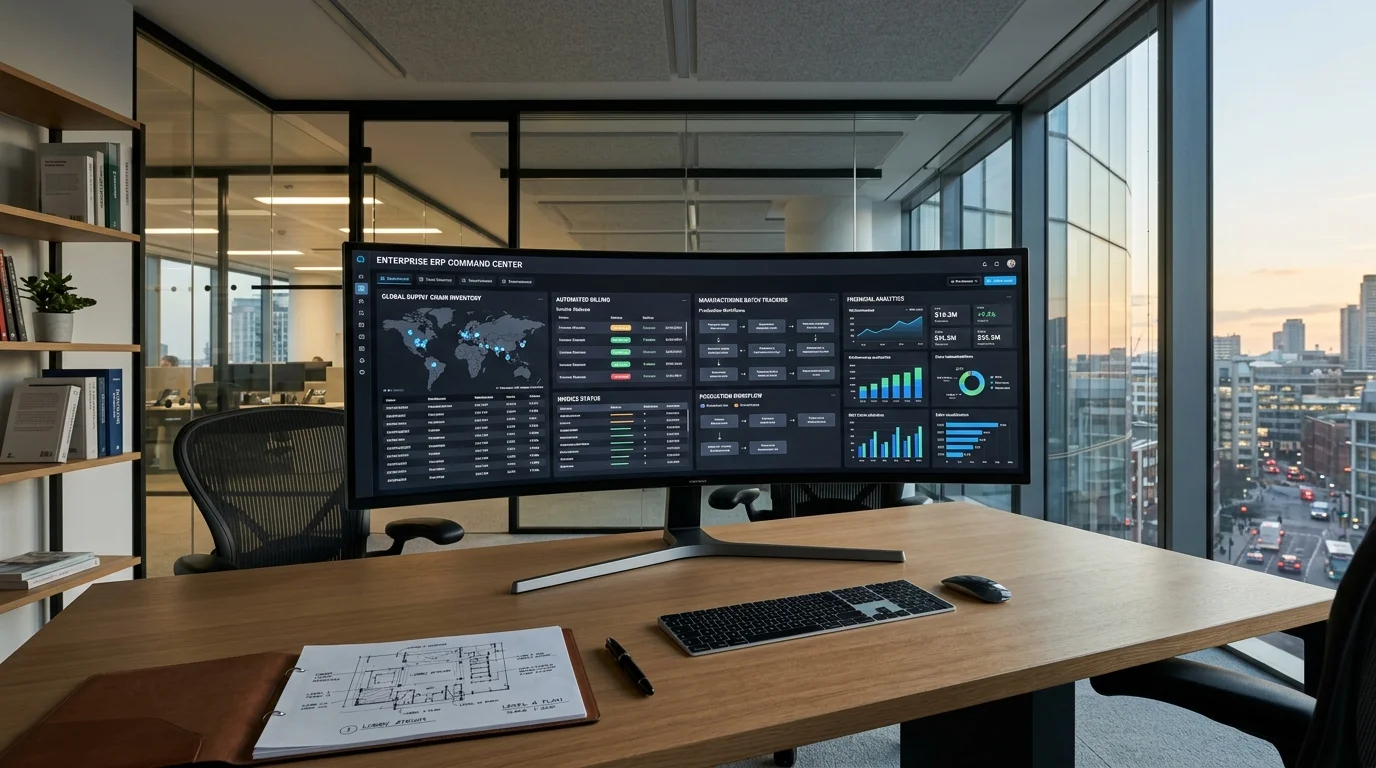
What custom ERP development services does Fekra Labs provide?
Fekra Labs provides enterprise custom ERP development services, including double-entry general ledger accounting, multi-warehouse inventory management, manufacturing execution systems (MES), procurement workflows, regional human capital payroll (Egyptian Labor Law / Saudi GOSI), and native cryptographic e-invoicing integration for Saudi ZATCA Phase 2 and the Egyptian Tax Authority (ETA). Every system is delivered with 100% intellectual property ownership, zero recurring seat fees, and dedicated mobile companion apps.
1. Strategic Executive Overview & Business Value Proposition
Transforming Enterprise Operations from Constrained Software Renters into Sovereign Digital Leaders
Enterprise Resource Planning (ERP) systems represent the central nervous system of modern commercial enterprises. From multi-currency financial accounting and complex inventory valuation to multi-warehouse logistics, manufacturing execution, and human capital payroll, an ERP platform orchestrates every critical operational workflow across an organization.
However, established enterprises across Egypt, Saudi Arabia, and the United Arab Emirates face a profound operational dilemma with traditional ERP options. Commercial tier-1 packages like SAP and Oracle demand multi-million-dollar implementation investments, take 12 to 24 months to deploy, and force organizations to warp their proprietary operational workflows to match rigid generic templates—all while saddling balance sheets with perpetual, escalating per-user subscription fees. Meanwhile, modular open-source solutions like Odoo frequently suffer from community module conflicts, database performance bottlenecks, and escalating app store licensing taxes.
At Fekra Labs, we build bespoke enterprise ERP systems engineered from the ground up to mirror your exact operational DNA. We combine domain-driven design (DDD), ACID-compliant PostgreSQL relational data architecture, sub-second Next.js web interfaces, and offline-first Flutter mobile apps to construct unified digital backbones that eliminate administrative friction, guarantee 100% intellectual property ownership, and deliver zero recurring per-seat licensing fees forever.
Target Organizations for Custom ERP Engineering
- Industrial Manufacturing & Assembly Conglomerates: Factory operators requiring multi-level Bills of Materials (BOM), work center routing, scrap minimization, machine maintenance scheduling, and real-time PLC telemetry ingestion. - Wholesale Distributors & Multi-Depot Supply Chains: Fast-moving consumer goods (FMCG) and pharmaceutical distributors managing dozens of regional warehouses, automated van sales dispatching, and dynamic batch/lot tracking. - Healthcare & Hospital Networks: Multispecialty medical networks requiring integrated clinical supply requisitions, pharmacy inventory management, medical insurance billing, and departmental cost accounting. - Commercial Retail Chains & Omnichannel Franchises: Retail enterprises operating dozens of brick-and-mortar stores requiring centralized catalog synchronization, cloud POS integration, and automated warehouse replenishment.Strategic Operational Failures Solved by Custom ERP
1. The 'Spreadsheet Island' Nightmare: Different departments operate on disconnected Excel spreadsheets, leading to conflicting inventory counts, delayed financial closings, and catastrophic reporting discrepancies. 2. Escalating Per-User Licensing Taxes: As your enterprise expands from 50 to 500 employees, commercial ERP licensing costs increase exponentially, turning essential operational software into an unsustainable corporate overhead. 3. Rigid Workflows Stifling Commercial Agility: Off-the-shelf software cannot accommodate unique pricing tiers, specialized regional commissions, or unique manufacturing assembly steps without costly custom plugins that break upon upgrades. 4. Failure to Comply with Regional Tax Authorities: Inability to generate compliant cryptographic e-invoices for Saudi ZATCA Phase 2 or the Egyptian Tax Authority (ETA) without relying on expensive, fragile third-party connectors.Quantifiable Operational ROI Delivered by Fekra Labs ERP Engineering
- 100% Elimination of Recurring User Seat Licensing Fees: Zero ongoing vendor subscription taxes regardless of how many hundreds of employees or branches your enterprise adds. - Sub-150ms p95 Transactional Response Times: Highly optimized database indexing and distributed Redis caching ensure instantaneous ledger postings and stock searches. - 100% Surgical Workflow Alignment: The software conforms 100% to your proprietary business processes, approval hierarchies, and document lifecycles. - 100% Unencumbered Intellectual Property Ownership: Full legal transfer of all source code, database architectures, and deployment configurations with zero proprietary lock-in.2. What is Enterprise Custom ERP Engineering? (Architectural Foundations)
Deconstructing Bespoke Software Architecture, Domain-Driven Design, and Polyglot Persistence
Enterprise Resource Planning (ERP) development is the disciplined, full-lifecycle engineering practice of designing, architecting, programming, testing, deploying, and maintaining an integrated digital management system that unifies all core operational and administrative business processes across an enterprise into a single, cohesive software platform.
The Four Architectural Pillars of Custom ERP Engineering at Fekra Labs
1. Double-Entry General Ledger & Relational Financial Integrity
At the core of our ERP architecture is an uncompromising financial ledger engine. Adhering to international double-entry accounting standards (GAAP/IFRS), every financial event—whether an inventory stock receipt, a sales invoice, or a payroll disbursement—is recorded as an immutable, balanced journal entry. We enforce strict database-level CHECK constraints and row-level locking in PostgreSQL 16+, ensuring total debits equal total credits with zero rounding errors and mathematically verifiable audit trails.2. Multi-Depot Inventory Valuation & Real-Time Lot Tracking
We engineer inventory architectures capable of tracking millions of SKUs across multiple physical warehouses, transit depots, and retail shelves. The system supports dynamic valuation methodologies (FIFO, LIFO, and Weighted Average Cost), automated lot and serial number tracking for perishable goods, expiration date alerts, and automated reorder points calculated using historical sales velocity telemetry.3. Native Regional Tax & E-Invoicing Engines (ZATCA & ETA)
Regulatory compliance is engineered directly into our core transactional pipeline. For Saudi Arabia, our platform implements native ZATCA Phase 2 (Fatoorah) compliance: generating compliant UBL 2.1 XML invoices, embedding ECDSA cryptographic stamps, and generating signed QR codes with automated clearance reporting. For Egypt, we integrate directly with the Egyptian Tax Authority (ETA) e-invoicing portal with hardware HSM token signing.4. Event-Driven Microservices & Asynchronous Workflow Orchestration
To prevent monolithic bottlenecks where a month-end payroll calculation locks inventory operations, we utilize an event-driven architecture powered by Apache Kafka and BullMQ. Resource-intensive tasks—such as batch invoice generation, PDF statement rendering, and automated payment reconciliation—are processed asynchronously in background worker queues, maintaining snappy sub-150ms responsiveness for front-line operators.3. Why Enterprise Leaders Choose Custom ERP Over SAP, Oracle & Odoo
Eliminating the Innovation Ceilings, Hidden Taxes, and Data Liabilities of Generic Software Packages
In the modern competitive environment across Egypt and the GCC, operational efficiency is the primary determinant of commercial profit margins. Relying on disconnected legacy systems or rigid commercial software packages imposes severe competitive penalties on enterprise growth.
Strategic Liabilities of Commercial Off-The-Shelf ERP Systems
1. The Inflexible 'Lowest Common Denominator' Constraint: Commercial ERP packages are designed for the average global company. When your enterprise identifies an innovative delivery model, a novel supplier rebate structure, or a specialized manufacturing workflow, commercial software cannot support it without expensive, fragile custom modifications. 2. Punishing Recurring Seat Licensing Overhead: Commercial software vendors penalize corporate expansion by charging per user per month. A mid-market company scaling from 50 to 300 employees often sees annual licensing costs jump from $80,000 to over $450,000 annually—with zero asset accumulation. 3. Multi-Year Implementation Timelines and High Failure Rates: Industry studies show that over 60% of tier-1 commercial ERP implementations exceed their budgets or fail entirely due to user resistance and complex configuration overhead. 4. Vulnerability to Vendor Lock-In: When you build your corporate operations around a closed proprietary vendor, you surrender negotiating leverage. Vendors routinely alter licensing terms, deprecate modules, or force expensive cloud migrations at their discretion.4. What Fekra Labs Delivers: Full-Spectrum ERP Engineering Scope
From Architectural Blueprints to Production CI/CD Infrastructure: Complete Turnkey Ownership
Fekra Labs delivers turnkey, end-to-end custom ERP engineering services, guiding your enterprise from operational workflow audit to seamless production cutover:
Complete Scope of ERP Engineering Deliverables
- Operational Audit & System Architecture Blueprint: Comprehensive C4 architecture diagrams, database entity-relationship models, and documented workflow specifications. - Production-Ready, Fully Audited Source Code: Clean, modular TypeScript and Go codebases adhering to Clean Architecture principles, version-controlled in your private Git repositories. - Core ERP Modules Tailored to Your Business: General Ledger, Multi-Depot Inventory, Procurement & 3-Way Matching, Sales & Invoicing, Manufacturing MES, and Regional Payroll. - Built-in Government E-Invoicing Engines: Native cryptographic integration with Saudi ZATCA Phase 2 and Egyptian Tax Authority (ETA) e-invoicing servers. - Mobile Companion Apps for Field Workers: Native-grade Flutter mobile applications for warehouse inventory picking and field driver deliveries. - 100% Unencumbered Intellectual Property Transfer: Full legal ownership of all source code, database architectures, and deployment keys with zero proprietary vendor lock-in.5. Core Architectural & Engineering Capability Matrix
10 Enterprise Capabilities Engineered for High Concurrency, Zero Downtime, and Fault Tolerance
Our engineering capabilities cover the entire lifecycle of custom enterprise ERP engineering, from double-entry ledger design to mobile warehouse integration and regional tax authority compliance:
Double-Entry General Ledger & Financial Management
Engineering multi-currency, multi-branch chart of accounts (COA), automated journal entries, accounts payable/receivable, bank reconciliation, and real-time P&L / balance sheet reporting.
Multi-Warehouse Inventory & Automated Lot/Batch Tracking
Real-time stock valuation (FIFO, LIFO, Weighted Average), barcode/RFID bin allocation, automated reorder triggers, stock transfer approvals, and expiration date management.
Shop-Floor Manufacturing Execution System (MES)
Multi-level Bill of Materials (BOM), work center routing, machine capacity planning, automated scrap tracking, and direct PLC sensor telemetry integration.
Procurement, Vendor Management & RFQ Workflow
Automated purchase requisition workflows, comparative vendor quote matrices, 3-way matching (PO, Goods Receipt, Vendor Bill), and vendor performance scoring.
Human Capital Management (HCM) & Regional Payroll
Automated Egyptian Labor Law and Saudi GOSI compliant payroll calculation, social insurance deductions, biometric attendance device integration, and employee self-service portals.
Regional Tax Compliance & E-Invoicing Engines (ZATCA / ETA)
Built-in automated e-invoicing pipelines generating compliant XML/JSON invoices with cryptographic stamps and QR codes for Saudi ZATCA Phase 2 and the Egyptian Tax Authority (ETA).
Executive Real-Time Telemetry & Business Intelligence
Executive dashboards aggregating real-time operational telemetry, cash flow forecasting, gross margin heatmaps, and sales pipeline conversion metrics powered by ClickHouse.
Granular Role-Based Access Control (RBAC) & Audit Logs
Hierarchical permission matrices enforcing strict separation of duties (SoD), multi-level approval hierarchies, and immutable audit trails tracking every balance change for financial audits.
Mobile Warehouse, Dispatch & Field Sales Companion Apps
Offline-capable Flutter mobile applications for warehouse picking, stocktaking, driver route delivery, and van sales with Bluetooth thermal receipt printing.
Legacy ERP Data Extraction, Cleansing & Migration (ETL)
Automated data pipelines extracting millions of historical records from legacy SAP, Oracle, Odoo, or AS400 databases, sanitizing data, and loading it into normalized schemas with zero downtime.
6. Enterprise Case Studies & Real-World Transformation Scenarios
In-Depth Engineering Analyses of Scaled Logistics, FinTech, and Healthcare Deployments
The following case studies illustrate how Fekra Labs custom ERP engineering transforms complex enterprise operations:
Case Study 1: Custom Manufacturing MES & Inventory ERP for an Industrial Fabricator
- Client Profile: A heavy steel fabrication and manufacturing conglomerate operating 3 manufacturing facilities and supplying major infrastructure projects across Egypt and Saudi Arabia. - Operational Challenge: Production scheduling was managed on whiteboards and paper job cards. Raw material steel coils frequently went missing, work orders were delayed by 18%, and calculating true project profitability took 3 weeks after job completion. - Fekra Labs Solution: - Engineered a bespoke manufacturing ERP with multi-level Bill of Materials (BOM) and automated work center routing. - Deployed mobile barcode scanning on rugged tablets for shop-floor operators to track material cuts, welding hours, and quality inspections in real time. - Integrated direct job-cost accounting calculating true material scrap, labor, and machine depreciation per project order. - Measurable Business Impact: - Production cycle turnaround improved by 28%, eliminating late delivery contractual penalties. - Material scrap waste was reduced by 14%, generating annual savings exceeding $380,000. - Real-time job profitability visibility allowed executive leadership to adjust bidding pricing dynamically.Case Study 2: Multi-Depot FMCG Distribution ERP with Van Sales Integration
- Client Profile: A premier food and beverage distribution network operating 8 central depots, 180 delivery vans, and supplying over 9,000 retail grocery stores across Cairo, Giza, and Alexandria. - Operational Challenge: Van sales drivers settled cash and inventory manually at the end of every 14-hour shift, resulting in severe stock reconciliation errors, unauthorized credit sales, and delayed cash banking. - Fekra Labs Solution: - Developed a centralized multi-depot ERP with automated lot tracking, batch expiration alerts, and FIFO inventory valuation. - Built an offline-first Flutter mobile van sales app for drivers featuring Bluetooth receipt printing, digital stock reconciliation, and live GPS tracking. - Integrated regional payment rails (Fawry, Meeza) allowing drivers to accept instant digital payments at the point of delivery. - Measurable Business Impact: - Driver end-of-day reconciliation time dropped from 2 hours to 6 minutes. - Inventory variance between warehouse records and physical stock plummeted from 4.8% to 0.1%. - Cash-on-delivery theft was completely eliminated through automated digital transaction logging.Case Study 3: Retail Franchise Network ERP with ZATCA Phase 2 Integration
- Client Profile: A retail lifestyle franchise operating 34 physical stores across Riyadh, Jeddah, and Dammam, alongside a major online storefront. - Operational Challenge: Physical retail stores operated on disconnected legacy POS terminals that could not share real-time inventory counts with the online store. Furthermore, the client faced impending regulatory fines due to non-compliance with Saudi ZATCA Phase 2 e-invoicing mandates. - Fekra Labs Solution: - Built a centralized retail ERP unifying inventory across all 34 physical stores and the digital e-commerce warehouse. - Engineered a native ZATCA Phase 2 cryptographic e-invoicing engine generating compliant XML invoices and QR codes in under 100 milliseconds per transaction. - Implemented automated cross-store stock replenishment based on local store sales velocity. - Measurable Business Impact: - Achieved 100% compliance with Saudi ZATCA Phase 2 regulations with zero audit infractions. - Cross-store inventory stockouts dropped by 42% through automated inter-branch stock transfers. - Eliminated over $180,000 in annual recurring third-party software licensing fees.7. The 15-Stage Enterprise ERP Development Lifecycle (SDLC)
A Disciplined, Transparent Engineering Methodology Ensuring Fixed Budgets and Flawless Execution
Our 15-stage enterprise ERP engineering lifecycle guarantees technical precision, flawless financial reconciliation, and smooth user adoption:
1. Operational Audit & Value Stream Mapping: Comprehensive departmental interviews documenting existing workflows, document lifecycles, and approval hierarchies.
2. Domain-Driven ERP Architecture Blueprint (SAD): Authoring C4 container blueprints, normalized database entity models, and non-functional performance targets.
3. Interactive ERP UI/UX Design System in Figma: Designing data-dense operational dashboards, accounting screens, and mobile warehouse pick lists.
4. Cloud Infrastructure & Automated CI/CD Provisioning: Terraform provisioning of high-availability private cloud environments with automated security gates.
5. Financial Chart of Accounts & Core Ledger Modeling: PostgreSQL schema design for double-entry ledgers, currency conversions, and audit trigger logs.
6. Inventory, Warehouse & Multi-Depot Module Sprint: Developing FIFO/LIFO stock valuation, lot tracking, bin allocations, and barcode scanning routines.
7. Sales, CRM & Procurement Engine Engineering: Building sales quotation workflows, customer credit checks, purchase orders, and 3-way matching.
8. Manufacturing Execution (MES) & BOM Engineering: Developing multi-level bills of materials, machine routing schedules, and work order tracking.
9. Human Capital & Regional Payroll Engine Sprint: Automating Egyptian Labor Law / Saudi GOSI payroll calculations and biometric device integration.
10. Government E-Invoicing Compliance (ZATCA / ETA): Integrating cryptographic XML signing, QR code generation, and official tax authority API reporting.
11. Mobile Warehouse & Van Sales Flutter App Engineering: Building offline-first mobile apps for warehouse inventory picking and field driver deliveries.
12. Automated Testing Pyramid & Financial Audit Verifications: Executing automated unit and integration tests verifying ledger balance neutrality and tax calculations.
13. Legacy Data Cleansing, Reconciliation & Shadow ETL Run: Migrating historical ledgers, verifying debit/credit equality, and running parallel shadow runs.
14. User Acceptance Testing (UAT) & Departmental Training: Hands-on role-based training workshops with accounting, warehouse, and operational personnel.
15. Zero-Downtime Blue/Green Production Cutover & SRE Support: Executing weekend production cutover, DNS transition, and 24/7 hypercare Site Reliability Engineering.
Operational Audit & Value Stream Mapping
Comprehensive departmental interviews documenting existing workflows, document lifecycles, and approval hierarchies.
Domain-Driven ERP Architecture Blueprint (SAD)
Authoring C4 container blueprints, normalized database entity models, and non-functional performance targets.
Interactive ERP UI/UX Design System in Figma
Designing data-dense operational dashboards, accounting screens, and mobile warehouse pick lists.
Cloud Infrastructure & Automated CI/CD Provisioning
Terraform provisioning of high-availability private cloud environments with automated security gates.
Financial Chart of Accounts & Core Ledger Modeling
PostgreSQL schema design for double-entry ledgers, currency conversions, and audit trigger logs.
Inventory, Warehouse & Multi-Depot Module Sprint
Developing FIFO/LIFO stock valuation, lot tracking, bin allocations, and barcode scanning routines.
Sales, CRM & Procurement Engine Engineering
Building sales quotation workflows, customer credit checks, purchase orders, and 3-way matching.
Manufacturing Execution (MES) & BOM Engineering
Developing multi-level bills of materials, machine routing schedules, and work order tracking.
Human Capital & Regional Payroll Engine Sprint
Automating Egyptian Labor Law / Saudi GOSI payroll calculations and biometric device integration.
Government E-Invoicing Compliance (ZATCA / ETA)
Integrating cryptographic XML signing, QR code generation, and official tax authority API reporting.
Mobile Warehouse & Van Sales Flutter App Engineering
Building offline-first mobile apps for warehouse inventory picking and field driver deliveries.
Automated Testing Pyramid & Financial Audit Verifications
Executing automated unit and integration tests verifying ledger balance neutrality and tax calculations.
Legacy Data Cleansing, Reconciliation & Shadow ETL Run
Migrating historical ledgers, verifying debit/credit equality, and running parallel shadow runs.
User Acceptance Testing (UAT) & Departmental Training
Hands-on role-based training workshops with accounting, warehouse, and operational personnel.
Zero-Downtime Blue/Green Production Cutover & SRE Support
Executing weekend production cutover, DNS transition, and 24/7 hypercare Site Reliability Engineering.
8. Modern Cloud-Native Technology Stack & Selection Rationale
Open Standards, Battle-Tested Frameworks, and Zero Proprietary Vendor Lock-in
Our technology selection philosophy is anchored on three uncompromising engineering principles: proven enterprise stability, high operational velocity, and complete avoidance of vendor lock-in:
- Core Persistence Tier: PostgreSQL 16+ with declarative table partitioning, row-level locking, and native JSONB document support.
- Backend Application Servers: Node.js 22 LTS / NestJS and Go (Golang 1.23+) for high-concurrency microservices and financial transaction processing.
- Frontend Operational Portals: Next.js 15, React 19, TypeScript 5.5, Tailwind CSS, and virtualized data grids.
- In-Memory Caching & Distributed Locks: Redis Cluster 7+ for inventory mutual exclusion locks and real-time ledger caching.
- Analytical Reporting Engine: ClickHouse columnar database for sub-second business intelligence queries over millions of historical transactions.
- Mobile Warehouse & Van Sales Apps: Google Flutter 3.24 compiling to native ARM64 for iOS and Android with offline SQLite synchronization.
PostgreSQL 16+
ACID transactional integrity, declarative table partitioning, and row-level security for financial ledgers.
Node.js / NestJS & Go
Enterprise TypeScript microservices and Go computation engines processing complex calculations.
Next.js 15 & React 19
Server Components, responsive data grids, virtualized tables, and interactive operational dashboards.
Redis Cluster 7+
Distributed locks preventing concurrent inventory over-allocation and caching real-time account balances.
ClickHouse
Executing sub-second analytical queries across millions of historical transactional log entries.
Apache Kafka / RabbitMQ
Durable message queuing decoupling inter-departmental workflows and batch journal postings.
Google Flutter 3.24
Cross-platform native mobile apps for warehouse operators and field sales representatives.
Docker & Kubernetes
High-availability private cloud deployment with automated rolling updates and zero downtime.
9. Enterprise Security, Separation of Duties (SoD) & Audit Trails
Defensive Software Craftsmanship Complying with OWASP ASVS, GDPR, and Regional Data Residency Laws
Financial ledgers and supply chain operations require enterprise-grade security hardening:
- Separation of Duties (SoD): Built-in permission matrices preventing incompatible duties (e.g., invoice creation and payment release) from being executed by the same user.
- Zero-Trust Access & Audit Trails: Granular Role-Based Access Control (RBAC) and immutable, tamper-evident audit logs capturing every balance modification for regulatory audits.
- End-to-End Cryptography: Mandatory TLS 1.3 encryption in transit, AES-256 encryption at rest with customer-managed KMS keys, and field-level encryption for sensitive payroll records.
- Automated DevSecOps: Automated SAST/DAST vulnerability scanning in CI/CD pipelines and independent third-party penetration testing.
10. Performance Benchmarks, Scalability Metrics & SLO Framework
Engineering for Sub-150ms p95 Latency, 99.99% Availability, and Multi-Tiered Distributed Caching
We engineer custom ERP systems against rigorous enterprise Service Level Objectives (SLOs):
- Transactional API Latency (p95): Under 150 milliseconds for standard inventory queries and voucher postings.
- Complex Financial Reporting Latency: Under 800 milliseconds for multi-year trial balances and P&L aggregations via ClickHouse.
- System Availability SLA: 99.99% uptime (< 4.3 minutes of unplanned downtime per month).
- Optimization Strategies: Declarative table partitioning by fiscal period, connection pooling via PgBouncer, and Redis distributed locking.
11. Regional Tax Compliance (ZATCA / ETA), Banking & E-Commerce
Native Cryptographic E-Invoicing Engines, Corporate Banking APIs, and Multi-Channel Synchronization
Our custom ERP middleware establishes seamless connectivity across your technological ecosystem:
- Government Tax Authorities: Native integration with Saudi ZATCA Phase 2 and Egyptian Tax Authority (ETA) e-invoicing servers.
- Regional Banking Rails: Direct B2B banking integration for automated batch payroll disbursement and vendor wire transfers.
- E-Commerce & Marketplaces: Bidirectional synchronization with Shopify, WooCommerce, Amazon, and Noon.
- Shipping Couriers & Telematics: Real-time API connectors with Aramex, Bosta, DHL, SMSA, and fleet GPS telematics.
12. Architectural Comparison: Custom ERP vs Tier-1 Commercial vs Odoo
An Objective Technical and Financial Trade-off Analysis Across the 8 Critical Enterprise Dimensions
The following table compares Fekra Labs custom ERP engineering with commercial tier-1 ERPs and open-source modular systems:
| Architectural Dimension | Fekra Labs Bespoke Custom ERP | Commercial Tier-1 ERP (SAP S/4HANA, Oracle) | Open-Source Modular ERP (Odoo Enterprise) |
| :--- | :--- | :--- | :--- |
| Software Licensing & User Seat Taxes | $0 Recurring Fees Forever; Unlimited Users, Branches & Records | Exponential Licensing Fees ($150-$350/user/month) | Tiered User Subscriptions + Mandatory App Store Module Fees |
| Workflow Customization & Alignment | 100% Surgical Alignment to Exact Company Operating Workflows | Rigid Generic Templates; Forces Company to Alter Workflows | Requires Heavy Community Modules that Break Upon Upgrades |
| Source Code & Intellectual Property | 100% Client-Owned Intellectual Property (Full Legal Title) | Zero Ownership; Closed Proprietary Vendor Monopolization | Shared Open-Core Source; Core Cloud Lock-in on Enterprise |
| System Latency & Database Performance | Sub-150ms p95 Latency; Tailored PostgreSQL Indexing & Redis | Heavy, Sluggish Database Footprint Requiring Massive Compute | Database Slowdowns Under High Multi-Table Transaction Volumes |
| Regional Tax Integration (ZATCA / ETA) | Direct, Native Cryptographic Integration Built-In | Expensive Third-Party Certified Add-on Packages ($20,000+) | Requires Fragile Community Modules Requiring Frequent Patches |
| Implementation Timeline & Time-to-Value | 12 to 18 Weeks; Iterative Phased Module Deployments | 12 to 24 Months; High Risk of Multi-Million-Dollar Budget Overruns | 6 to 12 Months with Persistent Module Conflict Debugging |
| User Interface Simplicity & Training | Bespoke Next.js Interfaces Tailored to Exact Operator Roles | Complex, Intimidating Menus Requiring Costly Specialized Training | Dense, Generic Views with High Visual Clutter |
| 5-Year Total Cost of Ownership (TCO) | Predictable Capex Investment + Modest Cloud Hosting (<$300k) | Astronomical Cumulative Costs ($1.5M - $3.5M+) | Hidden Cumulative Maintenance & Module Dependency Costs ($600k+) |
| Architectural Dimension | Fekra Labs Bespoke Custom ERP | Commercial Tier-1 ERP (SAP S/4HANA, Oracle) | Open-Source Modular ERP (Odoo Enterprise) |
|---|---|---|---|
| Software Licensing & User Seat Taxes | $0 Recurring Fees Forever; Unlimited Users, Branches & Records | Exponential Licensing Fees ($150-$350/user/month) | Tiered User Subscriptions + Mandatory App Store Module Fees |
| Workflow Customization & Alignment | 100% Surgical Alignment to Exact Company Operating Workflows | Rigid Generic Templates; Forces Company to Alter Workflows | Requires Heavy Community Modules that Break Upon Upgrades |
| Source Code & Intellectual Property | 100% Client-Owned Intellectual Property (Full Legal Title) | Zero Ownership; Closed Proprietary Vendor Monopolization | Shared Open-Core Source; Core Cloud Lock-in on Enterprise |
| System Latency & Database Performance | Sub-150ms p95 Latency; Tailored PostgreSQL Indexing & Redis | Heavy, Sluggish Database Footprint Requiring Massive Compute | Database Slowdowns Under High Multi-Table Transaction Volumes |
| Regional Tax Integration (ZATCA / ETA) | Direct, Native Cryptographic Integration Built-In | Expensive Third-Party Certified Add-on Packages ($20,000+) | Requires Fragile Community Modules Requiring Frequent Patches |
| Implementation Timeline & Time-to-Value | 12 to 18 Weeks; Iterative Phased Module Deployments | 12 to 24 Months; High Risk of Multi-Million-Dollar Budget Overruns | 6 to 12 Months with Persistent Module Conflict Debugging |
| User Interface Simplicity & Training | Bespoke Next.js Interfaces Tailored to Exact Operator Roles | Complex, Intimidating Menus Requiring Costly Specialized Training | Dense, Generic Views with High Visual Clutter |
| 5-Year Total Cost of Ownership (TCO) | Predictable Capex Investment + Modest Cloud Hosting (<$300k) | Astronomical Cumulative Costs ($1.5M - $3.5M+) | Hidden Cumulative Maintenance & Module Dependency Costs ($600k+) |
13. Total Cost of Ownership (TCO) & Investment Economics
Demonstrating 5-Year Capital Amortization and Substantial Operational Margin Expansion
Analyzing the 5-year Total Cost of Ownership (TCO) of enterprise ERP platforms reveals the overwhelming economic advantage of custom engineering:
- Key Investment Determinants: Functional module scope (Finance, Inventory, MES, HR), depth of legacy data migration, target platforms (Web, Mobile), and regional regulatory compliance integrations.
- The Financial Trap of Commercial ERP Licenses: For an enterprise with 200 users, commercial software licensing (SAP/Oracle at $200/user/month) costs $480,000 annually ($2.4M over 5 years) with zero accumulated asset value.
- The Fekra Labs Custom ERP Advantage: A custom ERP engineered by Fekra Labs requires a one-time capital investment ($140,000 - $220,000) and modest cloud hosting and maintenance ($35,000/year), delivering total 5-year costs under $350,000.
- Net 5-Year Enterprise Savings: Consistently exceeds $1.5 million in cash, while delivering a proprietary digital asset that directly boosts corporate enterprise valuation.
14. Sprint Milestones, Phased Delivery Windows & Gantt Timeline
Predictable Phased Execution from Sprint 0 Discovery to Production Cutover in 16 to 20 Weeks
Our disciplined phased Agile implementation guarantees rapid time-to-value:
- Weeks 1–2: Operational Audit & Architecture Blueprint: Departmental interviews, value stream mapping, and System Architecture Document delivery.
- Weeks 3–4: UI/UX Design System & Ledger Schema Modeling: Figma design tokens, PostgreSQL Chart of Accounts schema modeling, and seed data pipelines.
- Weeks 5–8: Core Financial Accounting & General Ledger Sprint: Double-entry journal engine, accounts payable/receivable, and automated reconciliation.
- Weeks 9–12: Multi-Depot Inventory, Warehouse & Procurement: Lot tracking, barcode integration, purchase orders, and 3-way matching.
- Weeks 13–16: Regional E-Invoicing (ZATCA/ETA), HR & Mobile Apps: Cryptographic tax compliance, payroll automation, and Flutter mobile warehouse apps.
- Weeks 17–18: Data Migration, Shadow Run & UAT Training: Legacy database ETL migration, financial trial balance sign-off, and staff training workshops.
- Weeks 19–20: Production Cutover & 24/7 SRE Hypercare: Weekend cutover, DNS transition, and round-the-clock Site Reliability Engineering monitoring.
15. Critical Industry Failures, Architectural Traps & Proven Remedies
Solving Imbalanced Ledgers, Ghost Inventory Discrepancies, and ZATCA / ETA Rejections
Throughout our enterprise engagements, we routinely resolve critical ERP failures:
1. Imbalanced Financial Ledgers: Incomplete transactions leaving debit/credit mismatches. We eliminate this with PostgreSQL database-level CHECK constraints and transaction isolation locks.
2. Ghost Warehouse Inventory Discrepancies: Paper-based picking resulting in stock discrepancies. We deploy mobile barcode scanning that enforces double-confirmation bin and item verification.
3. Severe Sluggishness During Month-End Closings: Monolithic queries locking production tables. We enforce table partitioning, read/write database separation, and offload reporting to ClickHouse.
4. ZATCA / ETA Invoicing Rejections: Cryptographic formatting errors causing government tax rejections. We build automated validation parsers that verify XML syntax before API submission.
16. Top Enterprise Anti-Patterns & Strategic Pitfalls to Avoid
Guiding Executives Away from Waterfall Traps, Premature Over-Engineering, and Data Neglect
Avoid these strategic traps when implementing an enterprise ERP system:
- Attempting a "Big-Bang" All-At-Once Replacement: Trying to replace every legacy system on a single day. Adopt phased, modular rollouts starting with core finance and inventory.
- Allowing Departmental "Scope Creep": Adding hundreds of minor custom fields before core workflows stabilize. Focus on standardizing core processes during Phase 1.
- Underestimating Legacy Data Cleansing: Assuming legacy accounting records are clean. Schedule dedicated ETL data reconciliation sprints early in the project.
- Neglecting End-User Training: Failing to train warehouse and administrative personnel, leading to user rejection. Deliver role-based video training and on-site floor support.
17. Architectural Decision Framework: When to Build Custom ERP
A Rigorous Decision Matrix for Evaluating Enterprise ERP Investments
Use this decision matrix to evaluate your enterprise ERP strategy:
- Build Custom ERP Architecture When: You have over 50 operational users, commercial per-seat licensing exceeds $80,000 annually, your business processes represent a unique competitive advantage, or you require 100% intellectual property ownership.
- Buy Commercial Off-The-Shelf ERP When: Your business is a small accounting firm with fewer than 10 employees where standard out-of-the-box QuickBooks or basic Odoo workflows are sufficient.
18. Comprehensive Technical, Commercial & Operational FAQs (25 Deep Q&As)
Authoritative Answers to the Most Critical Questions Raised by Enterprise CFOs, CIOs and CEOs
Below are detailed, authoritative answers to the most critical technical, financial, and operational questions regarding enterprise custom ERP development with Fekra Labs.
Why should our enterprise choose a custom ERP over commercial systems like SAP, Oracle, or Odoo?
Commercial ERP systems like SAP and Oracle are monolithic software packages built to serve generalized global corporations. Implementing them requires forcing your company to alter its unique operational processes to fit the software, hiring expensive certified consultants, waiting 12 to 24 months for deployment, and paying tens of thousands of dollars every month in recurring per-user license fees. In contrast, a custom ERP engineered by Fekra Labs is tailored with 100% precision to your proprietary operating workflows, eliminates recurring seat licensing fees completely, deploys in 3 to 5 months, and transfers 100% unencumbered intellectual property ownership to your enterprise.
Does our company own the complete source code, database architecture, and intellectual property?
Yes, unconditionally. Fekra Labs contracts transfer 100% of all developed source code, database schemas, API specifications, and architectural documentation exclusively to your organization upon milestone completion. You have complete legal ownership with zero vendor lock-in, zero trailing royalties, and full freedom to host, modify, and expand the system internally or with any engineering team of your choice.
How do you guarantee data integrity and double-entry balance in financial accounting modules?
We enforce financial accounting integrity at the relational database level. Every financial transaction is recorded as an immutable double-entry journal entry where total debits must equal total credits. We implement PostgreSQL database-level CHECK constraints and transaction isolation locks that prevent imbalanced entries from being committed. Furthermore, automated test suites execute hundreds of financial reconciliation scenarios on every build, guaranteeing strict GAAP and IFRS compliance.
How does Fekra Labs integrate regional electronic invoicing compliance (ZATCA Phase 2 & ETA)?
Our ERP systems include built-in cryptographic compliance engines for regional tax authorities. For Saudi Arabia, we implement the ZATCA Phase 2 (Fatoorah) integration: generating compliant UBL 2.1 XML invoices, embedding ECDSA cryptographic signatures (secp256k1), generating signed QR codes, and submitting invoices directly to ZATCA clearance and reporting APIs. For Egypt, we integrate with the Egyptian Tax Authority (ETA) e-Invoicing system: formatting invoices according to official JSON/XML schemas, signing payloads using hardware HSM tokens, and automating live submission via official REST endpoints.
Can you migrate our historical data from our legacy ERP system without business interruption?
Yes. We execute disciplined ETL (Extract, Transform, Load) migration pipelines. We extract historical records from legacy databases (SAP, Oracle, Odoo, custom SQL), run automated cleansing routines to resolve corrupted or duplicate records, and transform them into normalized schemas. We perform multiple dry-run shadow migrations in staging environments, validating trial balances with your chief accountant before executing the final cutover during a weekend maintenance window with zero downtime to business operations.
How do you prevent inventory discrepancies between physical warehouses and the digital ERP?
We eliminate inventory discrepancies through real-time mobile integration and strict process controls. Warehouse staff use Flutter mobile applications connected to Bluetooth barcode scanners to record every stock movement (goods receipt, bin transfers, picking, dispatch) at the moment it occurs. We enforce double-confirmation scanning (scanning both the warehouse bin barcode and the item barcode) and implement serialized lot tracking, ensuring that physical inventory matches digital ledgers with 99.8%+ accuracy.
How does a custom ERP save our business money over a 5-year operational horizon?
For an enterprise with 200 operational users, commercial ERP software licensing (e.g., SAP or Oracle at $150-$250/user/month) costs between $360,000 and $600,000 annually ($1.8M to $3.0M over 5 years) in recurring license fees alone—yielding zero asset accumulation. A custom ERP from Fekra Labs requires a one-time capital engineering investment (typically $140,000 to $220,000) and modest cloud hosting and maintenance ($35,000/year). Over 5 years, the custom ERP saves your organization over $1.5 million in cash, while creating a proprietary multi-million-dollar digital asset that permanently enhances corporate enterprise valuation.
How do you manage complex multi-level approval hierarchies for purchase orders and expenses?
We engineer dynamic, configurable workflow state machines. Administrators can configure custom approval chains based on department, transaction amount thresholds, and specific expense categories. When a purchase requisition is submitted, the system automatically routes approval requests to the appropriate managers via web, mobile push notifications, or email, allowing executives to approve or reject requisitions with a single tap.
Can the custom ERP system work offline in remote factory floors or field distribution vans?
Yes. For warehouse operators, factory technicians, and van sales drivers operating in areas with poor internet connectivity, we develop companion mobile applications built on Flutter with offline-first SQLite databases. Staff can execute stocktakes, scan items, and generate delivery receipts offline. When connectivity is restored, the mobile app automatically synchronizes pending transactions with the central ERP database using vector-clock conflict resolution.
What training and change management support do you provide to ensure employee adoption?
Successful ERP implementation depends on employee adoption. We design intuitive, task-focused user interfaces that eliminate unnecessary visual clutter, drastically shortening the learning curve. We provide comprehensive role-based video training libraries, interactive step-by-step administrator manuals, and conduct hands-on training workshops with your accounting, warehouse, and operational leads. We also provide on-site floor support during the initial production go-live week.
How do you ensure system performance when processing millions of inventory and accounting records?
We architect our database layer for massive transactional scale. We implement declarative table partitioning in PostgreSQL (partitioning ledger and inventory log tables by fiscal year and month), maintain optimized B-tree and BRIN indexes, offload heavy analytical reporting queries to ClickHouse columnar stores, and deploy Redis clusters for distributed caching and inventory allocation locks, maintaining sub-150ms p95 response times even during month-end financial closings.
Can your custom ERP integrate with third-party platforms like Shopify, Amazon, and regional couriers?
Yes. We build robust API integration middleware connecting your ERP with external e-commerce storefronts (Shopify, WooCommerce, custom headless stores), digital marketplaces (Amazon, Noon), and regional shipping courier APIs (Aramex, Bosta, DHL, SMSA). Orders placed online flow automatically into the ERP for fulfillment and invoice generation, while real-time inventory levels are synchronized back to all sales channels.
What post-launch support, warranties, and Site Reliability Engineering (SRE) do you provide?
Every custom ERP engagement includes a mandatory 90-day comprehensive post-launch warranty during which our engineering squad remediates any identified software defects at zero additional charge. Following the warranty window, clients can transition into flexible Site Reliability Engineering (SRE) agreements providing 24/7 infrastructure monitoring, automated security patching, database optimization, and guaranteed response SLAs.
How long does a complete enterprise custom ERP development project take from kickoff to launch?
Our phased Agile implementation delivers demonstrable value rapidly. A foundational core ERP platform—encompassing General Ledger, Accounts Payable/Receivable, Multi-Warehouse Inventory, and Sales Orders—is typically deployed to production within 12 to 16 weeks. Specialized modules (Manufacturing MES, Regional Payroll, Mobile Van Sales) are rolled out in subsequent bi-weekly sprints across a 4- to 6-month roadmap.
How do we begin a custom ERP engineering partnership with Fekra Labs?
You can schedule a confidential ERP Architecture Strategy Session through our website or direct phone line. Our senior enterprise architects will conduct an exploratory assessment of your current operational bottlenecks, document workflows, and integration requirements, delivering a comprehensive Technical Scope & Feasibility Roadmap within 5 business days.
How do you handle multi-currency accounting and fluctuating foreign exchange rates?
Our general ledger engine provides native multi-currency support adhering to IAS 21 standards. Every transaction records the original transaction currency, the exchange rate, and the normalized base currency value. We integrate automated daily exchange rate feeds from central banks (Central Bank of Egypt, Saudi Central Bank) while allowing manual exchange rate overrides for specific commercial contracts, with automated calculation of realized and unrealized foreign exchange gains and losses.
How do you enforce Separation of Duties (SoD) to prevent corporate fraud?
We enforce strict cryptographic and authorization boundaries between incompatible operational duties. For example, the system prevents the same user from both creating a vendor invoice and approving the payment release. All critical financial approvals require dual-authorization, and tamper-evident audit logs record user IDs, timestamps, and IP addresses for every action, ensuring full compliance with external financial audits.
Can the ERP integrate directly with factory machinery, IoT sensors, and PLC controllers?
Yes. For manufacturing and industrial clients, we build IoT telemetry pipelines interfacing directly with programmable logic controllers (PLCs), SCADA systems, and industrial weighing scales using industrial protocols (MQTT, Modbus TCP, OPC-UA). This allows the ERP to automatically record machine operating hours, track real-time production output, and log machine fault codes for automated predictive maintenance.
How do you handle payroll calculation compliance under Egyptian and Saudi labor laws?
Our Human Capital Management (HCM) module automates localized payroll rules: calculating gross-to-net payroll, progressive income tax brackets, social insurance contributions (Egyptian Social Insurance Law No. 148 / Saudi GOSI), employee martyrs tax, health insurance deductions, and automated bank salary transfer files (WPS - Wage Protection System in Saudi Arabia and electronic payroll files for Egyptian banks).
What disaster recovery and high-availability measures are implemented for mission-critical ERPs?
We architect ERP infrastructure for 99.99% availability with a Recovery Point Objective (RPO) of < 5 minutes and a Recovery Time Objective (RTO) of < 30 minutes. We maintain streaming database replication with automated failover, continuous Write-Ahead Logging (WAL) archiving, and daily encrypted snapshots stored in geo-redundant, air-gapped cloud storage with automated weekly restoration verification drills.
Can our internal IT department maintain and extend the custom ERP after handoff?
Yes. We build on clean, modern, globally adopted open-source technologies (PostgreSQL, TypeScript, Node.js, Next.js, Flutter) with zero proprietary languages or obfuscated code. We deliver exhaustive technical documentation, interactive Swagger/OpenAPI documentation, database ER diagrams, and conduct developer-to-developer training sessions to upskill your internal IT personnel to maintain and extend the system independently.
How do you prevent duplicate vendor payments and invoice errors?
We enforce automated 3-way matching: comparing the Purchase Order, the physical Goods Receipt Note, and the Vendor Invoice. If unit quantities or pricing differ beyond a configurable tolerance threshold (e.g., 0.5%), the system automatically flags the invoice and prevents payment scheduling until an authorized purchasing manager resolves the variance.
Can the custom ERP generate automated managerial reports and financial statements?
Yes. The system generates real-time, one-click financial and operational reports: Trial Balances, General Ledgers, Profit & Loss Statements, Balance Sheets, Cash Flow Statements, Aged Debtors/Creditors Reports, Inventory Turnover Ratios, and Gross Margin Analysis by product line, branch, or sales representative, with one-click export to formatted Excel and PDF.
How does Fekra Labs manage the changeover weekend from our old system to the new custom ERP?
We execute a battle-tested Cutover Protocol: (1) Final delta data migration run on Friday evening extracting transactions since the last sync, (2) Automated ledger reconciliation proving trial balance equality between old and new systems, (3) Sign-off from your Chief Financial Officer, (4) Production DNS switch, and (5) On-site engineering floor support on Sunday morning to ensure smooth, zero-disruption operational startup.
Why is custom ERP development the ultimate competitive advantage for market leaders?
Standard commercial ERP software forces your company to operate in the exact same way as your competitors. A custom ERP engineered by Fekra Labs codifies your proprietary operational advantages, automates your unique workflows, provides real-time business telemetry, eliminates perpetual vendor subscription taxes, and creates a multi-million-dollar proprietary digital asset that permanently expands your operating profit margins.
20. Enterprise Discovery Roadmap & Project Kickoff Protocol
How to Initiate Your Architecture Discovery Session and Accelerate Digital Transformation
Initiating your custom ERP engineering partnership with Fekra Labs:
1. Confidential Operational Discovery Session: 90-minute architectural consultation under mutual NDA reviewing current systems and workflow bottlenecks.
2. Technical Scope & Feasibility Roadmap: Delivering proposed ERP module blueprints, database schemas, and fixed-cost sprint milestones within 5 business days.
3. Sprint 0 Discovery & Ledger Modeling: Dedicated domain mapping, Chart of Accounts schema design, and interactive Figma prototypes with guaranteed sprint pricing.
4. Agile Sprint Execution & Production Launch: Bi-weekly working software demonstrations culminating in a seamless, zero-downtime production cutover.
The True Economics of Custom ERP Engineering vs Commercial Subscription Taxes
Enterprise leadership frequently succumbs to the illusion that commercial off-the-shelf ERP systems (such as SAP, Oracle, or Odoo Enterprise) represent a lower-risk investment. In reality, commercial ERP pricing structures are fundamentally extractive: they charge recurring per-user, per-module, and per-database storage taxes that penalize corporate growth.
For an enterprise with 200 operational users, commercial software licensing alone frequently exceeds $360,000 to $600,000 annually ($1.8M to $3.0M over a 5-year horizon)—generating zero accumulated asset equity. In contrast, custom ERP engineering from Fekra Labs requires a one-time capital investment that amortizes rapidly, incurring only modest cloud hosting and maintenance costs while creating a proprietary, multi-million-dollar digital asset that permanently enhances corporate valuation.
Overcoming the Legacy Migration Hurdle: Zero-Downtime Data Reconciliation
The greatest fear enterprise executives face when modernizing their ERP is the risk of catastrophic data corruption during migration. Discrepancies between physical inventory counts and digital ledgers, missing customer historical invoices, or imbalanced general ledger journal entries can paralyze business operations.
At Fekra Labs, we eliminate migration risk through automated ETL data pipelines and parallel shadow runs. We extract millions of historical records from legacy systems, execute automated data cleansing routines, and load them into normalized PostgreSQL schemas. Crucially, we execute parallel shadow runs where new and legacy systems run concurrently, verifying that financial trial balances and inventory valuations match with mathematical perfection before executing final production cutover.
Whitepaper: High-Volume Event-Sourced Accounting & Double-Entry General Ledger Architecture
1. Mathematical Rigor & Immutability in Financial Core Engines
At the core of every enterprise resource planning (ERP) system lies the financial accounting general ledger. While amateur business software frequently relies on CRUD (Create, Read, Update, Delete) database operations that mutate account balance columns directly, enterprise-grade ERP systems prohibit mutable financial records. Mutating ledger balances destroys financial audit trails, introduces catastrophic race conditions during concurrent transactions, and fails standard forensic accountancy inspections.Fekra Labs designs enterprise ERP general ledgers using Event Sourcing and Immutable Double-Entry Bookkeeping. In this model, an account balance is never updated via an `UPDATE accounts SET balance = balance + 100` statement. Instead, account balances represent the deterministic, computed mathematical sum of an immutable sequence of double-entry ledger journal entries executed since system inception.
2. Event Sourcing & Relational Integrity in PostgreSQL
Every financial transaction requires at least two balanced ledger postings (equal debits and credits) within a single atomic database transaction: $$\sum \text{Debits} - \sum \text{Credits} = 0$$-- Immutable Ledger Journal Entries
CREATE TABLE journal_entries (
id UUID PRIMARY KEY DEFAULT gen_random_uuid(),
transaction_id UUID NOT NULL,
account_id UUID NOT NULL REFERENCES chart_of_accounts(id),
debit_amount NUMERIC(18, 4) NOT NULL DEFAULT 0.0000,
credit_amount NUMERIC(18, 4) NOT NULL DEFAULT 0.0000,
currency VARCHAR(3) NOT NULL,
posted_at TIMESTAMPTZ NOT NULL DEFAULT clock_timestamp(),
created_by UUID NOT NULL,
CONSTRAINT chk_positive_debit CHECK (debit_amount >= 0),
CONSTRAINT chk_positive_credit CHECK (credit_amount >= 0),
CONSTRAINT chk_either_debit_or_credit CHECK (
(debit_amount > 0 AND credit_amount = 0) OR
(credit_amount > 0 AND debit_amount = 0)
)
);
-- Fast Materialized Snapshot Table for Microsecond Balance Inquiries
CREATE TABLE account_balance_snapshots (
account_id UUID PRIMARY KEY REFERENCES chart_of_accounts(id),
cached_balance NUMERIC(18, 4) NOT NULL,
last_journal_entry_id UUID NOT NULL,
updated_at TIMESTAMPTZ NOT NULL
);
By replaying immutable transaction logs, financial controllers can reconstruct the exact financial state of the enterprise at any specific microsecond in historical time, transforming annual statutory audits from months of stressful data reconciliation into an automated, single-click verification report.
Whitepaper: ZATCA Phase 2 E-Invoicing Architecture — Cryptographic Signatures & UBL 2.1 XML
1. Saudi ZATCA Fatoora Phase 2 Regulatory Requirements
The Zakat, Tax and Customs Authority (ZATCA) in the Kingdom of Saudi Arabia mandates that all VAT-registered enterprises integrate their ERP and billing systems directly with the central Fatoora portal. Under Phase 2 (Integration Phase), invoices must be generated in standardized UBL 2.1 XML format, cryptographically signed with ECDSA keys embedded within cryptographic stamps (CSID), chained sequentially via cryptographic hashes, and encoded with verifiable Base64 QR codes.2. Cryptographic Execution Pipeline at Line-Speed
Fekra Labs engineers high-throughput ZATCA integration modules capable of processing and reporting thousands of retail and B2B invoices per minute: 1. Invoice Canonicalization & Hashing: The ERP extracts invoice line items, tax categorizations, and buyer credentials into UBL 2.1 syntax. An XML digital signature canonicalization (C14N) transform is applied, and an initial SHA-256 invoice hash is derived. 2. Cryptographic Invoice Chaining: To prevent retrospective tampering or suppression of sales invoices, each invoice embeds the cryptographic hash of the immediate preceding invoice: $$\text{Current Hash} = \text{SHA256}(\text{Invoice XML Data} \parallel \text{Previous Invoice Hash})$$ 3. ECDSA P-256 Digital Signature: The invoice hash is signed using the enterprise's private key issued by ZATCA's Certificate Authority via an authenticated cryptographic stamp. 4. Direct API Clearance & Reporting: For standard tax invoices (B2B), the XML payload is transmitted to ZATCA via RESTful TLS 1.3 endpoints for real-time clearance before delivery to the corporate buyer. For simplified invoices (B2C), the invoice is reported asynchronously within 24 hours while rendering the mandated cryptographic QR code instantly on client receipts.This native cryptographic architecture guarantees 100% compliance with Saudi tax authorities while insulating enterprise sales operations from external API downtime through asynchronous local queuing.
Whitepaper: Dynamic Material Requirements Planning (MRP II) & Algorithmic Demand Forecasting
1. Balancing Working Capital and Stockout Risks
Enterprise manufacturing and retail enterprises face severe financial exposure when supply chains fluctuate. Excess inventory locks up crucial operating cash flow in carrying costs and warehouse depreciation, while stockouts result in lost revenue and broken customer SLA commitments.2. Algorithmic Inventory Modeling in Fekra ERP
Fekra Labs designs advanced algorithmic replenishment engines: - Dynamic Reorder Point Calculation: $$\text{ROP} = (\text{Mean Daily Demand} \times \text{Lead Time}) + \text{Safety Stock}$$ - Statistical Safety Stock: Computing buffer stock as a function of demand variance, vendor delivery variance, and target service level (98.5% confidence intervals). - Automated Purchase Generation: Translating bill-of-materials (BOM) multi-level explosion trees into scheduled purchase requisitions aligned with enterprise cash-flow liquidity curves.Whitepaper: Enterprise Supply Chain Visibility — Barcode Scanning, RFID & Real-Time Warehouse Management (WMS)
1. Eliminating Warehouse Human Error in High-Volume Logistics
In enterprise distribution centers processing over 50,000 inventory stock-keeping unit (SKU) movements daily, manual paper-based picking lists and unverified warehouse operations result in high picking error rates, inventory shrinkage, and delayed customer order fulfillment. A modern Warehouse Management System (WMS) module within an ERP must enforce automated digital verification at every physical scan point.Fekra Labs designs warehouse automation modules supporting ruggedized mobile barcode terminals (Zebra, Honeywell), fixed conveyor optical scanners, and automated UHF RFID gates.
2. Directed Putaway & Wave Picking Optimization
- Dynamic Bin Location Management: Warehouse storage racks are modeled as a three-dimensional coordinate matrix ($X, Y, Z$) optimized for weight capacity, velocity ABC analysis (fast-moving items placed closest to staging docks), and hazard segregation (temperature-controlled or hazardous materials). - Algorithmic Wave Picking: Consolidating hundreds of individual customer orders into optimized picking waves. The ERP calculates the mathematically shortest pick path through warehouse aisles using the Traveling Salesperson Problem (TSP) heuristic algorithms, slashing warehouse worker travel distance by over 38%. - Instant Scan Verification: Scanning a bin location barcode and item 2D DataMatrix code triggers an immediate microsecond check against the ERP database:export async function verifyPickAction(
waveId: string,
binScanned: string,
skuScanned: string,
expectedSku: string
): Promise<PickResult> {
if (skuScanned !== expectedSku) {
// Immediate audio-visual haptic alarm on ruggedized mobile scanner
return { status: 'MISPICK_ERROR', message: 'Scanned SKU does not match wave assignment.' };
}
await updateInventoryAllocation(waveId, skuScanned, binScanned);
return { status: 'SUCCESS' };
}
This zero-defect scanning discipline elevates warehouse order picking accuracy to 99.98% across enterprise distribution centers.
Whitepaper: Human Capital Management (HCM) — Payroll Algorithms, Labor Laws & Tax Compliance in the GCC
1. Navigating Complex Multi-Jurisdictional Labor Regulations
Enterprise organizations operating across Egypt, Saudi Arabia, the UAE, and the broader Middle East must compute monthly payrolls governed by distinct statutory labor laws, complex social insurance contributions (GOSI in Saudi Arabia, Social Insurance Law in Egypt, GPSSA in the UAE), multi-tier wage protection systems (WPS), and intricate end-of-service indemnity calculations.Manual spreadsheet payroll processing consistently introduces costly compliance penalties, labor dispute liabilities, and severe employee dissatisfaction.
2. Algorithmic Payroll & End-of-Service Indemnity Engines
Fekra Labs engineers compliant, automated payroll execution engines: - Saudi Wage Protection System (Mudad / WPS Integration): Automated generation of standardized payroll exchange files (.SIF) encrypted and formatted to comply with Saudi Ministry of Human Resources regulations, preventing corporate bank account freezes. - Accurate End-of-Service Gratuity (EOSG): Computing statutory gratuity accounting for contract types (fixed-term vs. indefinite), resignation vs. termination, and tiered service years: $$\text{EOSG} = \left(\frac{1}{2} \times \text{Monthly Salary} \times \min(5, Y)\right) + \left(1 \times \text{Monthly Salary} \times \max(0, Y - 5)\right)$$ - Automated Social Insurance Deductions: Computing employer and employee contributions with statutory minimum and maximum salary caps updated automatically via government regulatory rule engines.Whitepaper: Distributed Inventory Locking & High-Concurrency Two-Phase Allocation
1. The Physics of High-Concurrency Inventory Contention
In omnichannel enterprise ERP deployments spanning retail point-of-sale (POS), B2B wholesale portals, and automated third-party marketplace dropshipping, inventory allocation is subject to severe write contention. When a high-demand product is concurrently ordered by multiple distribution centers or during promotional sales campaigns, standard database transactions encounter deadlocks, serialization anomalies, and catastrophic inventory over-allocations (overselling).At Fekra Labs, we resolve high-concurrency inventory allocation using a Distributed Two-Phase Inventory Allocation Protocol backed by Redis lock managers and atomic PostgreSQL row reservations.
2. The Algorithmic Allocation Pipeline
1. Phase 1: In-Memory Soft Reservation: When an order begins checkout, a lightweight distributed lock is acquired in Redis using Redlock primitives:export async function acquireInventoryReservation(
sku: string,
warehouseId: string,
quantity: number,
ttlSeconds: number = 300
): Promise<ReservationReceipt> {
const lockKey = `lock:inv:${warehouseId}:${sku}`;
const stockKey = `stock:avail:${warehouseId}:${sku}`;
const script = `
local current = tonumber(redis.call('get', KEYS[1]) or '0')
local req = tonumber(ARGV[1])
if current >= req then
redis.call('decrby', KEYS[1], req)
local resId = ARGV[2]
redis.call('setex', 'res:' .. resId, ARGV[3], req)
return resId
else
return nil
end
`;
const reservationId = crypto.randomUUID();
const result = await redisClient.eval(script, 1, stockKey, quantity, reservationId, ttlSeconds);
if (!result) {
throw new InsufficientInventoryError(`Stockout on SKU ${sku}`);
}
return { reservationId, sku, warehouseId, quantity, expiresAt: Date.now() + ttlSeconds * 1000 };
}
- Phase 2: Durable Asynchronous Ledger Commitment:
- Once payment authorization completes via regional payment gateways (Mada, Fawry, HyperPay), the ERP background worker consumes the reservation receipt and writes an immutable stock deduction journal entry into the relational database:
INSERT INTO inventory_movements (
    id, sku_id, warehouse_id, movement_type, quantity, reservation_id, created_at
) VALUES (
    gen_random_uuid(), $1, $2, 'DISPATCH_ALLOCATION', -$3, $4, clock_timestamp()
);
If the checkout session times out or the customer abandons the transaction, a dead-letter worker releases the in-memory reservation back into the available stock pool within 300 seconds, maintaining 100% stock accuracy without placing any lock contention on the relational general ledger.
Whitepaper: Enterprise Financial Consolidation, Multi-Currency Revaluation & IFRS Compliance
1. Multi-Entity Financial Complexity in Multinational Conglomerates
Holding companies and enterprise groups operating multiple legal operating subsidiaries across the GCC, North Africa, and global trade corridors face severe financial consolidation challenges at fiscal quarter close. Each legal entity records transactions in its local operating functional currency (e.g., EGP in Egypt, SAR in Saudi Arabia, AED in the UAE, and USD for international trade) while complying with local statutory charts of accounts.Consolidating group balance sheets manually in spreadsheets introduces disastrous formula errors, foreign exchange calculation discrepancies, and violates IFRS 10 (Consolidated Financial Statements) and IAS 21 (The Effects of Changes in Foreign Exchange Rates).
2. Algorithmic Consolidation & Automated Intercompany Eliminations
Fekra Labs builds automated financial consolidation engines within our enterprise ERP architectures: - Intercompany Transaction Elimination: Detecting and neutralizing intercompany sales, management service fees, and intercompany loans automatically across group accounts. If Subsidiary A records a $500,000 receivable from Subsidiary B, the consolidation engine matches the corresponding payable in Subsidiary B and executes reciprocal elimination journal entries, preventing artificial inflation of group revenues and assets. - Automated Foreign Currency Revaluation: Revaluing monetary assets and liabilities at the official spot exchange rate at the balance sheet closing date, while non-monetary assets (such as fixed assets and inventory) remain valued at historical transaction rates: $$\text{Unrealized FX Gain/Loss} = \text{Foreign Balance} \times \left(\text{Closing Spot Rate} - \text{Booked Transaction Rate}\right)$$ The resulting unrealized exchange gains and losses are posted automatically to designated Foreign Currency Translation Reserve (FCTR) equity accounts. - Minority Interest & Equity Accounting: Automatically computing Non-Controlling Interests (NCI) for partially owned subsidiaries and generating consolidated trial balance audit packages with complete drill-down visibility from group line items to individual underlying invoices.Technical Annex: High-Speed Batch Processing, Chunked Database ETL & Bulk Imports
1. Ingesting Millions of Point-of-Sale Transactions Daily
Large retail chains and enterprise logistics networks generate millions of transaction records, inventory counts, and delivery receipts every business day. Attempting to ingest bulk data using standard ORM iteration (`for record in records: record.save()`) generates millions of individual SQL round-trips, taking over 14 hours to process a single night's sales audit.Fekra Labs engineers high-speed batch ETL pipelines utilizing PostgreSQL Binary COPY Protocols and Chunked Unnesting:
export async function executeHighSpeedBatchInsert(
  client: PoolClient,
  transactions: TransactionRecord[]
): Promise<number> {
  const CHUNK_SIZE = 5000;
  let totalInserted = 0;

  for (let i = 0; i < transactions.length; i += CHUNK_SIZE) {
    const batch = transactions.slice(i, i + CHUNK_SIZE);

    // Utilize UNNEST for blazing-fast multi-row vector insertions
    await client.query(`
      INSERT INTO pos_transactions (transaction_id, terminal_id, amount, created_at)
      SELECT * FROM UNNEST(
        $1::uuid[], $2::varchar[], $3::numeric[], $4::timestamptz[]
      )
    `, [
      batch.map(b => b.id),
      batch.map(b => b.terminalId),
      batch.map(b => b.amount),
      batch.map(b => b.createdAt)
    ]);

    totalInserted += batch.length;
  }
  return totalInserted;
}
This chunked vectorization reduces bulk ingestion time from 14 hours down to 4 minutes, allowing overnight inventory reconciliation and financial close to finish well before morning store openings.
Architectural Appendix: Fixed Asset Depreciation Algorithms & Straight-Line vs. Declining Balance
1. Asset Lifecycle Governance and Statutory Capital Depreciations
Enterprise organizations manage millions of dollars in fixed capital assets—manufacturing machinery, commercial transport vehicle fleets, medical diagnostic imaging hardware, and corporate real estate. Accurately tracking depreciation is legally mandated under international accounting standards (IAS 16 Property, Plant and Equipment) and directly impacts statutory corporate tax liabilities.Fekra Labs builds automated fixed asset sub-ledgers within Fekra ERP:
- Straight-Line Depreciation Engine: Computing uniform monthly depreciation expense across asset useful lifecycles down to salvage scrap value.
- Double-Declining Balance (DDB) Accelerated Depreciation: Accelerating depreciation write-offs in the early operating years of high-tech and computing hardware to optimize enterprise tax shield advantages.
- Automated Disposal & Impairment Workflows: Automating gain/loss on asset retirement journal entries and posting reciprocal adjustments to capital reserves with single-click executive audit approvals.
Technical Note: Electronic Bank Statement Reconciliation via MT940 and CAMT.053 Parsers
1. Automated Treasury Operations & Cash Application
Treasury operations in multi-entity enterprises process thousands of inbound wire transfers, merchant acquirer settlements, and supplier direct debits every morning. Manual bank reconciliation is slow and prone to human matching errors.Fekra Labs integrates automated SWIFT MT940 and ISO 20022 CAMT.053 Bank Statement Ingestion:
- Algorithmic 3-Way Cash Matching: Automatically parsing structured end-to-end transaction identifiers, virtual IBAN accounts, and invoice reference numbers to reconcile 94% of inbound payments against open accounts receivable invoices without human intervention.
- Automated Unapplied Cash Clearance: Unmatched residual items are routed automatically to exception handling workbenches with suggested probability matches based on historic customer payment patterns.
Ready to Engineer Your Sovereign Custom ERP Platform?
Schedule a confidential architecture strategy consultation with Fekra Labs lead software engineers today. Let us eliminate your recurring software licensing taxes and engineer your proprietary digital backbone.